
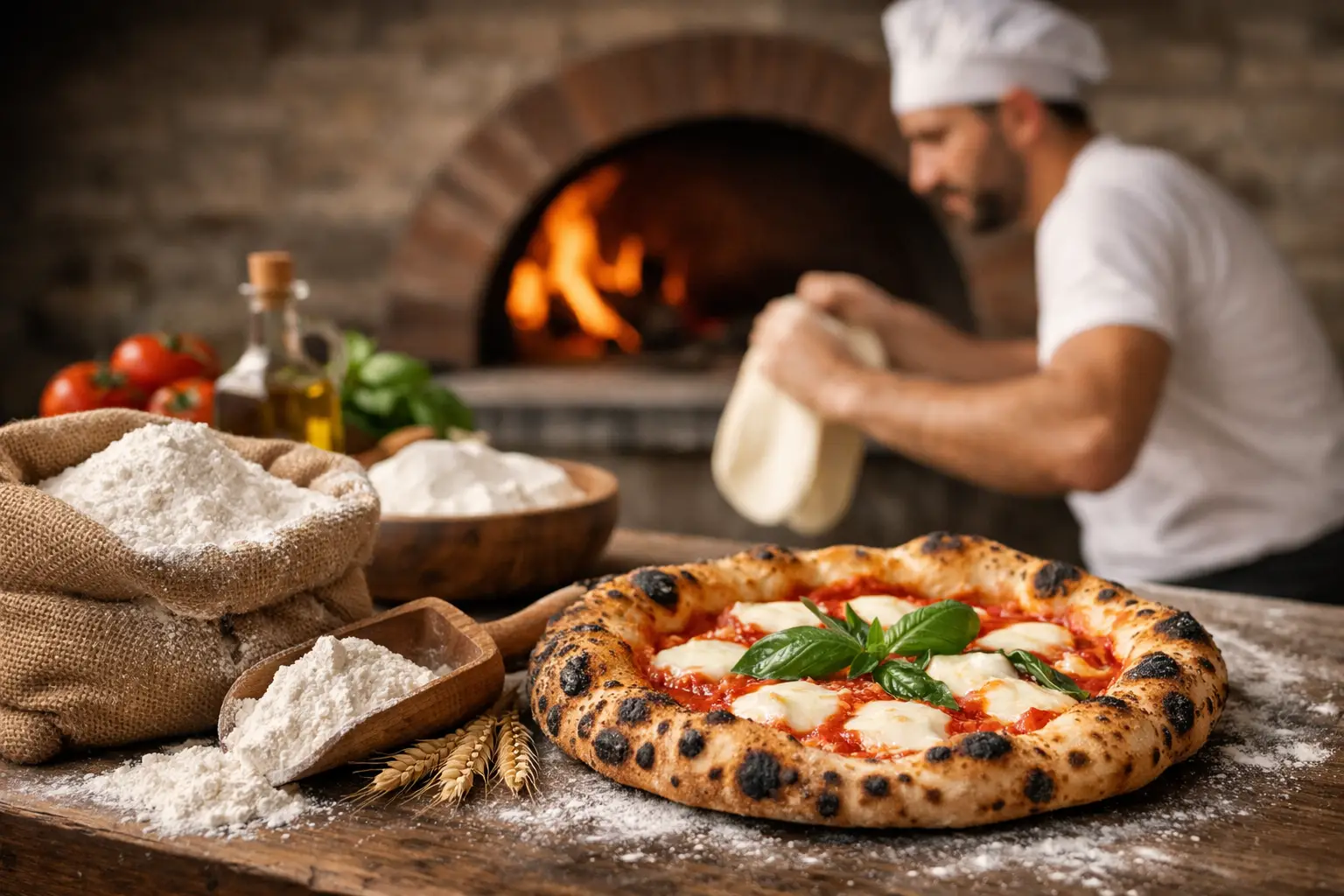
If your dough looks right in the mixer but tears on the bench, or bakes pale with a dense rim, flour is often the first place to look. Choosing the best flour for neapolitan pizza is not about chasing an Italian label for its own sake. It is about selecting a flour that can handle long fermentation, open cleanly by hand, and bake into a tender, light cornicione without turning tough.
Neapolitan pizza places unusual demands on flour. The dough is typically mixed with only flour, water, salt, and yeast, then fermented with restraint rather than overloaded with oil or sugar. That means the flour has to do real structural work. It must absorb enough water to support fermentation, develop gluten without becoming overly elastic, and bake quickly at high heat while preserving softness in the crumb.
What makes the best flour for Neapolitan pizza
The most suitable flour for this style is usually a finely milled wheat flour with moderate to moderately high strength. In practical terms, many pizzaiolos look for Italian 00 flour with a W value often in the range of about 260 to 320, depending on fermentation time, room temperature, and production schedule.
That range matters because Neapolitan dough is a balance, not a maximum. Flour that is too weak can collapse during fermentation, become sticky on the bench, or produce a flat, tight crust. Flour that is too strong can resist opening, trap too much chew into the finished pizza, and push the dough away from the soft, delicate structure expected in true Neapolitan pizza.
The word 00 is often misunderstood. It refers primarily to how finely the flour is milled, not automatically to its strength. A 00 flour can still be weak, medium, or strong. Fine milling helps create a smooth dough and refined texture, but the real performance comes from the wheat blend, protein quality, and overall flour strength.
00 flour versus bread flour
For many bakers in the US, the question is whether imported 00 flour is necessary or whether bread flour can produce similar results. The honest answer is that it depends on your oven, your fermentation method, and how strictly you are aiming for traditional Neapolitan characteristics.
A well-chosen 00 flour usually gives the most reliable path to an authentic result. It tends to open more gently, bake with a softer bite, and support the light but defined edge associated with the style. It is especially useful when you are working with high-heat pizza ovens and dough formulas built around classic Neapolitan standards.
Bread flour can still make excellent pizza, especially in home settings where oven limitations change the equation. In a lower-temperature oven, a slightly stronger flour may help with structure and color. The trade-off is texture. Bread flour often produces a crust that is chewier and less delicate than what a trained pizzaiolo would usually target for Neapolitan pizza.
If your goal is strict style accuracy, 00 is usually the better starting point. If your goal is the best possible pizza from a conventional home oven, bread flour may be a practical compromise. Those are not the same goal, and it helps to be clear about which one you are pursuing.
Protein content is useful, but not enough
Many bakers shop flour by protein percentage, and that can be helpful, but it is not a complete system. Two flours with the same listed protein can behave very differently in the mixer and during fermentation. Protein content tells you something about potential gluten development, but not everything about gluten quality, extensibility, or fermentation tolerance.
For Neapolitan pizza, a flour in the roughly 11.5 to 13 percent protein range often performs well, but context matters. A shorter same-day dough may work beautifully with a softer flour. A dough intended for longer fermentation, especially beyond 24 hours, often benefits from a somewhat stronger flour that can hold structure without over-ripening.
This is where many home bakers get frustrated. They buy a flour because the protein number looks right, then assume their hydration or fermentation is the problem when the dough misbehaves. Sometimes it is. But sometimes the flour simply does not have the balance of strength and extensibility the process requires.
How fermentation changes your flour choice
The best flour for neapolitan pizza at 8 hours is not always the best flour at 48 hours. Fermentation length has a direct effect on how much strength your dough needs at the start.
For short fermentation, a medium-strength 00 flour can be ideal. It develops quickly, opens easily, and produces a soft crust with less resistance. For longer fermentation, especially in professional production where dough balls must remain stable over time, a stronger 00 flour often gives better control.
Too weak a flour in long fermentation can lead to dough that spreads excessively, sticks during opening, and loses oven spring. Too strong a flour in short fermentation can create a tight disk that fights the hands and bakes with a heavy chew. That is why serious dough work begins with process design, not just ingredient shopping.
When we teach dough formulation, flour is never treated as an isolated ingredient. It is connected to water temperature, mixing intensity, bulk time, balling schedule, final proof, and bake environment. The flour that performs beautifully in one workflow can underperform in another.
What to look for on the bag
If you are evaluating flour for Neapolitan pizza, start with the type, then the strength, then the intended use. A 00 flour labeled for pizza is often a better sign than one marketed broadly for pastry or general baking. If the manufacturer provides a W value, that gives you a more useful benchmark than protein alone.
Look for consistency and transparency. Serious flour producers usually indicate whether the flour is suited to short, medium, or long fermentation. They may also suggest hydration ranges or ideal applications. Those details matter more than marketing language about authenticity.
Be cautious with flours that are very high in protein unless you have a specific reason to use them. Stronger is not automatically better. Many bakers overcorrect toward high-strength flour when their real issue is fermentation management or poor ball handling.
Common flour mistakes that affect the final pizza
One common mistake is assuming any 00 flour will produce true Neapolitan results. Some 00 flours are too weak for long fermentation. Others are designed for pastries and will not give the gas retention needed for a proper cornicione.
Another mistake is switching flours without adjusting the process. If you move from an average bread flour to a stronger pizza flour, water absorption may change. Mixing time may change. Fermentation pace may change. Good dough work requires reading the dough in front of you, not only following a fixed percentage chart.
A third mistake is judging flour after one bake in the wrong oven conditions. In a home oven with a steel, a flour may color differently and dry out faster than it would in a high-temperature deck or dome oven. That does not mean the flour is poor. It may mean the bake environment is asking for small adjustments in hydration, dough weight, or bake timing.
So which flour should you choose?
If you want the closest path to classic Neapolitan pizza, start with a reputable 00 pizza flour of medium to moderately high strength. For many bakers, that means a flour suitable for 12 to 24 hour fermentation, with enough strength to stay stable but enough extensibility to open by hand without shrinking back aggressively.
If you are baking in a dedicated pizza oven at high heat, that choice becomes even more important. The right 00 flour will help the dough expand rapidly, blister properly, and remain soft rather than leathery. If you are baking in a standard home oven, a strong bread flour or a US-milled pizza flour can still perform well, but expect a slightly different texture and adjust your expectations accordingly.
The strongest recommendation is this: match the flour to the method. A flour is only the best flour for Neapolitan pizza when it supports your fermentation schedule, your handling skill, and your oven. That is how professionals think about ingredients. Not as isolated products, but as part of a controlled system.
A serious pizzaiolo learns to read flour the way a baker reads dough development or oven behavior. Once you understand that relationship, buying flour gets simpler, and your pizzas get more consistent. Start with a flour built for pizza, test it across the exact process you plan to repeat, and let the dough tell you whether you are getting closer to the standard you want to serve.