
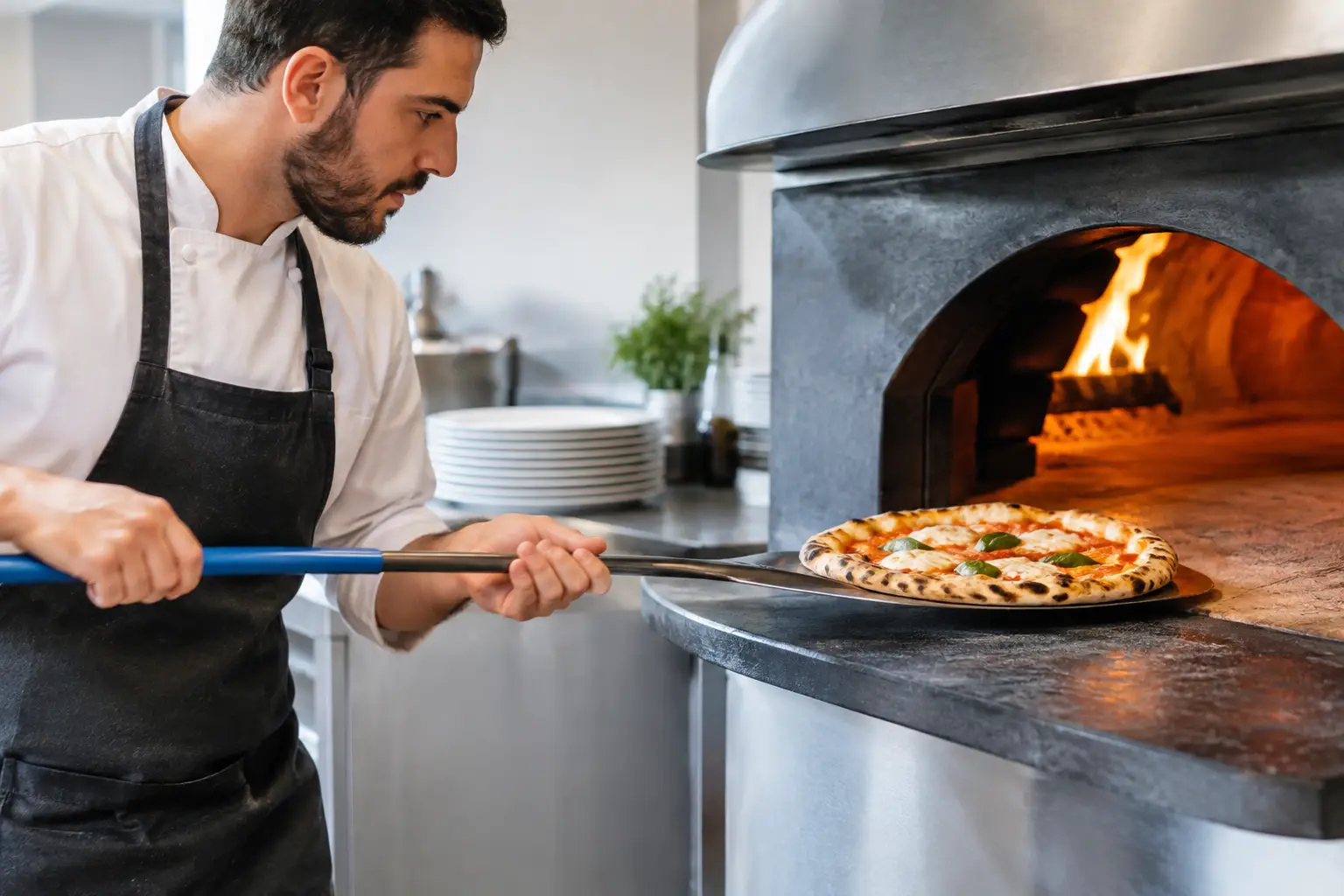
A pizza can look ready in 70 seconds and still be wrong. The cornicione may have color but no internal structure. The base may be pale from a weak floor, or burned because the oven was allowed to run ahead of the dough. Commercial pizza oven training addresses these moments directly. It teaches a pizzaiolo to read heat, dough behavior, and the demands of service as one connected system.
For Neapolitan pizza, the oven is not simply the final step in production. It is an active part of the method. Its floor temperature, dome heat, flame position, recovery rate, and airflow all influence the finished pizza. Learning to operate it with discipline separates a repeatable service from a series of guesses.
Why Commercial Pizza Oven Training Goes Beyond Temperature
New operators often focus first on a single number: the oven temperature. That number matters, but it does not explain the full baking environment. A high-temperature commercial oven can have a hot dome and a floor that has lost too much energy after a busy stretch. It can also have a properly charged floor and excessive top heat that colors the rim before the center sets.
Training develops the habit of reading the oven in layers. A pizzaiolo learns to assess where heat is concentrated, how quickly the deck recovers, and whether the flame is creating an even baking path. They also learn that the correct setting depends on the product. A classic Neapolitan pizza requires a different relationship between dough, floor, and flame than a thicker pan pizza or a longer-baking New York-style pie.
This is why copying another restaurant's stated temperature rarely produces the same result. Oven design, fuel source, deck material, chamber size, door use, dough hydration, and volume all change the equation. Good instruction gives operators a method for making informed adjustments rather than a rigid number to follow.
Learn the Difference Between Floor Heat and Top Heat
A pizza needs heat from below to set the base and support its structure. It needs radiant heat from above to expand and color the cornicione, melt the cheese, and finish the toppings. When these forces are out of balance, defects become predictable.
Too much floor heat can scorch the bottom before the rim develops. Too little floor heat often leaves a soft, underbaked center, even when the top looks finished. Excessive top heat can char the rim while leaving the base weak. A trained operator recognizes these outcomes, identifies the source, and responds with a measured change to oven management, not a random change to every part of the recipe.
That response may involve moving the flame, allowing the floor to recover, adjusting the pizza's position in the chamber, or changing the launch sequence. In some cases, the dough itself is the real issue. An overly fermented or poorly shaped dough can bake differently even in a well-managed oven. Oven training should teach this distinction.
The Skills That Matter During Service
A commercial oven behaves differently during a quiet practice session than it does during a sustained rush. Opening the door repeatedly, loading several pizzas, turning pies, and managing a live flame all draw heat from or redistribute heat within the chamber. Service skill is the ability to protect consistency while those variables keep moving.
A disciplined pizzaiolo develops a working rhythm. They inspect the cooking floor, clear debris before it becomes carbonized, launch pizzas into appropriate zones, turn them at the right moment, and watch for changes in color and lift. They also communicate with the dough station and expediter. An oven operator working in isolation cannot maintain the same standard as a team that understands timing.
Commercial pizza oven training should include the following operational habits:
- Preparing and stabilizing the oven before the first order, rather than attempting to build heat during service.
- Establishing a clear loading pattern so pizzas do not crowd the chamber or enter cold areas of the deck.
- Turning each pizza with purpose, based on the flame direction and the color already developing on the rim.
- Brushing the floor consistently to prevent burnt flour and semolina from transferring bitterness and dark spots to the next pie.
- Monitoring recovery between rushes and making small corrections before quality declines across an entire ticket rail.
The value of these habits is not speed for its own sake. Speed without control produces waste. The objective is a steady pace in which every pizza receives the attention its bake requires.
Turning Is a Technical Decision
Turning is often taught as a quick motion, but the motion is only one part of the skill. The important question is why the pizza is being turned at that particular second. In a live-flame oven, one side of the cornicione usually develops faster because it faces the flame. Turning redirects the pizza into a new heat pattern and gives the operator control over that asymmetry.
A turn made too early can interrupt bottom setting and make the pizza difficult to manage. A turn made too late can create a blackened blistered edge that overwhelms the flavor of the dough. Operators should learn to judge the rim, the underside, the melt of the cheese, and the movement of the center together.
The peel matters here as well. A properly sized turning peel, kept clean and handled with a light touch, protects the pizza's shape. Aggressive turning can tear the base, dislodge toppings, or compress the cornicione. The technique should be precise enough to be repeated hundreds of times in a shift.
Fuel, Equipment, and the Limits of One Method
Wood-fired ovens remain central to the identity of Neapolitan pizza, but commercial kitchens use several oven types. Gas-fired, electric, hybrid, and wood-fired models can all demand different operating habits. Training should respect those differences rather than treating one fuel source as universally superior.
Wood requires fire building, ember management, and an understanding of how flame placement affects radiant heat. Gas can offer greater adjustment and consistency, yet its flame pattern and deck recovery still need active attention. Electric ovens may provide highly controlled settings, but a pizzaiolo must still understand bake balance, loading, and product variation.
The right equipment depends on a restaurant's concept, local regulations, ventilation capacity, production volume, available labor, and desired product. Authentic technique does not mean ignoring practical constraints. It means understanding the standards of the pizza well enough to make sound decisions within the equipment available.
Safety Is Part of Professional Oven Work
High heat creates obvious risks, but many preventable problems begin with routine carelessness. Peels left in walkways, wet tools brought near a hot chamber, loose sleeves, overloaded fuel areas, and rushed cleaning practices can all create hazards. Professional training treats safety as a working discipline, not a brief orientation topic.
Operators should know the manufacturer's procedures for ignition, shutdown, cleaning, and maintenance. They should understand how to respond to irregular flame behavior, excessive smoke, damaged tools, or a sudden loss of heat. For wood-fired equipment, fire management and ash removal need clear procedures. For gas equipment, staff should know when a condition requires stopping work and involving qualified service personnel.
A clean oven also supports better pizza. Burnt residue on the floor produces bitterness, smoke, and uneven spotting. Clean peels reduce sticking. An organized oven station gives the operator room to move safely and keeps tools where they can be used without hesitation.
Train the Eye Before Chasing Output
The most useful early exercise is often not baking more pizzas. It is baking fewer pizzas with deliberate observation. Record the oven condition, dough maturity, launch position, bake time, turning point, and result. Then change one variable at a time. This builds the visual memory that lets an operator make calm corrections during service.
For restaurant founders, this approach is especially valuable because it creates a standard that can be taught to the entire team. A recipe alone is not a system. The team needs shared language for a pale base, fast color, weak recovery, excessive char, or uneven flame. When staff can describe what they see accurately, training becomes faster and quality control becomes practical.
At Neapolitan Pizza School, oven work belongs alongside dough fermentation, shaping, and topping restraint because each stage affects the next. The goal is not to make the oven seem mysterious. It is to give the pizzaiolo enough technical command to respect its power and use it with consistency.
The best next bake is not the one made at a higher temperature or in less time. It is the one in which the pizzaiolo can explain exactly why the oven produced the result, and what to adjust when the next pizza demands something different.