
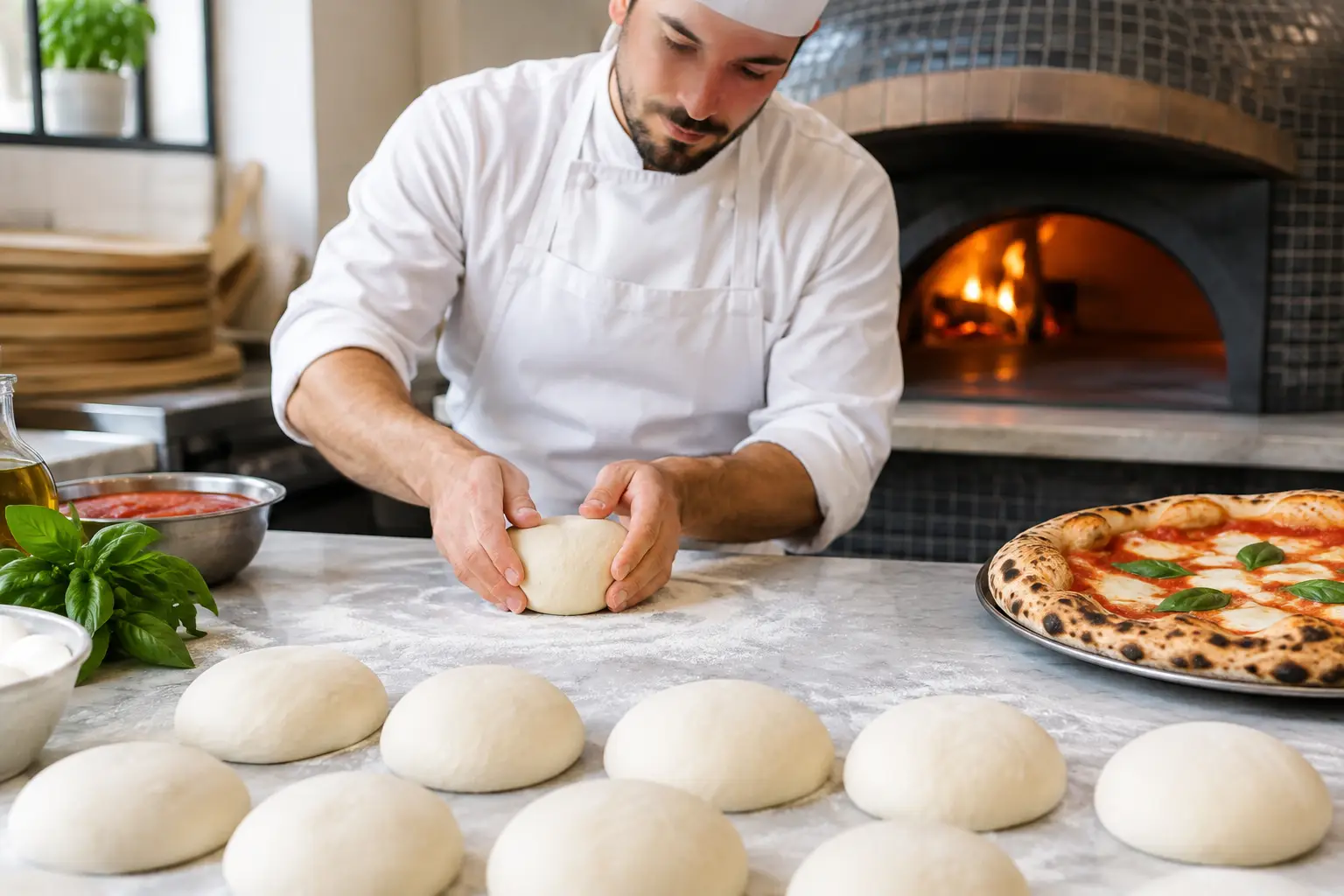
A pizza that opens beautifully but bakes too small usually was not lost at the bench. It was decided when the dough was divided. A reliable dough ball sizing chart gives you a starting weight for the diameter, rim, and style of pizza you intend to make, so every later step has a clear target.
For Neapolitan pizza, ball weight is more than a production number. It affects how easily the dough opens, the thickness of the center, the volume of the cornicione, and how the pizza handles in a hot oven. Use the numbers below as working ranges, then refine them for your flour, hydration, fermentation schedule, and oven.
Neapolitan Dough Ball Sizing Chart
The chart assumes hand-stretched dough, a relatively thin center, and a raised outer rim. It is designed for pizzas baked around 30 to 32 centimeters, or 12 to 13 inches, which is the most common range for a classic Neapolitan presentation.
| Finished pizza diameter | Dough ball weight | Best use | | --- | ---: | --- | | 9 inches / 23 cm | 180-200 g | Small personal pizza or practice pizza | | 10 inches / 25 cm | 200-220 g | Lighter personal pizza | | 11 inches / 28 cm | 220-240 g | Smaller traditional-style pizza | | 12 inches / 30 cm | 240-260 g | Standard Neapolitan pizza | | 12.5 inches / 32 cm | 260-280 g | Generous cornicione and classic restaurant size | | 13 inches / 33 cm | 280-300 g | Larger pizza, requiring disciplined opening | | 14 inches / 36 cm | 310-340 g | Large format, better suited to a slightly sturdier dough |
For most students working toward a traditional Neapolitan pizza, 250 to 270 grams is an excellent place to begin. That range generally opens into a 12-inch pizza with enough dough to create an airy rim while preserving a thin, tender center.
The chart is not a rulebook independent of technique. A 260-gram ball can become an 11-inch pizza with a thick rim if opened conservatively, or a 13-inch pizza with a very thin center if pushed aggressively. The purpose of portioning is to establish consistency, not to replace judgment at the bench.
Why Dough Ball Weight Changes the Finished Pizza
A dough ball has a fixed amount of mass. When it is stretched over a larger area, that mass becomes thinner. This seems obvious, but it explains many common pizza problems: a dense rim, a center that tears, a pie that feels heavy, or a pizza that cannot be launched confidently.
If the ball is too small for the diameter you want, the center is stretched beyond its strength. You may see translucent patches, sticking on the peel, or a base that bakes too crisp before the rim has fully expanded. If the ball is too large, the pizza can remain thick and bready through the center, especially in an oven that does not reach true Neapolitan temperatures.
The rim matters as well. A pizzaiolo who leaves a wide, untouched border needs more dough than one who opens nearly to the edge. For a pronounced, open cornicione, choose the upper end of a sizing range. For a lower, more restrained rim, use the lower end and distribute the dough more evenly during opening.
Start With Diameter, Then Adjust for Style
The most useful way to use a dough ball sizing chart is to choose the finished diameter first. Measure the usable space on your peel and consider the size of your oven floor. A 13-inch pizza may sound appealing, but it is only practical if you can launch, turn, and retrieve it without crowding the oven.
Next, decide what you want the pizza to feel like. A 12-inch margherita intended to have a classic soft center and a prominent cornicione might use 260 grams. The same diameter for a slightly crisper home-oven pizza could use 240 to 250 grams, particularly if the bake is longer. The extra dough that works in a 60- to 90-second bake can become excessive in a three-minute bake.
This is where style and equipment meet. Traditional Neapolitan dough benefits from intense heat that sets the exterior quickly while preserving a moist interior. A lower-temperature oven gives the dough more time to dry, so a slightly smaller ball or a more moderate rim can produce a more balanced result.
A practical target for home pizzaiolos
If you are learning to open dough consistently, make several balls at the same weight rather than dividing a batch into random sizes. For example, divide six 1,560-gram dough batches into six 260-gram balls. Open each one to the same 12-inch target. Repetition makes it easier to identify whether a problem comes from fermentation, shaping, flour management, or your opening technique.
Once 260 grams feels predictable, test one variable at a time. Try 240 grams at the same diameter. Then try 280 grams. Compare the center, the rim, the launch, and the baked texture. This is a more valuable exercise than chasing a single universal number.
Hydration and Fermentation Affect Sizing
Two dough balls that weigh the same can behave very differently. Hydration, flour strength, fermentation maturity, and dough temperature all influence extensibility and gas retention.
A higher-hydration dough is often more extensible, which means a 250-gram ball may open wider with less force. But higher hydration also makes the dough more delicate and can complicate launching. If your dough is very soft, do not assume you should reduce ball weight simply because it stretches easily. The right question is whether it can hold its shape, retain its gases, and bake cleanly in your oven.
Long-fermented dough is typically more relaxed than young dough. A well-matured 260-gram ball can open with very little resistance and still produce a light rim. Under-fermented dough may fight back, causing you to leave too much thickness in the center or force the dough beyond its strength. In that situation, changing ball size treats the symptom rather than the cause.
Flour also matters. A stronger flour can support larger pizzas and longer fermentation schedules, while a softer flour may perform best with a more modest opening. The correct dough ball weight is always connected to the dough formula and process behind it.
How to Portion Dough Accurately
Use a digital scale. Eyeballing portions is acceptable only after you have developed a highly calibrated hand, and even then, a scale is the better tool for repeatable training or service.
After bulk fermentation, turn the dough onto a lightly floured surface and divide it with a bench scraper. Weigh each piece before shaping. If a piece is 10 grams heavy or light, correct it before balling. A few grams will not ruin a pizza, but repeated variation makes it harder to evaluate results and plan production.
Shape each portion into a taut, smooth ball without trapping a large pocket of flour inside the seam. Surface tension helps the ball retain its form during proofing, while a clean seal prevents it from spreading prematurely. Place the balls in covered dough boxes or individual containers with enough space for expansion.
Avoid excessive bench flour during balling. Extra flour becomes part of the handling environment and can dry the dough skin, interfere with the seal, and burn on the oven floor. The dough should be manageable, not coated.
Common Sizing Mistakes
The first mistake is treating dough ball weight as the only measure of success. A 260-gram portion is not automatically correct if the dough is overproofed, weak, or opened poorly. Weight provides a controlled starting point, but fermentation and shaping decide how that portion performs.
The second is making balls too large to compensate for weak opening technique. A heavy dough ball may feel safer because it resists tearing, but it can create an overly thick pizza. Learn to press from the center outward, preserve the rim, and stretch with restraint. The goal is not simply to make the dough bigger. It is to create an even center with a defined border.
The third is ignoring topping weight. A lightly dressed marinara can tolerate a thinner center than a pizza carrying abundant fresh mozzarella, vegetables, or cured meats. Neapolitan pizza depends on balance. If the topping load increases, either keep the pizza slightly smaller, use a marginally heavier ball, or reduce the moisture in the toppings.
Finally, do not confuse a large rim with a good rim. Cornicione volume comes from proper fermentation, careful gas preservation, and fast baking. Adding 30 grams of dough may increase thickness, but it cannot replace the internal structure created by sound dough management.
Choose a Consistent Benchmark
For a classic 12-inch Neapolitan pizza, begin with 260-gram dough balls and open them with an intentional, modest rim. Record the dough temperature, proof time, oven conditions, final diameter, and bake result. Those details will teach you far more than a chart alone.
As your hands become more precise, the numbers stop being restrictions and become useful controls. That is the point of portioning: to give every pizza a deliberate foundation before it ever reaches the oven.