
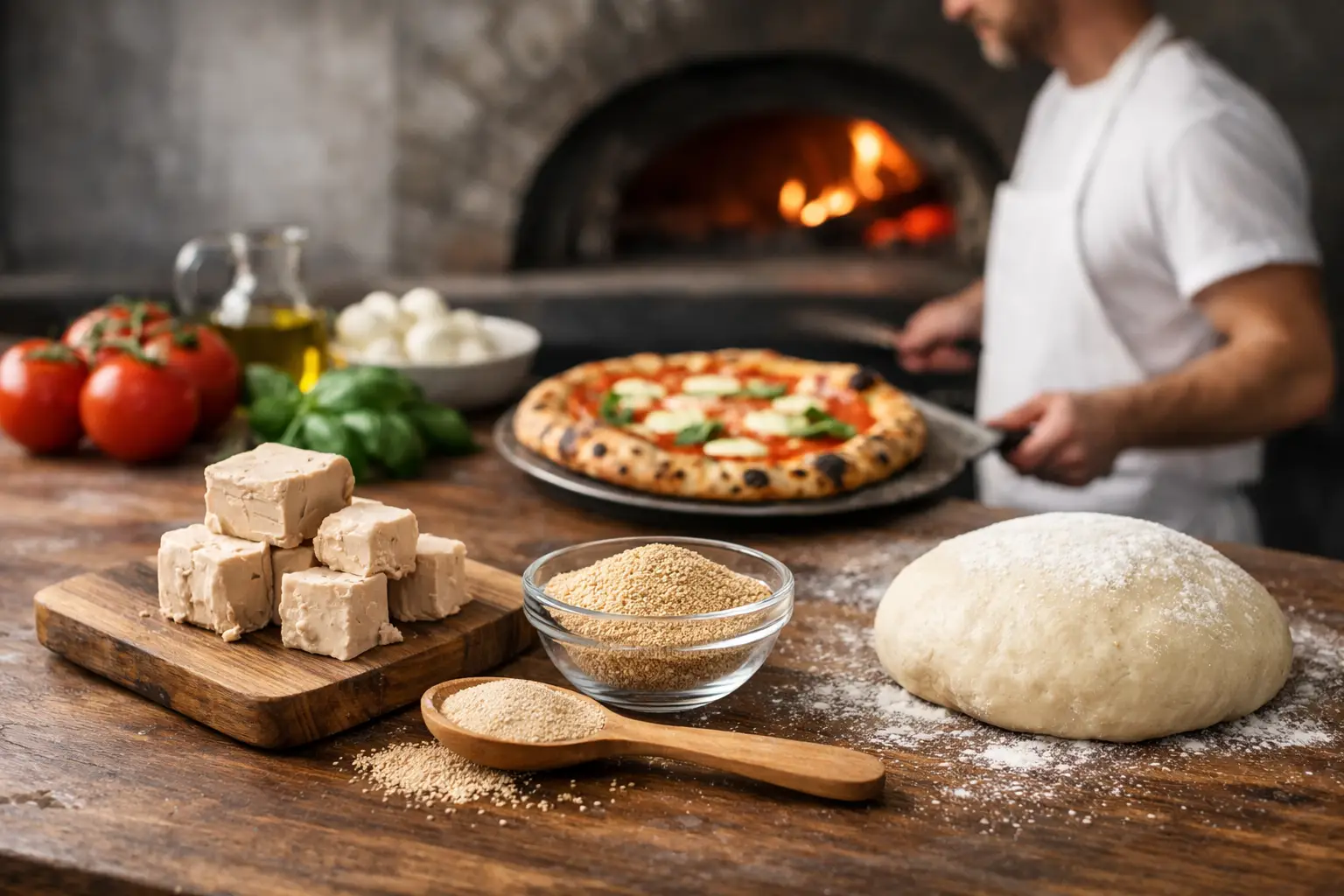
Fresh yeast vs dry yeast is not a question of authenticity versus convenience. Both can produce excellent Neapolitan-style dough when the formula, fermentation schedule, and dough temperature are under control. The real difference is how each yeast behaves in your workflow - and whether you can repeat that workflow with precision.
For a pizzaiolo, yeast is not simply an ingredient that makes dough rise. It is a fermentation tool. Its dosage affects timing, extensibility, aroma, and how confidently a dough ball opens at the bench. Choose the form that lets you manage those variables consistently.
What fresh yeast and dry yeast actually are
Fresh yeast, often called compressed yeast or cake yeast, is a moist block of living baker's yeast. It is soft, perishable, and usually stored refrigerated. Its high moisture content makes it easy to disperse in water, but it also means it has a short shelf life and can lose activity quickly when poorly stored.
Dry yeast is the same basic organism in a more stable form. Most pizza makers encounter either active dry yeast or instant dry yeast. Active dry yeast has larger granules and is often dissolved in water before mixing, although modern versions can sometimes be mixed with flour. Instant dry yeast has finer particles, activates more readily, and is generally mixed directly into flour.
Neither form is automatically superior because it is fresh or dry. A well-kept yeast with known activity is more valuable than a traditional-looking ingredient with uncertain performance.
Fresh yeast vs dry yeast in Neapolitan pizza dough
Neapolitan pizza places unusual demands on dough. The dough must mature sufficiently without weakening, remain extensible enough for hand opening, and bake quickly in a very hot oven. Those results come from the complete system: flour strength, water temperature, yeast level, salt, room conditions, balling time, and oven management.
Yeast form matters because it influences how accurately you can run that system.
Fresh yeast: traditional handling, narrower margin for storage
Fresh yeast is familiar to many traditional Italian bakeries and pizzerias. It dissolves easily in the mixing water and can feel intuitive when working with small quantities in a direct dough. For a pizzeria that receives frequent deliveries, uses enough yeast to move through it quickly, and follows a controlled daily production schedule, fresh yeast can work very well.
Its limitation is consistency over time. Fresh yeast must remain cold, protected from drying, and used before its activity declines. A block that appears acceptable may ferment more slowly than a new block. If your dough suddenly requires an extra hour to rise, the cause may be the yeast rather than the formula.
Fresh yeast also requires more weight for the same fermentative power. That is not a problem in a professional setting with a precise scale, but it becomes less convenient when a home baker needs a very small dose for a long fermentation.
Dry yeast: stable, measurable, and practical
Instant dry yeast is often the more practical choice for serious home pizza makers and emerging pizza businesses. It stores longer when sealed and refrigerated or frozen according to the manufacturer's guidance, and its dry form makes small doses easier to weigh repeatedly.
That stability is especially useful in doughs with long room-temperature or cold fermentation schedules. When a formula calls for a fraction of a gram of yeast, a reliable scale and instant dry yeast give you a strong starting point for controlled testing.
Active dry yeast can also make fine pizza dough, but it is less efficient for highly precise production because its granules are larger and its performance can vary slightly by brand and age. If you use it, follow the manufacturer's mixing guidance and keep your process consistent.
Conversion is a starting point, not a formula
A common working conversion is approximately 3 parts fresh yeast to 1 part instant dry yeast by weight. For example, 3 grams of fresh yeast may be replaced with about 1 gram of instant dry yeast. Active dry yeast typically falls between the two in strength, but brand-specific guidance should take priority.
Do not treat conversion as a guarantee that two doughs will ferment identically. Yeast products vary, and a tiny change matters in a pizza formula. A difference of 0.1 gram can alter the schedule of a small home batch, particularly in warm conditions.
The correct approach is to convert your preferred formula, then test it under your actual conditions. Record flour temperature, water temperature, room temperature, mixing time, dough temperature after mixing, bulk-fermentation duration, balling time, and final dough behavior. If the dough matures early, reduce yeast or lower dough temperature. If it remains tight and underdeveloped at bake time, adjust in the opposite direction.
Flavor: yeast choice matters less than fermentation control
Fresh yeast is sometimes described as producing better flavor, while dry yeast is accused of creating a less refined dough. In a well-managed pizza process, that claim is too simple.
The flavor of Neapolitan pizza dough is shaped primarily by fermentation and maturation: how long the dough develops, the temperature it experiences, the quality and suitability of the flour, and whether the dough is baked at the right point. Using more yeast to force a fast rise can create an overly yeasty aroma and a dough that lacks maturity. That can happen with fresh or dry yeast.
A restrained yeast dose and a schedule appropriate to your environment will usually produce a cleaner, more balanced result than choosing one yeast form based on reputation alone. The goal is not maximum fermentation. The goal is dough that is mature, elastic, aromatic, and strong enough to support rapid baking.
How yeast choice changes your daily workflow
Choose fresh yeast when you have dependable refrigeration, frequent turnover, and a production routine built around it. It is a sound option for pizzaiolos who value its handling characteristics and can control inventory closely.
Choose instant dry yeast when repeatability, long storage, and accurate low-dose scaling matter most. It is particularly effective for students developing a reliable home process, operators testing formulas, and anyone making dough only once or twice each week.
For either yeast, do not add it directly onto salt. Dissolve fresh yeast in water before incorporating it into the dough. With instant dry yeast, either blend it thoroughly with flour or dissolve it in the mix water, depending on your established method. What matters is even distribution. Pockets of yeast create uneven fermentation that no amount of later handling can fully correct.
Signs your yeast decision needs adjustment
If dough balls expand too quickly, become fragile, and spread excessively at opening, the problem may be too much yeast, too much warmth, or too long a fermentation. Changing from fresh yeast to dry yeast without changing the actual fermentative power will not solve it.
If the dough remains dense, resistant, and difficult to open, assess the full process before blaming the yeast. Cold dough, insufficient time, overly strong flour for the schedule, or inadequate mixing can all produce the same result. Yeast is one lever among several.
A simple diagnostic test is valuable: make two small batches with identical flour, hydration, salt, dough temperature, and fermentation conditions. Use fresh yeast in one and instant dry yeast in the other, converted by weight. Evaluate expansion, aroma, extensibility, and baked texture at the same time point. That side-by-side comparison will teach more than a general rule ever can.
The best choice for your dough
For most serious pizza students, instant dry yeast offers the clearest path to repeatable results. It is stable, easy to portion, and well suited to methodical recipe development. Fresh yeast remains an excellent choice when it is genuinely fresh and your schedule supports it.
At Neapolitan Pizza School, the focus is not on treating any ingredient as a shortcut or a symbol of tradition. The discipline lies in understanding what each ingredient does, then building a process you can execute again tomorrow. Select the yeast you can store properly, measure accurately, and test with care. Your dough will respond to that consistency long before it responds to a label.