
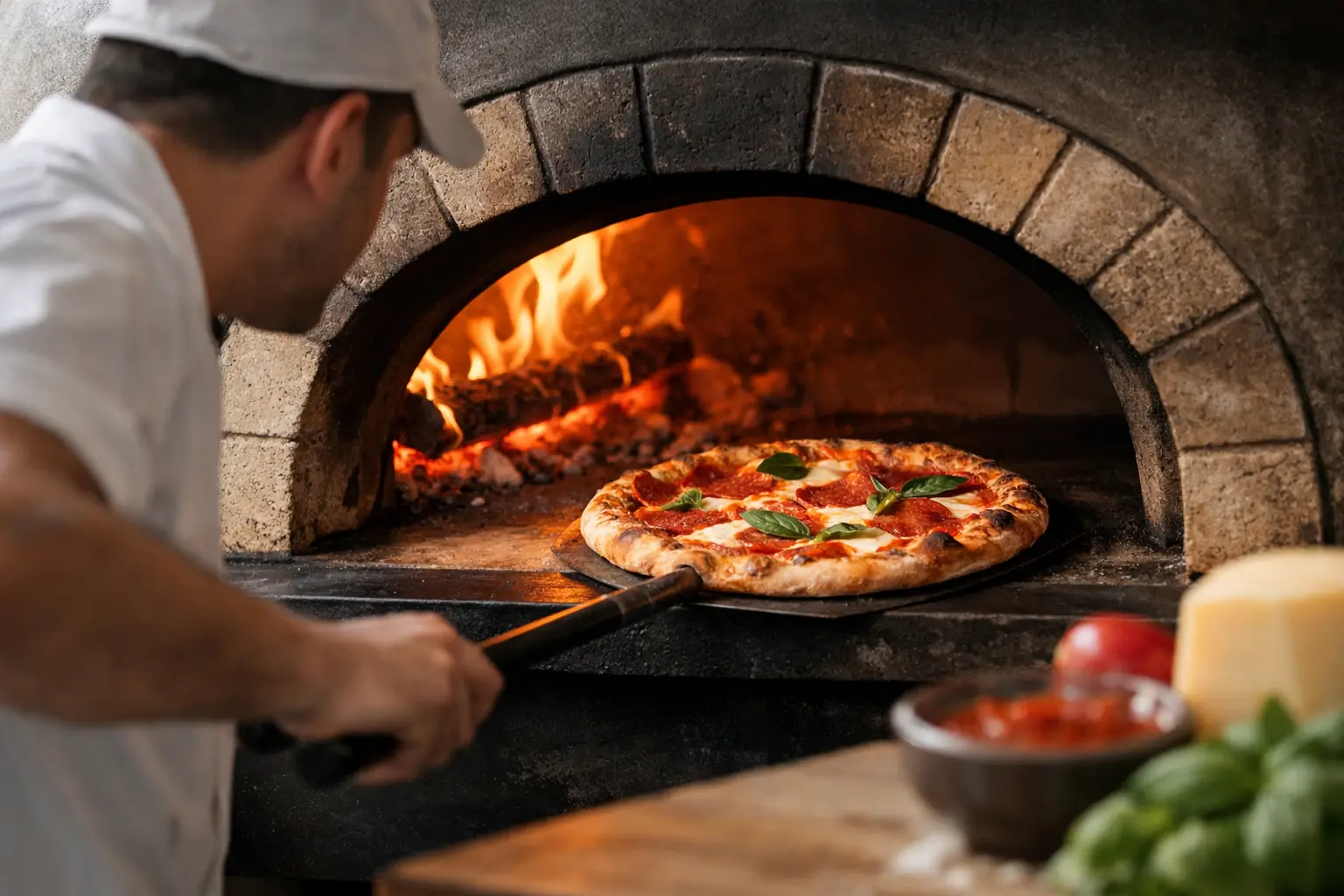
If your pizza is pale on top, scorched underneath, or baking unevenly from one side to the other, the problem is often not the dough. It is the oven. When people ask how hot should pizza oven be, they are usually asking a more practical question: what temperature produces the crust, structure, and bake you are actually trying to achieve?
For Neapolitan pizza, the answer is not subtle. A true Neapolitan bake happens in an extremely hot oven, typically around 800 to 900 degrees Fahrenheit, with a floor temperature that supports a bake of roughly 60 to 90 seconds. But that does not mean every pizza should be baked at the highest number your oven can reach. Temperature only makes sense when matched to style, dough design, and oven type.
How hot should pizza oven be for each style?
The right heat depends first on the pizza you want to make. This is where many bakers get off track. They hear that hotter is better, then try to force every dough into a high-heat bake. That usually leads to burnt bottoms, undercooked interiors, or toppings that break before the crust is fully set.
Neapolitan pizza requires the highest heat because the dough, hydration, fermentation, and topping load are built for a fast bake. At 800 to 900 degrees Fahrenheit, the crust can spring quickly, moisture can evaporate without drying the pizza out, and the edge can blister while the center stays soft and extensible. This is not just tradition for its own sake. The style depends on that thermal environment.
New York-style pizza generally works lower, often in the 600 to 700 degree range in a professional setting, though many shops adjust based on oven design and production flow. That longer bake builds more dehydration and structure, which suits a firmer, foldable slice.
Home oven pizza is different again. A standard residential oven often tops out around 500 to 550 degrees Fahrenheit. That is below ideal Neapolitan range, but it can still produce very good pizza if the dough and method are adapted. In that setting, preheating a baking steel thoroughly matters more than chasing an impossible air temperature.
Pan pizza, Sicilian, and Detroit-style pizzas operate on a different logic. These styles are not trying to replicate a 90-second wood-fired bake. They need enough heat to crisp the exterior and bake through a thicker interior, usually at more moderate temperatures.
Oven temperature is not just one number
One of the biggest misconceptions in pizza baking is that oven temperature is a single measurement. In practice, you are managing several kinds of heat at once: floor heat, dome or ceiling heat, ambient chamber heat, and live flame if you are using wood or gas. Those elements do not always move together.
This matters because the bottom and top of the pizza cook differently. The oven floor drives conduction into the base. The dome and flame provide radiant heat to the rim, cheese, and toppings. The surrounding hot air contributes convection, though it is usually less decisive than the other two.
A pizza oven can read very hot overall and still bake poorly if the floor is too cool. The reverse is also true. If the deck or stone is overheated relative to the top environment, the base can char before the rim opens and colors properly.
For serious pizza work, especially Neapolitan, you need to think beyond the control dial. You are balancing top and bottom heat, not simply turning temperature up.
The ideal Neapolitan range
For authentic Neapolitan pizza, a chamber temperature around 800 to 900 degrees Fahrenheit is the practical target. The floor often sits somewhat lower than the flame path or hottest part of the dome, but still hot enough to support rapid oven spring and browning. A well-managed oven in this range allows the pizza to bake quickly without becoming dry, rigid, or cracker-like.
That short bake is central to the style. The crust should show leopard spotting and light char, but not deep bitterness. The cornicione should be developed and airy, not merely inflated. The center should remain tender rather than brittle. These are signs of proper heat application, not just proper dough handling.
There is also a trade-off here. Very high heat rewards control and punishes hesitation. If your launch is poor, if your dough is overloaded, or if your turn timing is off, the oven will expose it immediately. Lower temperatures can be more forgiving for practice, even if they move you away from strict Neapolitan standards.
How hot should pizza oven be at home?
If you are working in a conventional home oven, the realistic answer is usually as hot as the oven safely and consistently allows, typically 500 to 550 degrees Fahrenheit. But the more important question is how much heat your baking surface holds.
A steel or stone needs a full preheat, often far longer than the oven needs to reach its set point. If the oven says 550 after 15 minutes, the baking surface may still be well below that. Underheated surfaces are a common cause of weak oven spring and pale, soft bottoms.
For home Neapolitan-inspired pizza, many bakers get stronger results by using a baking steel and positioning it high in the oven, closer to the broiler or upper heating elements. That setup helps compensate for the lack of strong top heat. It is not the same as a live-fire pizza oven, but it improves balance.
If your home oven has a broiler, using it strategically can help finish the top. The caution is that every oven behaves differently. A method that works in one kitchen may burn the cheese in another. This is where disciplined testing matters more than assumptions.
Portable and outdoor pizza ovens
Portable gas, wood, and multi-fuel pizza ovens have changed what is possible for home pizzaiolos. Many can reach authentic Neapolitan temperature ranges, at least on paper. That makes them capable of excellent results, but it does not mean they are automatically easy to manage.
In these ovens, the challenge is often heat balance and recovery. The stone may become excessively hot near the flame side while the opposite side lags behind. Or the oven may recover slowly after each bake, especially during a longer session. If you launch pizza after pizza without monitoring the floor, consistency drops fast.
A common mistake is preheating until the stone is blazing hot, then launching a pizza with a dough formula that is not designed for such aggressive bottom heat. The result is blackening underneath before the rim fully develops. When that happens, the solution is not always lowering the flame completely. Sometimes it means adjusting preheat time, rotating earlier, or giving the floor time to settle into a more usable range.
Reading the pizza, not just the thermometer
Thermometers are essential, but experienced bakers also read the pizza itself. A pizza that sticks briefly, then releases cleanly and begins lifting around the rim, is often in a healthy thermal zone. A pizza that remains flat and dull after launch may be underbaked from below. A pizza that balloons too aggressively in isolated spots while the center lags may be telling you something about shaping, fermentation, or top heat.
Color matters, but context matters more. A deeply spotted crust can be desirable in a Neapolitan bake and a flaw in another style. A blond top may indicate insufficient radiant heat, but it can also come from topping choices with high moisture content.
This is why temperature targets should guide you, not blind you. If the pizza is consistently giving the wrong result, the number alone is not the answer. You need to interpret how the oven is delivering heat.
Common temperature mistakes
The most frequent mistake is assuming maximum heat is always correct. It is not. Heat has to match the dough system and style. A dough made for a 6-minute home bake will not behave like one built for 75 seconds in a Neapolitan oven.
The second mistake is ignoring floor temperature. Bakers often focus on the flame, visual drama, or chamber reading while the baking surface drifts too hot or too cool.
The third is weak preheat discipline. Pizza ovens do not become stable the moment they ignite or beep. They need time to saturate the baking surface and equalize the chamber.
The fourth is trying to fix every flaw with temperature. If your dough is underfermented, too cold, poorly opened, or overloaded, changing the oven by 50 degrees will not solve the core issue.
What temperature should you actually use?
If your goal is authentic Neapolitan pizza, use an oven environment in the 800 to 900 degree Fahrenheit range and learn to manage floor heat so the pizza bakes in 60 to 90 seconds with balanced top and bottom development. If you are working in a home oven, use the highest stable setting available, fully preheat your surface, and adapt your dough and bake method to that reality.
The best pizzaiolos do not ask for a single perfect number detached from context. They ask what temperature serves the product. That is the real standard. When heat is matched to style, dough, and oven behavior, pizza stops feeling unpredictable and starts becoming repeatable.
That is when the oven becomes more than a hot box. It becomes part of the craft.