
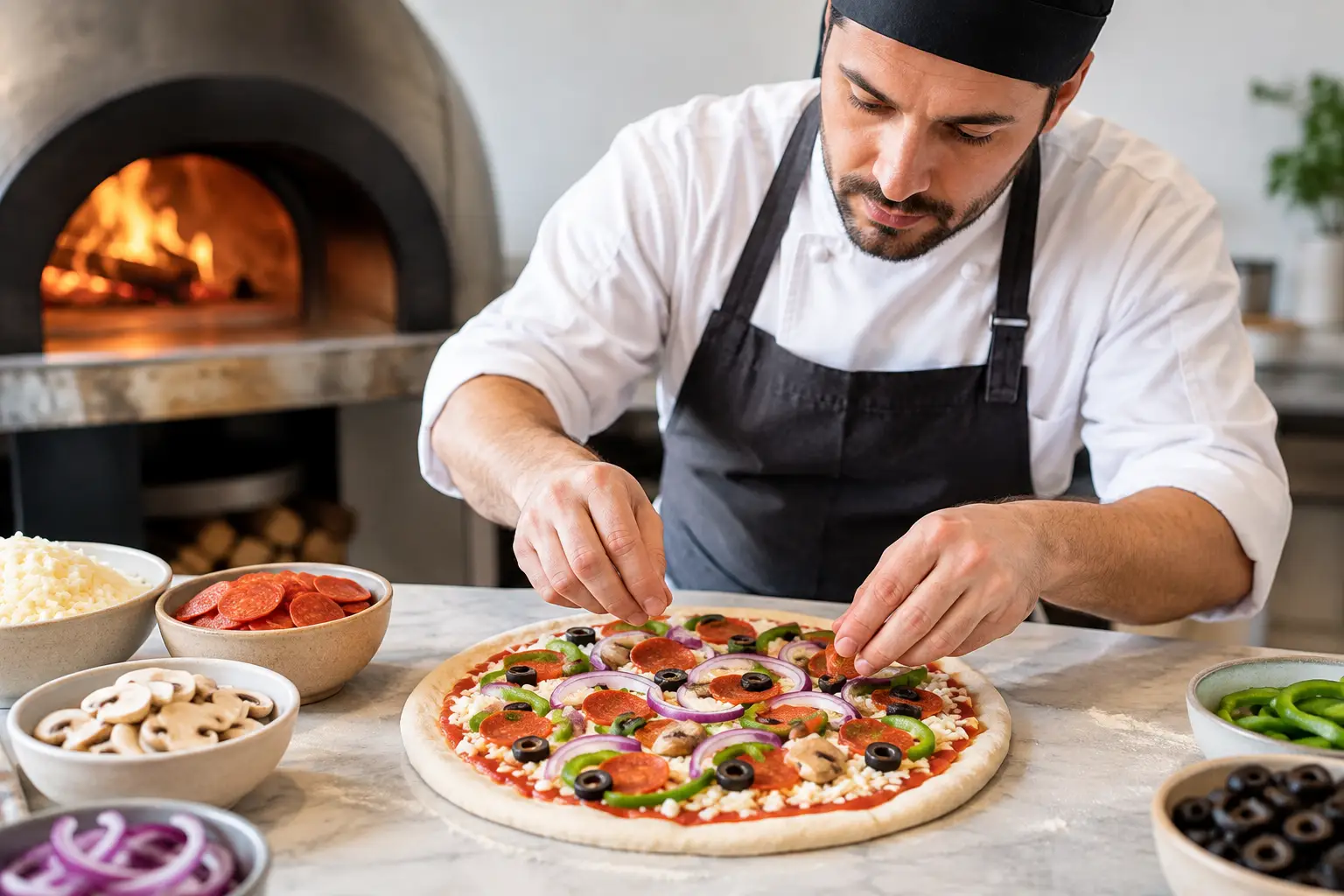
A Neapolitan pizza can have exceptional dough, properly fermented, expertly opened, and baked in a fiercely hot oven, yet still fail because of what happens on top. To balance pizza toppings properly is to protect the pizza’s structure, heat transfer, and identity. The goal is not abundance. It is a unified bite in which the crust, tomato, cheese, oil, and any additional ingredient remain distinct and coherent.
For aspiring pizzaiolos, this discipline is often harder than it sounds. Home-style pizza habits encourage coverage: more cheese, more meat, more vegetables, more sauce. Neapolitan pizza asks the maker to think differently. The topping is not a pile placed on a dough round. It is a measured composition designed for a pizza that bakes in roughly 60 to 90 seconds.
Why topping balance determines the bake
A pizza topping affects more than flavor. Every ingredient contributes water, fat, salt, sugar, and physical weight. In a hot Neapolitan oven, those variables determine whether the center sets cleanly, whether the rim rises freely, and whether the base stays light rather than damp.
The center of a Neapolitan pizza is meant to be soft and tender, but it should not be raw, flooded, or unable to support a slice. When the topping load is excessive, the dough must evaporate more moisture before it can finish baking. In a short bake, it does not have enough time. The result is a wet center, pale cheese, or a crust that colors before the middle is ready.
Balance also protects contrast. Tomato should bring freshness and acidity, not dominate the palate. Cheese should melt into pockets of richness, not form a thick blanket. Basil should perfume the finished pizza without becoming bitter under prolonged heat. A well-built pizza has restraint because each ingredient has a job.
Start with the dough’s capacity
Before measuring toppings, consider the dough ball, its hydration, fermentation, opening technique, and final diameter. A 250- to 280-gram dough ball opened into a typical 11- to 12-inch Neapolitan pizza has limited carrying capacity. If it has been stretched too thin in the center, even a normal amount of sauce may create problems. If the dough is under-fermented or handled roughly, a heavy topping load will further suppress oven spring.
The rim should remain largely untouched. Leave a clear border of about 1 inch so the cornicione can expand. Sauce or cheese dragged into that area does more than make the pizza look untidy. It weighs down the edge and interferes with the dramatic rise that gives Neapolitan pizza its characteristic open, airy structure.
A useful working principle is this: the dough must remain the foundation, not become a delivery surface for toppings. If the pizza looks heavily covered before it enters the oven, it is almost certainly overbuilt.
Build the base with measured sauce
Tomato is usually the first topping decision, and it sets the moisture level for everything that follows. For a standard Neapolitan pizza, a modest ladle of crushed tomatoes is enough. The exact amount depends on the tomato’s consistency and the dough size, but many pizzas need only about 2.5 to 3.5 ounces of sauce.
Choose tomatoes with clean flavor and avoid reducing them into a thick, cooked sauce. Traditional Neapolitan-style tomato application relies on crushed or milled tomatoes that retain brightness. However, a watery product needs attention. Drain excess liquid if necessary, or the free water will run toward the center during baking.
Spread the tomato with the back of a spoon using light circular movements. Do not press it into the dough. A thin, even layer is more effective than a dense red coat. You should still see dough through the sauce in places. That visual restraint is not stinginess. It is sound pizza construction.
Salt and oil are part of the topping system
Seasoning should support the tomato rather than correct it aggressively. Salt, a small amount of extra-virgin olive oil, and perhaps basil may be all that is required for a Marinara. Because salt draws moisture and oil changes the way toppings fry and melt, both should be applied intentionally.
Too much oil can make the center greasy, particularly when paired with fatty cheese or cured meats. A light drizzle contributes aroma and helps carry flavor across the surface. It should not create a visible pool.
Use cheese for distribution, not coverage
Fresh mozzarella is one of the most common causes of a watery pizza. It contains substantial moisture, and its behavior changes according to its format, temperature, and drainage. Fior di latte and buffalo mozzarella can both produce excellent results, but they must be handled differently.
Fior di latte should be cut or torn into small, irregular pieces and drained before use. Buffalo mozzarella is generally wetter and benefits from even more careful draining and smaller portions. Cold cheese also slows melting, so allowing it to lose its refrigerator chill before topping can improve performance.
Rather than covering the tomato evenly, distribute cheese in separated pieces. This leaves channels for steam to escape and allows the tomato to remain present. It also creates better visual and textural contrast: creamy melted cheese, bright tomato, charred rim, and exposed areas of sauce.
For a Margherita-sized pizza, think in modest handfuls, not handful after handful. The exact weight will vary by cheese and style, but the surface should never look sealed beneath dairy. If the pizza is releasing a large amount of liquid after baking, reduce the cheese portion, improve drainage, or both.
Balance pizza toppings properly by managing moisture
Vegetables, mushrooms, cooked greens, roasted peppers, and fresh herbs all require separate judgment. The question is not whether an ingredient tastes good. The question is whether it can cook correctly in the available time without shedding enough water to compromise the pizza.
Raw mushrooms, zucchini, and leafy greens can release significant moisture. Thin slicing helps, but some ingredients should be pre-cooked, salted and drained, or used sparingly. Roasted vegetables should be cooled and patted dry before they touch the dough. Ingredients preserved in oil, such as artichokes or sun-dried tomatoes, should be drained well so their flavor remains concentrated without making the center slick.
Cured meats present a different trade-off. Thin slices of prosciutto can become overly salty and rigid if baked for the full time, so they are often added after baking. Salami or soppressata may be baked, but should be placed in a single layer with enough space to render and crisp. A pizza does not need every possible savory element. Salt, fat, and heat build quickly.
Match toppings to the oven, not just the recipe
A Neapolitan oven is not a conventional home oven. The intense floor heat and radiant heat from above demand ingredients that cook rapidly. Thick raw sausage, large chunks of onion, dense potato slices, and bulky vegetables may work only if they are pre-cooked or cut with great care.
This is where recipe copying can mislead. A topping combination that succeeds in a 6-minute home-oven bake may not translate to a 75-second bake. Evaluate every topping according to what it needs to become finished: does it need to soften, render, brown, wilt, or merely warm through? Then decide whether it belongs on the pizza before the bake, after the bake, or not at all.
Think in flavor roles
A composed pizza usually needs a primary flavor, a supporting richness, and an accent. For example, tomato may be the primary flavor, mozzarella the richness, and basil the accent. On a white pizza, ricotta may provide richness, roasted squash may bring sweetness, and a bitter green or aged cheese may supply contrast.
When every topping is rich, salty, or smoky, the pizza becomes flat despite being intensely flavored. Add contrast deliberately. Acidic tomato can cut fatty cheese. Bitter greens can balance sweet roasted vegetables. Fresh herbs can lift cured meat. The answer is not always another topping. Sometimes the better decision is to remove one.
Keep in mind that high heat concentrates flavor. A pinch of pecorino, a few olives, or a small amount of anchovy can season an entire pizza. Ingredients with strong salinity should be distributed in small amounts so no individual bite becomes harsh.
Assemble in an order that supports execution
A practical sequence is sauce first, then cheese, then ingredients that need the heat of the oven. Finish with delicate herbs, fresh greens, or prosciutto after the bake when appropriate. This order is not absolute, but it gives the pizzaiolo control over moisture and exposure to heat.
Work quickly once the dough is opened. A stretched skin begins absorbing moisture immediately, especially in a humid kitchen or when topped with watery sauce. Build the pizza close to the oven, check that it releases freely from the peel, and launch without hesitation. A perfectly balanced topping plan can still fail if the pizza sits assembled long enough to stick or soften excessively.
Train your eye before relying on recipes
Recipes provide a useful starting point, but repetition develops judgment. Photograph pizzas before and after baking. Note where moisture pooled, whether cheese browned too aggressively, whether the rim rose evenly, and whether the center held its shape. Change one variable at a time on the next attempt.
At Neapolitan Pizza School, topping discipline is treated as part of the full pizza-making system, alongside dough fermentation, opening, fire management, and timing. This matters because the best topping formula is not universal. It depends on your flour, dough hydration, tomato, cheese, oven temperature, and the way you handle the pizza from bench to peel.
The next time a pizza feels heavy or wet, resist the instinct to increase heat or add more flour. Look first at the surface. A lighter hand, better-drained ingredients, and a clearer flavor hierarchy will often take the pizza further than another topping ever could.