
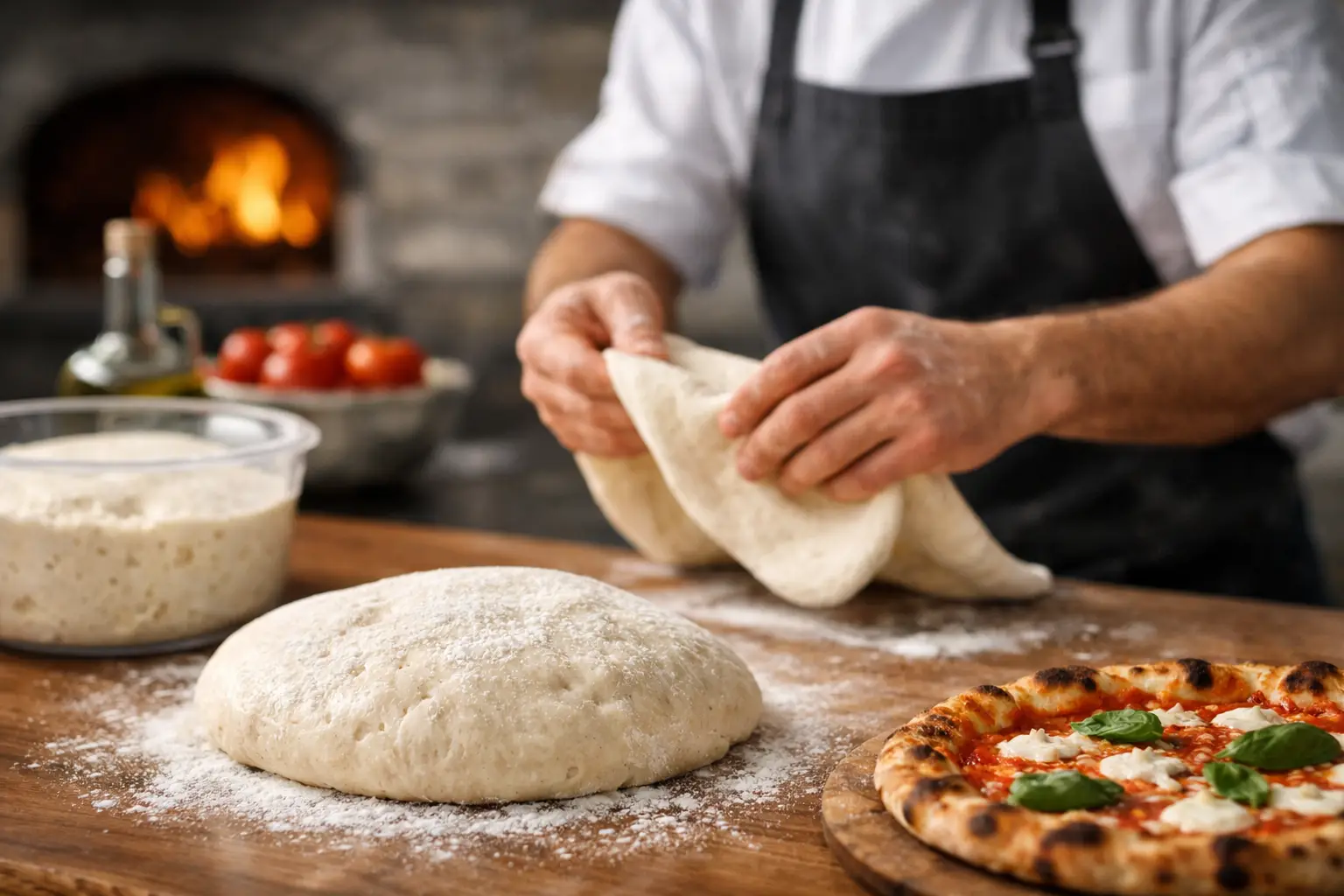
A dough that looks fine at mixing can still bake flat, pale, or dense if fermentation is mishandled. If you want to understand how to ferment pizza dough with consistency, you need to control three things with precision: time, temperature, and yeast activity. Everything else - softness, extensibility, aroma, browning, and the character of the cornicione - follows from those decisions.
For Neapolitan pizza, fermentation is not a waiting period between mixing and baking. It is the stage where the dough develops strength, digestibility, and flavor. When students struggle with sticky dough, tearing during opening, or a crust that colors before it fully expands, the cause is often not the flour or the oven. More often, the issue is fermentation that ran too fast, too slow, or too long.
What fermentation is doing in pizza dough
Fermentation begins as soon as yeast starts consuming available sugars in the dough. That process produces carbon dioxide, alcohol, and a range of organic compounds that influence aroma and flavor. At the same time, enzymes in the flour continue breaking starches into simpler sugars and modifying the dough structure.
In practical terms, proper fermentation gives you a dough that opens without fighting back, keeps gas without collapsing, and bakes with lightness rather than heaviness. It also affects the final taste more than many home bakers expect. A rushed dough can still rise, but it will usually taste one-dimensional and bake with less refinement.
This is where serious pizza making separates itself from casual bread mixing. Fermentation is not just about getting volume. It is about managing maturation and gas retention together. A dough can be fully risen and still not be properly matured. It can also be over-matured and no longer capable of holding its structure.
How to ferment pizza dough for better control
The best way to think about fermentation is as a schedule you design, not a mystery you react to. Your flour strength, room temperature, dough temperature after mixing, and yeast quantity all have to support the timeline you want.
For most pizza makers, there are two workable paths. The first is room-temperature fermentation, where the dough develops over several hours and is baked the same day. The second is a longer fermentation that includes refrigeration, often followed by a final room-temperature proof before baking. Both can work well. The right choice depends on your environment, your schedule, and the style of pizza you are pursuing.
If your kitchen is warm, same-day dough can move faster than expected. If your refrigerator runs very cold, long fermentation can stall more than you intended. That is why copying a dough formula without understanding the fermentation conditions often leads to inconsistent results.
Same-day fermentation
A same-day dough is useful when you need a practical schedule and a clean, balanced flavor. For many pizza makers, this means mixing in the morning, allowing a bulk rest, dividing into dough balls, then fermenting until service later in the day.
This method works best when room temperature is stable. The main advantage is predictability in a controlled environment. The trade-off is that flavor development is usually less pronounced than in a longer cold fermentation. If you use too much yeast to force the schedule, the dough may proof quickly but lose finesse.
Cold fermentation
Cold fermentation slows yeast activity and extends the timeline, which usually gives you more flexibility and deeper flavor development. It is especially useful for home bakers who want to spread the process across one or two days.
That said, cold fermentation is not automatically better. If the dough enters the refrigerator too warm, it may continue fermenting aggressively before the cold fully slows it down. If it stays refrigerated too long relative to the flour strength, it can weaken and become slack. A long fermentation only helps when the dough is built to withstand it.
Time, temperature, and yeast must agree
Many problems blamed on yeast are really temperature problems. Dough fermentation is highly sensitive to heat. A few degrees can change the pace enough to turn a reliable process into an inconsistent one.
If your dough is fermenting too quickly, the solution is not always less time. It may be lower dough temperature after mixing, less yeast, or cooler room conditions. If it is fermenting too slowly, adding time may help, but so might adjusting your final dough temperature or giving the dough a warmer proofing environment.
For serious control, monitor dough temperature after mixing. This matters because friction from mixing raises temperature, and that affects how quickly fermentation begins. A dough mixed to the correct consistency but finished too warm can outrun your intended schedule by hours.
Yeast quantity should support your timeline, not compensate for poor planning. More yeast is not a quality upgrade. In many cases, less yeast with better temperature control produces a more stable and better-tasting dough.
Reading the dough instead of the clock
A recipe can give you a target, but the dough gives you the truth. Learning how to ferment pizza dough well means recognizing visual and tactile signs at each stage.
During bulk fermentation, the dough should begin to show life without becoming loose and gassy too early. After balling, a properly fermenting dough ball gradually relaxes, smooths out, and gains volume while still holding shape. It should not spread like batter, and it should not remain so tight that it resists opening.
When the dough is ready to use, it should feel aerated but not fragile. Pressing lightly into the ball should leave a soft response rather than a dense spring-back or a total collapse. Aroma also matters. A mature dough smells pleasantly fermented, slightly creamy, and wheaty. A sharp alcoholic smell usually suggests it has gone too far.
Common fermentation mistakes
Under-fermented dough is often easy to spot in the oven. It opens with resistance, bakes with limited expansion, and can produce a tight crumb structure. The crust may look neat but feel heavy. This happens when the dough has not had enough time to build gas and relax its gluten adequately.
Over-fermented dough creates a different set of problems. It can feel sticky, weak, and difficult to handle. During shaping, it may degas too easily or tear at the center. In the oven, it may color fast without achieving the lift and edge structure expected from a well-prepared Neapolitan dough.
Another common mistake is treating bulk fermentation and ball fermentation as interchangeable. They are related, but they do not produce the same result. Bulk fermentation develops the mass of dough before division. Ball fermentation refines each portion for opening and baking. If you shorten one stage too aggressively, the other does not always fix it.
Choosing a fermentation schedule that fits your flour
Not every flour performs equally across long timelines. Stronger flours generally tolerate extended fermentation better because they can maintain structure longer. Weaker flours may perform beautifully on shorter schedules but break down if pushed too far.
This is one of the most misunderstood parts of dough work. Pizza makers often read about 24-, 48-, or even 72-hour fermentation and assume longer always means better. It does not. The flour has to match the schedule, and the schedule has to match the style you want. For authentic Neapolitan results, balance matters more than chasing an impressive number of hours.
If your dough becomes overly extensible and weak during long fermentation, reduce the timeline before changing everything else. If it remains tough and underdeveloped, you may need either more fermentation time or better temperature management.
How to improve your fermentation immediately
Start by keeping records. Note your flour, hydration, yeast amount, room temperature, dough temperature after mixing, refrigeration time, and how the dough handled at opening. Serious improvement rarely comes from guessing. It comes from comparing one controlled batch against the next.
Make only one major adjustment at a time. If you change yeast, hydration, flour, and fermentation schedule all at once, you will not know what solved the problem. A disciplined process is faster in the long run because it teaches you cause and effect.
It also helps to define your goal clearly. If you want more flavor, a moderate cold fermentation may help. If you want easier service flow in a professional setting, a same-day schedule with strong temperature control might be the better answer. Technique should serve the result, not the trend.
At Neapolitan Pizza School, this is one of the central lessons in dough training: fermentation is where craft becomes measurable. Once you stop treating it as a vague resting period and start managing it as a technical process, your dough becomes far more consistent.
The best dough makers are not the ones who memorize the longest timeline. They are the ones who can look at their flour, their room, their schedule, and their dough temperature, then make the right fermentation decision for that day.