
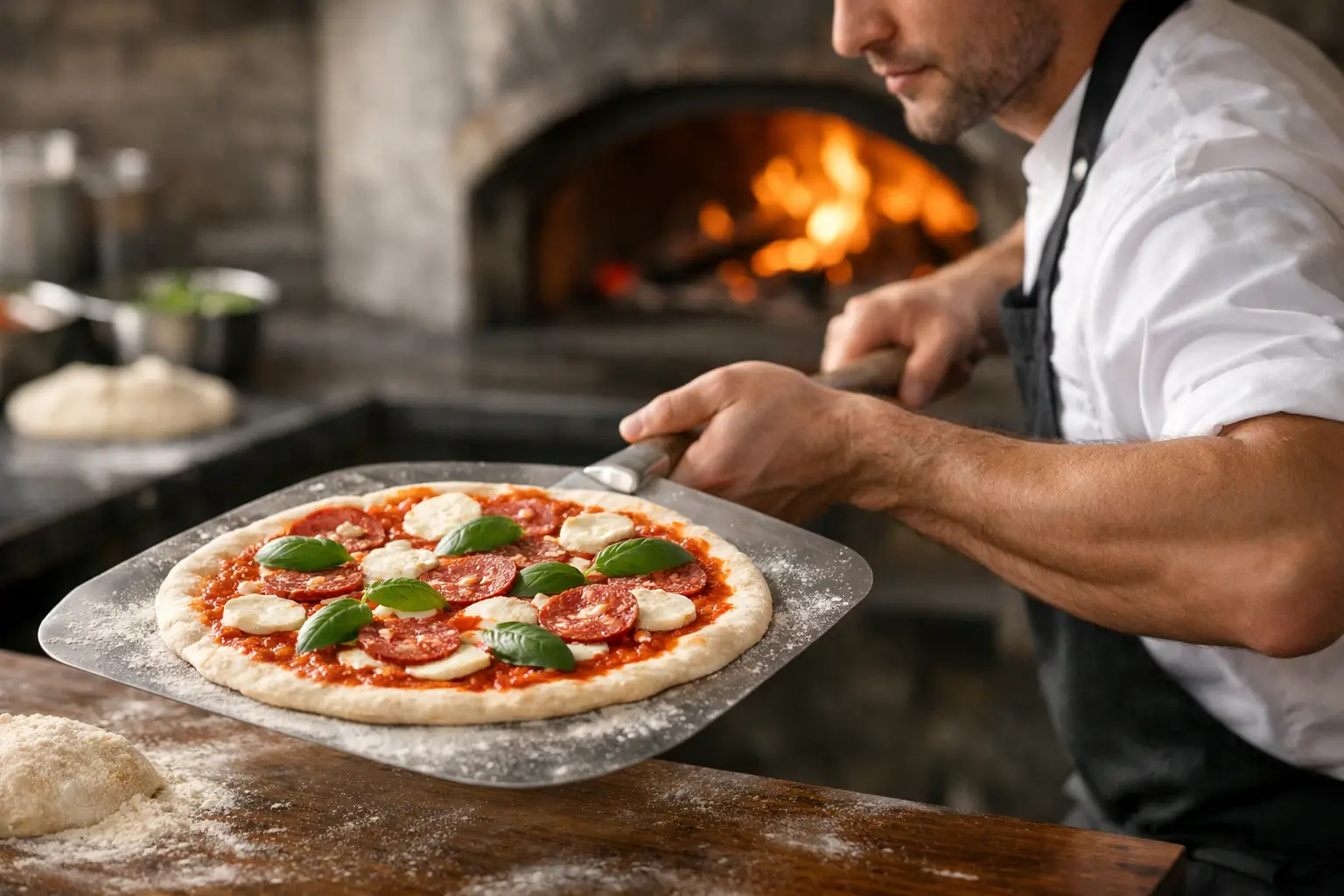
A pizza can be perfectly fermented, opened with care, and topped in the correct proportion, then ruined in one second at the oven entrance. The search term “how to launch pizza peel” points to that decisive movement: transferring a soft, dressed pizza from peel to oven floor without stretching it, folding it, or leaving half the topping behind.
For Neapolitan pizza, the launch is not a trick. It is a controlled transfer built on correct dough handling, a clean peel, restrained bench flour, and a short, direct motion. When those conditions are right, the pizza releases with very little force.
How to Launch a Pizza Peel With Control
A proper launch has two actions. First, place the front edge of the peel onto the oven floor, just beyond the landing spot. Then pull the peel back quickly and levelly while allowing the pizza to settle onto the floor.
Do not throw the pizza forward. Do not snap the peel upward. Both movements can stretch the rim, disturb the circular shape, or cause the center to fold. Think of the peel as a support that disappears from underneath the pizza, not as a shovel that propels it.
Stand close enough to the oven that your arm is not fully extended. Keep your wrist firm and the peel nearly level. As the peel enters the oven, its leading edge may angle down slightly to meet the floor, but the pizza itself should remain supported until the moment you begin the withdrawal.
The pull-back should be confident and continuous. A hesitant peel stops midway, which creates friction under the dough and can leave the pizza stuck to the metal. One clean withdrawal gives the dough the best chance of releasing in its original shape.
The Launch Begins Before the Pizza Is Topped
Most launch failures begin at the bench, not at the oven. A pizza that sticks to the peel has usually sat too long, absorbed moisture, or been built on an improperly prepared surface.
After opening the dough, dust the peel lightly with flour. Many pizzaiolos use a blend that includes semolina flour because its coarse particles reduce friction and stay more distinct under a moist dough. Fine flour can work, but it absorbs water more quickly and can become pasty. The right choice depends on your dough formula, oven style, and service rhythm, but the principle is the same: use only enough flour to create a dry, mobile surface.
Too much flour creates another problem. Excess flour burns on the oven floor, producing bitterness, smoke, and an unpleasantly dusty base. It can also make the pizza skate unpredictably when you try to position it. The goal is not to bury the peel. The goal is to create a thin barrier that allows movement.
Once the dough is on the peel, perform a quick shake. Grip the handle and move it forward and back a few inches. The dough should slide as one piece. If one area catches, lift that edge gently and add a small amount of flour beneath it. Do this immediately, before sauce or cheese has time to soak through.
A pizza should not remain on the peel while you search for ingredients, answer a question, or wait for oven space. In a professional setting, opening, topping, checking, and launching are a continuous sequence. At home, organize your mise en place before the dough reaches the peel.
Keep the Topping Load Appropriate
Authentic Neapolitan pizza relies on balance. A wet, overloaded pizza is difficult to launch because moisture reaches the dough quickly and weight makes the center sag. This is especially common with watery mozzarella, excessive sauce, or vegetables that have not been properly drained.
Use a moderate amount of tomato, distribute cheese evenly, and leave the cornicione clear. If using fresh mozzarella, drain it thoroughly and avoid placing heavy clusters in the center. The pizza should look composed, not crowded.
The condition of the dough matters as well. Overproofed dough can become fragile and sticky, while underproofed dough may resist opening and pull back in shape. A well-fermented dough with proper gluten development has enough extensibility to open thinly and enough structure to tolerate the transfer.
Choosing the Right Peel for the Job
A wooden peel and a metal peel serve different purposes. A wood peel is often forgiving for launching because its surface holds a light dusting of flour well and does not conduct moisture as quickly as metal. It is a practical choice for building and launching pizzas, particularly for learners.
A perforated metal peel is common in high-volume pizzerias and is excellent for turning and retrieving pizzas in a hot oven. It can also be used for launching, but the workflow must be clean and quick. The perforations reduce the amount of flour carried into the oven, yet dough can catch if it is left too long on the peel or if the surface is not properly dusted.
The peel must also be dry and free of residue. A damp peel is a sticking hazard. Wipe away sauce, melted cheese, charred flour, or moisture between pizzas. In a busy service, this discipline is as important as oven management.
Practice the Motion Without Dough First
Before working with a finished pizza, practice the movement with an empty peel. Place the peel on a counter or table and rehearse setting the edge down, then drawing it back in one smooth line. Notice whether you lift the handle as you pull. If you do, correct it. An upward lift can drag the pizza or wrinkle the near edge of the crust.
Next, use a round of parchment or a piece of scrap dough to observe the release. The goal is not speed for its own sake. The goal is a repeatable movement that stays level and controlled under pressure.
In a very hot Neapolitan-style oven, placement matters. Aim for a clear section of oven floor with enough room to turn the pizza during the bake. Avoid launching too close to an active flame, where the rim can char before the bottom has set. A well-managed oven has defined zones, and the launch should place the pizza where the bake can begin evenly.
The Final Shake Test
The final shake test is your last opportunity to prevent a failure. After topping and immediately before walking to the oven, give the peel a short shake. The entire pizza should move.
If it does not, never assume a forceful launch will solve the problem. It will not. A stuck pizza may tear, fold, or release unevenly, often pulling sauce and cheese across the peel. Return to the bench if necessary, free the stuck area carefully, and recheck the movement.
This pause takes seconds and prevents waste. It also develops the awareness that separates a deliberate pizzaiolo from someone relying on luck.
Correcting Common Launch Problems
If the pizza folds as it leaves the peel, the usual cause is a weak or hesitant withdrawal. Keep the peel low and pull it back in one committed motion. If the center remains on the peel, the dough has likely stuck from moisture, delay, or insufficient flour beneath that section.
If the pizza lands misshapen, check whether you are pushing it into the oven rather than placing and withdrawing. The peel should not drive the dough forward. It should support the dough until gravity and the clean pull-back allow it to settle.
If the dough tears, examine the opening process. Thin spots in the center, aggressive stretching, and overfermentation all reduce the dough’s tolerance for handling. A launch issue can reveal an earlier weakness in dough preparation.
If the base tastes bitter or looks heavily speckled with burnt flour, reduce the amount of flour on the peel and clean the oven floor more consistently. Semolina can help with release, but it is not a substitute for timing and technique.
A clean launch is quiet, direct, and almost unremarkable. That is exactly what you want. Build the pizza quickly, check that it moves, place the peel with purpose, and let disciplined repetition turn a stressful moment into part of the craft.