
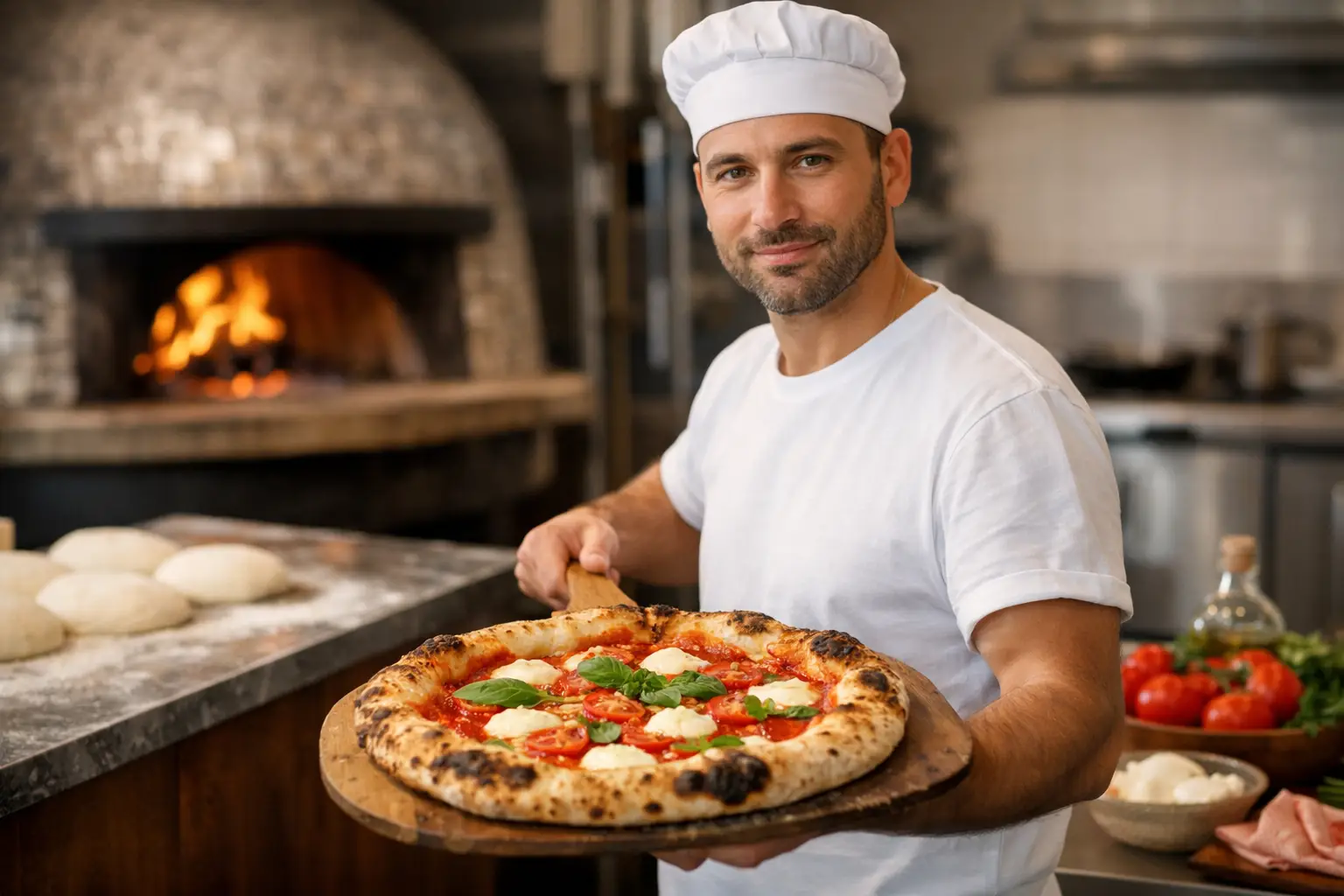
A pizzeria can look busy and still be built on weak foundations. The difference often appears at 7:30 p.m., when the oven is full, dough balls are warming too quickly, tickets are stacking up, and every pizza must still leave the pass with the same structure, color, and balance. The question of how to open a pizzeria is not mainly about finding a location or choosing a name. It is about building a repeatable production system before guests ever walk through the door.
For a Neapolitan-focused operation, that system must protect a specific product. A fast bake does not excuse weak fermentation. A wood-fired oven does not make an authentic pizza by itself. The business needs a clear point of view, disciplined numbers, trained hands, and service standards that hold under pressure.
How to Open a Pizzeria Starts With a Defined Concept
Before searching for a lease, decide exactly what kind of pizzeria you are opening. “Pizza for everyone” is a broad ambition, not an operating concept. Define your service model, price point, menu scope, guest experience, and production capacity.
A traditional Neapolitan pizzeria may center its menu on a limited number of pizzas, bake them rapidly at high heat, and serve them immediately. That format can create an exceptional guest experience, but it asks for careful pacing. A pizza intended to be eaten moments after baking will not travel like a crisp, foldable New York-style pie. If takeout and delivery will carry much of your revenue, you may need packaging, menu design, or a second product format that respects the realities of travel.
This is not a reason to dilute the concept. It is a reason to make the operating model honest. Decide whether your pizzeria is primarily dine-in, counter service, takeout, delivery, or a deliberate combination. Each choice affects kitchen layout, labor, seating, packaging costs, and the number of pizzas your oven must produce per hour.
Your concept should also answer a simple question: why will a guest choose your pizza over the established options nearby? The answer might be proper long-fermented dough, exacting ingredient standards, a focused regional menu, or a rare level of pizzaiolo craft. It cannot simply be that you have an oven.
Build the Financial Model Before Signing a Lease
Many restaurant problems begin with a lease that looked affordable before the full cost of opening became visible. Rent is only one part of occupancy cost. Consider common-area charges, property taxes, insurance requirements, utilities, grease management, permits, build-out overruns, signage, and the months of payroll and inventory needed before the operation reaches stable sales.
Create a conservative pro forma based on realistic assumptions. Estimate average check, seats, turns per service, takeout volume, food cost, labor cost, fixed overhead, and debt payments. Then test the model at lower sales levels. If the business only works when every dinner service is full, it is not yet a durable plan.
For pizza, capacity must be calculated from the oven outward. How many pizzas can be baked at once? What is the average bake time? How much room is available for stretching, topping, cutting, boxing, and staging? A small oven can support a serious craft operation, but it can also become the bottleneck that limits revenue while labor costs continue to rise.
Keep working capital separate from opening costs. The first months are when ingredient pars change, staff need retraining, equipment needs adjustment, and sales patterns become real rather than theoretical. Cash reserves give you room to correct those issues without compromising quality.
Design the Menu Around the Oven and the Dough
A pizzeria menu should be a production document as much as a marketing document. Every additional topping, appetizer, dessert, or special introduces more prep, storage, waste, and decision-making during service. Early on, a narrow menu is usually a strength.
Start with pizzas that demonstrate your standard. A marinara reveals the dough, tomato, garlic, oil, and oven work with nowhere to hide. A margherita tests moisture balance, cheese handling, basil placement, and timing. Build from there only when the team can execute the foundation consistently.
Ingredient choices must fit your intended result. High-moisture mozzarella, tomatoes, flour, olive oil, cured meats, and produce all behave differently depending on season, supplier, storage conditions, and bake profile. A topping that tastes excellent on a test pizza may release too much water during a busy service. Measure, test, and document each build rather than relying on visual memory.
Menu pricing also deserves precision. Do not price a pizza based only on what nearby restaurants charge. Know its actual food cost, including garnish, oil, flour bench waste, packaging, and the occasional remake. A premium product can command a premium price when the quality, service, and setting make that value clear.
Build a Dough Program, Not a Recipe
Dough is the operating core of a Neapolitan pizzeria. A formula matters, but a formula alone does not account for flour temperature, room temperature, water temperature, mixer friction, fermentation time, dough-box conditions, or the changing pace of service.
Your dough program should specify target dough temperature, mixing method, bulk fermentation, ball weight, proof time, storage method, and the acceptable window for use. Staff need to know what properly matured dough feels like and what to do when it is too tight, overproofed, cold, or fragile. Those decisions determine whether a pizzaiolo can open a round without tearing it and launch it with an even cornicione.
Avoid treating fermentation as a marketing phrase. Longer is not automatically better, and the right schedule depends on your flour, hydration, yeast level, temperature control, and service plan. The objective is dough that is extensible, flavorful, and predictable at the moment it is needed.
Document the process in weights, temperatures, and times. “Add water until it feels right” may work for one experienced baker, but it does not create a trainable system. Consistency is what allows craft to survive shift changes, growth, and a difficult Saturday night.
Choose Equipment for Control, Not Theater
A wood-fired oven can be central to the identity of a Neapolitan pizzeria, but it requires more than visual appeal. It demands trained fire management, adequate ventilation, wood storage, safe ash handling, and an operator who understands the relationship between hearth temperature, dome heat, flame position, and bake result.
Gas and electric high-temperature ovens can offer different forms of control and may suit certain locations, labor models, or utility constraints. The right choice depends on local code, capital budget, intended volume, and the product standard you will defend. Select the oven only after understanding the whole kitchen workflow.
Do not underinvest in the less glamorous equipment. Dough refrigeration, scales, mixers, dough boxes, make-line refrigeration, water filtration, ventilation, prep tables, smallwares, and point-of-sale systems all shape daily execution. A beautiful oven cannot compensate for warm cheese, inconsistent scaling, or an overcrowded make line.
Train the Team to Read the Pizza
A pizzeria does not need a large staff to begin, but it needs people who understand the sequence of work. Stretching, topping, launching, turning, finishing, and serving are connected actions. If one station falls behind, quality drops across the line.
Training should include the reasons behind each standard. A pizzaiolo who understands why excess bench flour burns, why toppings belong in specific proportions, and why a pizza needs a certain turn pattern can make sound adjustments in real conditions. Memorized motions are not enough.
Run structured test services before opening. Use timed tickets, limited menu simulations, and intentional disruptions such as an oven temperature change or a delayed dough delivery. Record what failed and revise the system. The purpose is not to prove the team is ready. It is to find what still needs work while the consequences are small.
For founders without a deep technical background, specialized instruction can shorten the costly trial-and-error phase. Neapolitan Pizza School approaches pizza as a disciplined craft, with attention to the dough, oven, shaping, and execution standards that determine the final pie.
Open With Standards You Can Maintain
A soft opening is not merely a marketing event. It is a controlled test of your menu, ticket flow, equipment, communication, and hospitality. Keep the first services manageable. A smaller guest count is preferable to a full dining room receiving inconsistent pizza.
Set non-negotiable quality checks for every service: dough maturity, scale accuracy, ingredient readiness, oven conditions, bake quality, and closing procedures. Review sales and labor numbers, but also review remakes, wait times, waste, and guest comments. The useful question is not whether a service felt busy. It is whether the team produced the pizza you promised.
Opening a pizzeria is a commitment to repetition at a high level. When the recipe, room, oven, and team are built around that commitment, each pizza becomes more than a good first impression. It becomes a reason for guests to return.