
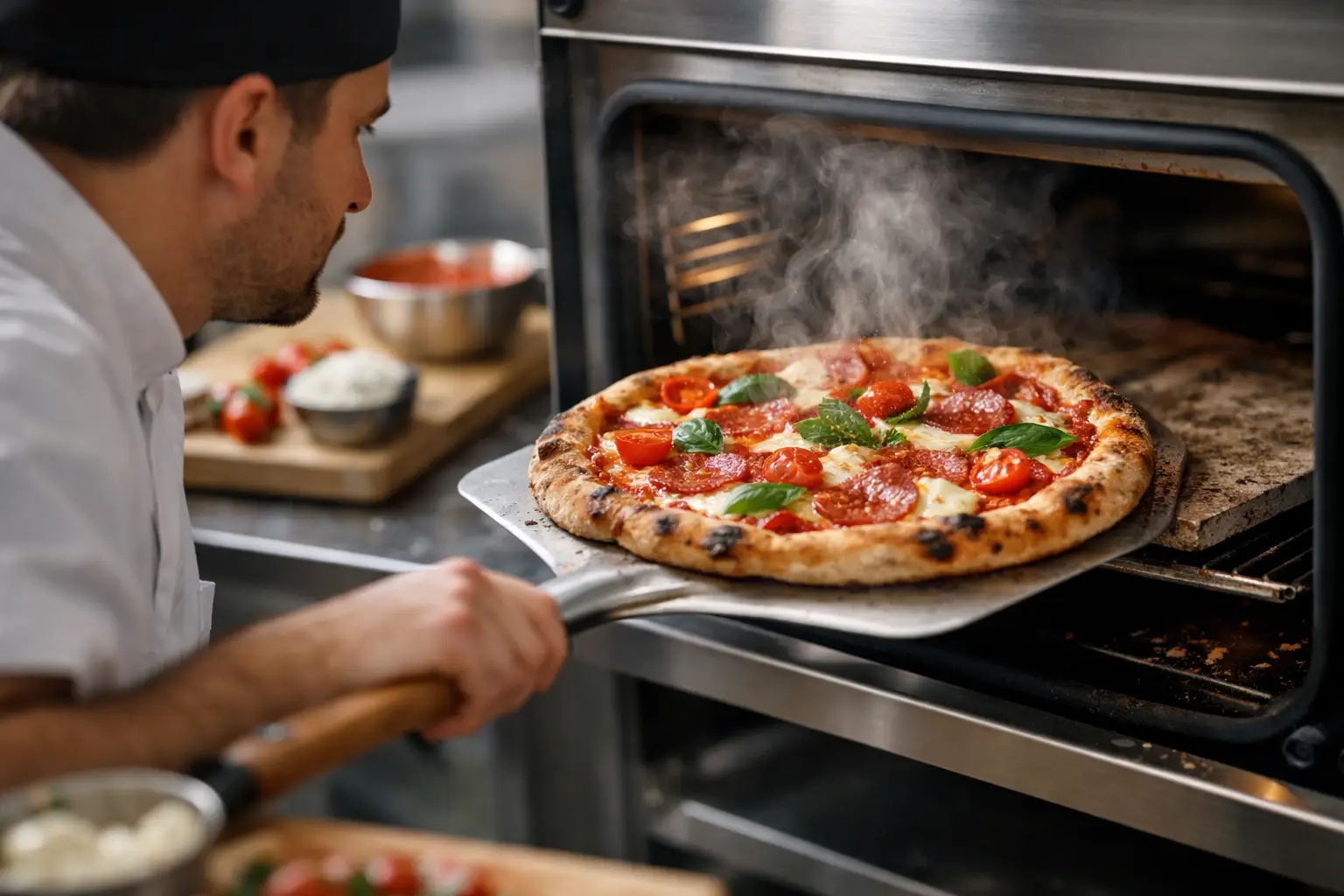
A wet center, pale underside, and slice that folds under its own weight are not solved by simply baking longer. To understand how to prevent soggy pizza, you need to control the relationship between dough, moisture, toppings, and heat. In Neapolitan pizza, this balance is especially demanding: the finished crust should be soft and tender, yet the base must be sufficiently set to support the toppings without becoming damp.
A properly made Neapolitan pizza is not intended to be cracker-crisp. It has a supple cornicione, a delicate center, and a light, evenly baked underside. Sogginess is different from tenderness. It is the result of excess water, inadequate heat transfer, poor timing, or a combination of all three.
Start With a Dough That Can Set Properly
The foundation of a dry, well-baked pizza begins before the dough is mixed. Hydration, fermentation, flour strength, and dough handling all determine how the base behaves in the oven.
Higher-hydration dough can produce an open, light crumb, but it also demands more precision. If the dough is very wet and your oven cannot deliver strong, immediate bottom heat, the center may remain under-set while the rim colors too quickly. For home pizza makers, reducing hydration slightly can be a practical adjustment. The goal is not to make a stiff dough, but to choose a hydration level your oven can bake decisively.
Fermentation matters just as much. Under-fermented dough can be dense and resistant to expansion, while over-fermented dough may become weak, sticky, and difficult to launch cleanly. A weak dough absorbs moisture from sauce and cheese quickly, then tears or compresses under toppings. When the dough has matured properly, it opens with an even structure and bakes into a more stable base.
During shaping, preserve a thinner center but do not stretch it to the point of translucency. An excessively thin center has little margin for error. It can bake beautifully in a properly managed high-temperature oven, but it will struggle under a heavy sauce application or in an oven with insufficient floor heat.
How to Prevent Soggy Pizza With Topping Control
Most soggy pizzas are overloaded before they ever reach the oven. Authentic Neapolitan pizza relies on restraint. Each topping should have a purpose, and every ingredient must earn its moisture.
Use a measured amount of sauce. A 10- to 12-inch pizza does not need a thick layer spread to the edge. Apply sauce in a thin, even spiral, leaving a clear border. The dough should still be visible in places beneath the sauce. Too much sauce creates a wet barrier between the dough and the oven's heat, slowing the set of the center.
Tomato quality and preparation also matter. Canned tomatoes should be crushed by hand or briefly milled, then seasoned simply. Avoid aggressively blending them into a thin liquid. If the tomatoes are unusually watery, drain some of the excess liquid before use. The aim is a sauce with body, not a dry paste.
Fresh mozzarella is one of the most common sources of excess water. Fior di latte should be cut in advance and allowed to drain. If it is packed in liquid, remove it from the container well before service and blot it lightly if needed. Buffalo mozzarella brings more moisture and requires even greater discipline. Use smaller pieces, distribute them sparingly, and expect a softer result unless your oven is exceptionally well managed.
Vegetables need the same consideration. Mushrooms, zucchini, spinach, and fresh tomatoes release water as they cook. Depending on the ingredient and the style of pizza, it may be better to pre-cook, salt and drain, or use a smaller amount. Raw vegetables can work, but only when the pizza has enough heat and time to evaporate their moisture without burning the rim.
Avoid treating pizza as a vehicle for a full salad bar. More toppings mean more water, more insulation, and a slower bake. A disciplined pizza is usually the better pizza.
Build the Right Heat From the Floor Up
A hot oven alone does not guarantee a well-baked pizza. The pizza floor must be properly heated, and it must remain hot enough after repeated bakes. The underside of the pizza sets through direct contact with the baking surface. If that surface is too cool, the top may cook while the center remains damp.
In a traditional Neapolitan oven, the balance between floor temperature and dome heat is central to the craft. Strong radiant heat from above cooks the toppings and cornicione, while the floor provides the energy needed to set and color the base. Too much top heat with too little floor heat creates a pizza that looks finished before it is structurally ready.
For wood-fired cooking, allow the oven floor to fully recharge after managing the fire. A large flame can create impressive visual heat, but it does not automatically mean the floor is ready. Experienced pizzaiolos read the oven through its flame, floor condition, and the way a test pizza responds. Temperature tools are useful, but they do not replace observation.
For home ovens, preheat a baking steel or stone for a generous amount of time. A thin stone may not retain enough energy for consistent results, especially across several pizzas. A steel generally transfers heat more aggressively and can be a strong option for home bakers who struggle with pale, soft bottoms. If your oven has a broiler, use it strategically to improve top heat while keeping the pizza close enough to the preheated surface for bottom color.
Launch Cleanly and Bake Without Delay
Once sauce touches stretched dough, the clock begins. The longer an assembled pizza sits on the peel, the more moisture migrates into the base. A pizza that waits while the oven door is opened, tools are located, or the oven is adjusted is more likely to stick and bake soft.
Prepare your peel, oven, and toppings before shaping. Build the pizza efficiently, check that it moves freely with a gentle shake, then launch it immediately. Use only enough flour or semolina to prevent sticking. Excess bench flour burns on the floor and can leave bitterness on the underside, but too little can cause a delayed launch and a misshapen pizza.
During the bake, turn the pizza as needed to expose each section to the oven's heat. Uneven turning can leave one area pale and soft while another burns. In a high-temperature Neapolitan-style bake, these movements are frequent and deliberate. The goal is even development, not frantic rotation.
If the top is fully cooked but the bottom remains pale, changing the bake time alone may not fix the problem. Longer exposure may dry the cheese or burn the rim before the floor provides enough energy. Instead, improve the preheat, move the pizza lower in the oven if possible, or use a more conductive baking surface.
Recognize the Difference Between a Wet Pizza and a Steam-Softened One
Pizza continues to release steam after it leaves the oven. A pizza placed on a solid plate, cutting board, or closed box can trap that steam beneath the base. The crust may be properly baked at first, then soften within a minute.
Serve pizza immediately when possible. If it must wait, use a wire rack or a perforated surface that allows steam to escape. Do not stack pizzas, and do not cover them tightly. This is particularly relevant for professionals managing service: a good bake can be compromised between oven and table.
Cutting technique also affects the result. A dull wheel drags toppings and compresses the center. Use a sharp pizza wheel or rocker, cut with confidence, and avoid letting a finished pizza sit too long before slicing. With a Neapolitan pizza, some flexibility in the center is normal. What should not be normal is visible liquid pooling on the surface or a base that has turned gummy.
Adjust the Variable That Is Actually Causing the Problem
When a pizza is soggy, diagnose it rather than changing everything at once. If the underside is pale, improve floor heat or reduce the amount of topping. If the underside is colored but the center is wet, examine sauce volume, cheese drainage, and topping moisture. If the base begins well but softens after baking, focus on steam management and service timing.
This methodical approach is more valuable than a single rule about hydration, cheese, or oven temperature. Every oven has limits, and every dough formula responds differently. The craft lies in recognizing which part of the system needs correction.
The next time a pizza comes out soft, resist the urge to bury the lesson under more cheese or more heat. Look at the base, the sauce, the moisture on the cheese, and the behavior of the oven floor. That careful observation is where consistent pizza-making begins.