
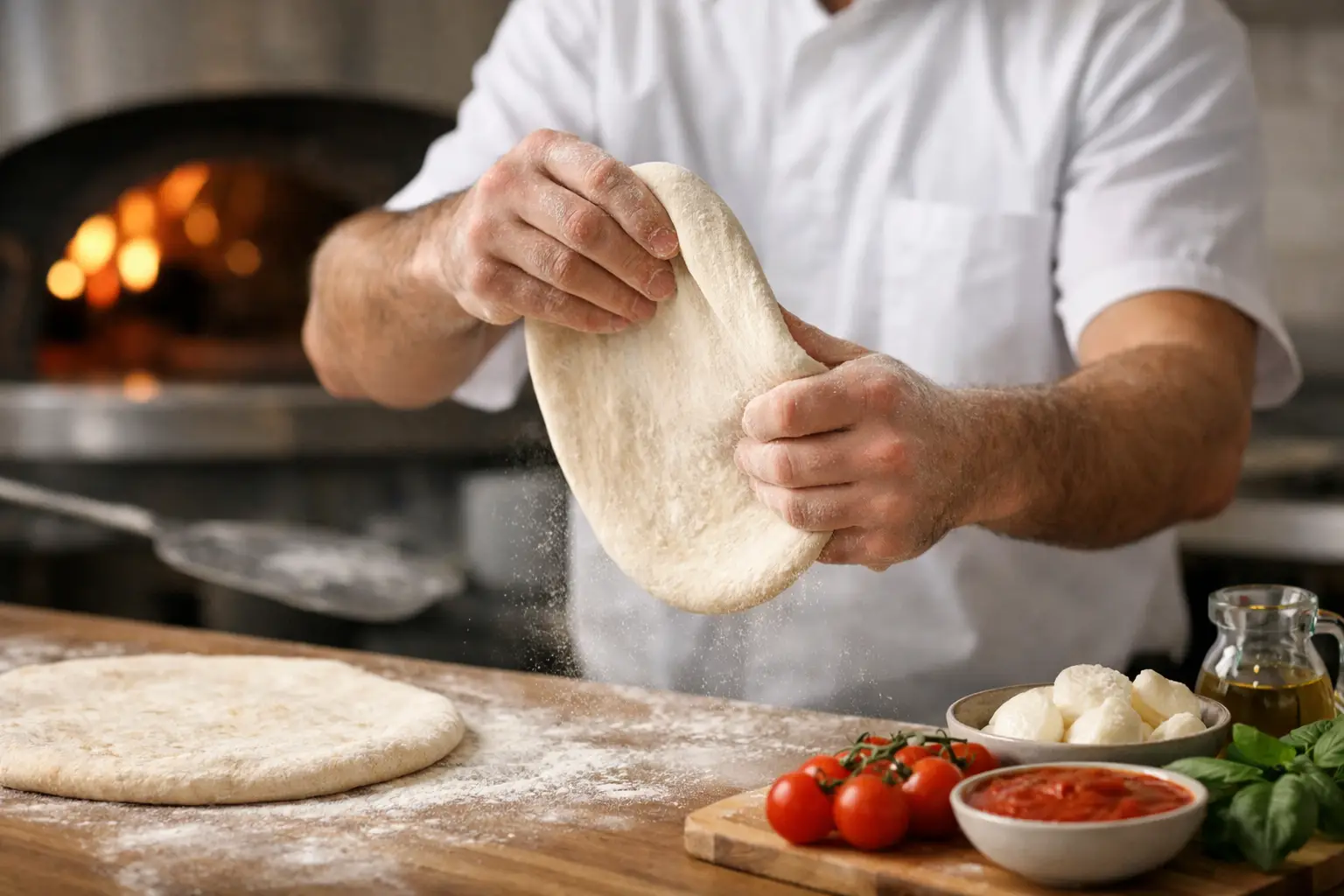
A well-fermented dough can still produce a poor pizza if the shaping is wrong. If you want to learn how to stretch pizza dough properly, the goal is not simply making it larger. The goal is preserving gas, protecting the rim, and opening the dough into a balanced disk that bakes evenly and retains the character built during fermentation.
This is where many home bakers and even experienced cooks go off track. They press too hard, use a rolling pin, force a cold dough ball into shape, or chase a perfect circle before the dough is ready. In Neapolitan pizza making, stretching is not a cosmetic step. It is a technical step that determines rim structure, center thickness, and final bake quality.
What stretching is really doing
When you stretch pizza dough, you are redistributing mass while trying to preserve the internal gas created during fermentation. That gas is especially important at the outer edge, where the cornicione develops. If you flatten the dough aggressively from edge to edge, you push out the very structure that gives the pizza lift and lightness.
A proper stretch also creates contrast. The center should be thin enough to bake quickly, but not so thin that sauce and moisture overwhelm it. The rim should remain slightly fuller because that is where expansion happens in the oven. Good shaping is controlled pressure, not brute force.
Before you stretch pizza dough, check these conditions
Most stretching problems start before your hands ever touch the dough. Dough that resists, snaps back, tears, or feels sticky beyond control usually points to a process issue rather than a shaping issue.
Temperature matters first. Cold dough is tight and elastic. Overly warm dough can feel slack and difficult to manage. For Neapolitan-style work, the dough should be relaxed and alive, not refrigerated-stiff and not collapsing. If your dough came from cold storage, give it enough time to come back to a workable temperature.
Fermentation matters just as much. Underproofed dough fights you and shrinks after every movement. Overproofed dough can spread too easily and lose strength. Neither condition stretches cleanly. The dough ball should feel aerated, soft, and extensible, with enough strength to hold shape.
Flouring is another point of control. Too little flour on the bench and the dough sticks. Too much flour and the dough skates, dries out, and can burn in the oven. Use enough bench flour to prevent sticking, then dust off the excess before topping.
How to stretch pizza dough step by step
Start by turning the dough ball into flour on both sides. Do not bury it. A light coating is enough to keep your hands and bench from grabbing the surface.
Place the dough on the work surface and identify the rim you want to preserve. From there, press the center gently with your fingertips, starting near the middle and working outward, but stop before the outer edge. Leave a visible border around the perimeter. That untouched ring is what will become the cornicione.
As you press, rotate the dough gradually. The point is to move gas outward toward the rim without crushing it out completely. You are opening the center, not flattening the entire round.
Once the disk has widened, lift it and place it across the backs of your hands or knuckles. Let gravity help, but do not let gravity do all the work. Rotate the dough as you move your hands outward slightly, supporting the center so it does not thin too fast in one spot.
If you prefer, you can also finish the opening on the bench by lifting one edge and stretching gently while rotating between movements. Both methods can work. What matters is even expansion and preservation of the edge.
The final shape does not need to be mathematically perfect. In fact, slight irregularity is normal in hand-stretched pizza. What matters is an even center and a defined rim.
Hand position and pressure
The best shaping pressure is lighter than most people expect. Fingertips are used to open the dough initially, but they should not jab or puncture. Once the dough is partially opened, the backs of the hands or knuckles provide broader support than fingertips, which reduces the risk of tearing.
Keep your hands moving. Holding the dough in one place for too long creates thin spots. If one area starts to stretch faster than the rest, rotate away from it and work another section. Think in terms of balance rather than expansion speed.
This is especially important with high-hydration doughs. They can open beautifully, but only if the movement stays controlled. If your hands are rough or rushed, a strong dough can still tear.
Common mistakes when learning how to stretch pizza dough
The rolling pin is the most obvious mistake. It flattens the gas structure and creates a dense, uniform disk that behaves nothing like a properly opened Neapolitan base. You may get a round shape, but you lose the bake quality that the fermentation worked to create.
Another common mistake is pressing the rim. Beginners often chase diameter by flattening the outer edge. The pizza gets bigger, but the cornicione disappears. A pizza with no preserved edge will bake flatter and feel heavier.
Stretching too early is also common. If the dough has not relaxed enough after balling, it will spring back. Bakers often respond by forcing it, which tightens the dough further or causes tearing. Sometimes the correct move is simply to wait ten to twenty minutes.
Then there is the opposite problem: overhandling a ready dough. Every extra pass pushes out gas and weakens structure. Once the dough reaches the size and thickness you need, stop.
Tears usually come from one of three causes: insufficient gluten development, poor fermentation balance, or uneven pressure during shaping. Patching a small tear is possible by pinching it closed gently, but frequent tearing means the process needs attention upstream.
If the dough keeps shrinking back
A shrinking dough is almost always too tight. That can come from underproofing, cold temperature, or not enough resting time after dividing and balling. In this case, do not keep fighting it. Open it slightly, let it rest, then return.
You should also review your mixing and fermentation. Strong flour and short fermentation can create a dough that is structurally sound but stubborn to shape. Extensibility has to be developed, not assumed.
If the dough tears or turns see-through
Transparency in the center is a warning sign. The dough is being stretched unevenly, often because one spot is carrying too much weight. Support the dough more fully with your hands and rotate more often.
If tearing happens repeatedly at the beginning of shaping, the dough may be underdeveloped or overfermented. If it happens at the end, the issue is more often technique. A dough can be excellent and still fail in untrained hands.
Thickness depends on style, but balance is non-negotiable
Not every pizza is opened to the same thickness, and that matters. A Neapolitan pizza should have a soft, thin center with a pronounced rim, but it still needs enough structure to carry toppings without becoming wet and fragile. New bakers often go too thin because they are aiming for visual authenticity rather than bake performance.
The better standard is balance. The stretched dough should suit the hydration, fermentation, topping load, and oven environment. A wood-fired oven with intense heat can handle a very thin center if the dough is opened correctly. A home oven may require slightly more substance to bake cleanly.
This is where serious practice separates itself from guesswork. Stretching is never an isolated trick. It reflects the entire dough process before it.
Practice the same motion, not random correction
Many people improve slowly because they change their method every time a dough behaves differently. A better approach is consistency. Use the same setup, the same pressure pattern, and the same sequence of movements, then evaluate the result against fermentation, temperature, and dough strength.
At Neapolitan Pizza School, this is treated as a repeatable skill rather than a casual kitchen move. That distinction matters. Once you understand what your hands are supposed to preserve, stretching becomes more precise and far less frustrating.
A good pizza round should feel opened, not flattened. If you can keep that standard in mind, your shaping will start serving the dough instead of overpowering it.