
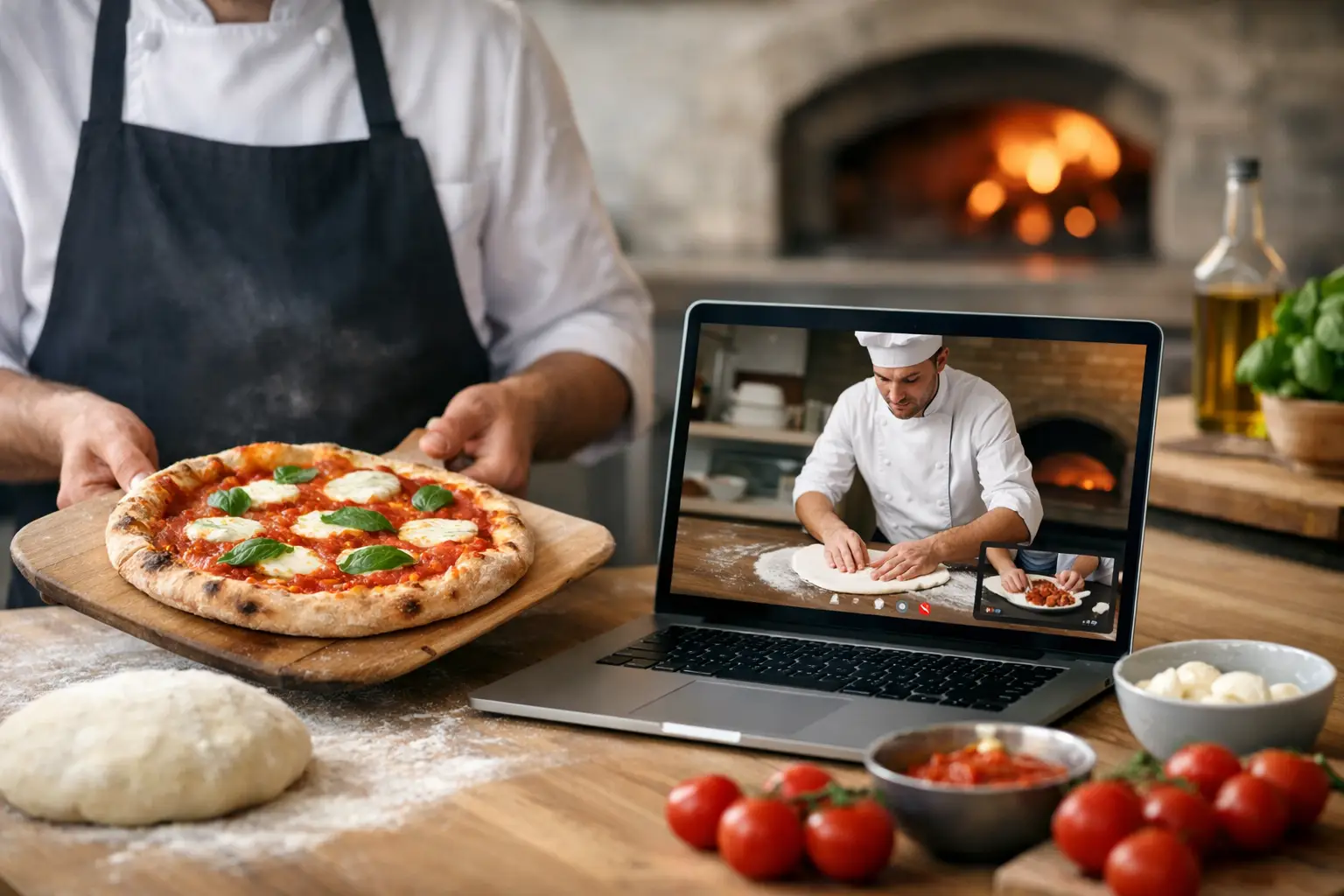
One bad dough session can send people into a spiral. The starter looked active, the flour was right, the fermentation window seemed reasonable, and yet the pizza baked dense, pale, or flat. That is usually the moment a serious learner starts looking for a pizza school online course - not for entertainment, but for answers that hold up batch after batch.
Neapolitan pizza is not difficult because it is trendy. It is difficult because it is disciplined. A few percentage points of hydration, a few degrees in dough temperature, or a small mistake in shaping can change the final bake in a very obvious way. That is why specialized instruction matters. General cooking classes may teach pizza as one topic among many. A focused course teaches the system behind the result.
What a pizza school online course should actually teach
A strong course is not just a set of recipes on video. It should train judgment. Recipes matter, but Neapolitan pizza depends on process control more than memorization. If a course does not explain why dough behaves the way it does, students often end up copying steps without being able to correct mistakes.
The best instruction starts with dough fundamentals - flour selection, hydration, salt, yeast management, and mixing technique. From there, it should move into fermentation planning, because timing is where many students lose consistency. Room temperature, dough temperature, bulk fermentation, balling, and proofing all work together. If a course treats fermentation as a single number instead of a variable process, it leaves out the central challenge of real pizza work.
Shaping also deserves more depth than many people expect. In Neapolitan pizza, shaping is not just about making a circle. It affects gas retention, rim structure, center thickness, and how the pizza bakes under intense heat. A good course teaches hand pressure, edge preservation, and how to avoid degassing the dough. That level of detail separates craft training from casual demonstration.
Then there is topping balance. Authentic Neapolitan pizza is not overloaded. The relationship between dough, tomato, cheese, oil, and basil has to support a fast bake and a balanced finished pie. Students should learn restraint as much as selection. Too much moisture, too much cheese, or poor distribution can ruin even well-fermented dough.
Oven management is the final piece many online learners underestimate. Whether the student is using a wood-fired oven, gas-fired unit, or a home setup designed to simulate high heat, the course should address heat saturation, stone recovery, flame positioning, bake timing, and turning technique. A pizza is not baked by temperature alone. It is baked by heat behavior.
Who benefits most from a pizza school online course
Not every learner needs the same kind of training. That is one reason some people feel disappointed by online education - they enroll in a course that does not match their goal.
For home cooks, the value is often consistency. They may already produce the occasional good pizza, but they cannot repeat it confidently. Their dough may be excellent one weekend and weak the next. A strong online course helps them understand what changed and how to adjust.
For aspiring pizzaiolos, the benefit is structure. Learning from scattered videos can create gaps in technique. One source recommends high hydration, another pushes long cold fermentation, another uses different flour entirely. Without a framework, students collect opinions instead of building skill. A specialized course puts the craft in order.
For restaurant founders and hospitality professionals, the stakes are higher. They are not just trying to make better pizza once. They need a process that can survive volume, staffing, service pressure, and customer expectations. In that context, an online course can be a practical starting point for menu development, dough workflow, and standards training. It will not replace operational experience, but it can prevent expensive early mistakes.
What online learning does well - and where it has limits
A pizza school online course offers obvious advantages. Access is one of them. Students can learn from a specialized institution without relocating or waiting for a rare in-person workshop. That matters for people who live far from dedicated pizza training or need to fit education around work and family.
It also allows repetition. This is not a small benefit. Pizza technique improves when students review mixing, shaping, and baking demonstrations multiple times. In a live class, a key movement can pass in seconds. In an online format, students can stop, replay, compare, and practice with more control.
The other major advantage is pace. A student who struggles with fermentation can spend extra time there before moving on. Someone with dough experience but weak oven management can focus attention where it matters. Good online education supports skill development without forcing every learner through the same rhythm.
Still, there are limits. Online instruction cannot physically correct your hand pressure during shaping or instantly diagnose every dough problem through a screen. It also cannot fully recreate the pace and sensory pressure of a working pizza station. That does not make it less valuable, but it does mean expectations should be realistic. Online training is highly effective when it is treated as disciplined practice, not passive viewing.
How to judge the quality of a pizza school online course
The first thing to look for is specialization. If pizza is one category among dozens, depth is usually limited. Neapolitan pizza has standards, techniques, and baking conditions that deserve focused treatment. Broad culinary content often smooths over the very details serious students need.
Second, look for technical clarity. A course should explain measurements, dough temperatures, timing logic, and bake variables in plain terms. If the instruction relies on vague phrases like "mix until ready" or "proof until good," it leaves too much to guesswork. Serious training gives students objective reference points.
Third, evaluate whether the course teaches cause and effect. This is where expertise shows. If dough tears, spreads, over-colors, or bakes with poor oven spring, the student should come away understanding likely reasons. The goal is not just to follow a formula. The goal is to troubleshoot with confidence.
Fourth, consider whether the course respects tradition without turning it into mythology. Authentic Neapolitan pizza is rooted in established methods, but good instruction explains those methods in a usable way. Tradition should guide technique, not block understanding.
A school such as Neapolitan Pizza School stands out when it treats pizza as a craft discipline rather than a content category. That distinction matters because students seeking real improvement usually need precision, not performance.
Common mistakes people make when choosing a course
Many people choose based on visuals alone. Beautiful pizza can attract attention, but strong results on camera do not guarantee strong teaching. The question is not whether the instructor can make great pizza. The question is whether the instructor can teach someone else to do it consistently.
Another common mistake is shopping only for shortcuts. Some students want a fast formula that works in any kitchen, with any flour, under any condition. Neapolitan pizza does not work that way. There is flexibility within the craft, but not infinite flexibility. If a course promises easy perfection without technical discipline, that promise usually fails in practice.
Price can also distort decision-making. The cheapest option may offer very little depth, while the most expensive one is not automatically the most useful. The better test is whether the course solves real problems. If it helps a learner control fermentation, improve shaping, and bake with more consistency, it delivers value.
What success looks like after the course
A worthwhile pizza school online course should change how you work. You should be better at reading dough before it becomes a problem. You should understand how to adjust fermentation when the room runs warm, how to shape without crushing the rim, and how to manage toppings so the bake stays balanced. You should also know why one pizza succeeded and another did not.
That kind of progress is not flashy, but it is the foundation of every excellent pie. Students often think mastery looks like a dramatic secret. More often, it looks like fewer variables left to chance.
If you are serious about Neapolitan pizza, choose instruction that respects the craft enough to teach it thoroughly. The right course will not make the work easier. It will make the work clearer, and that is what leads to better pizza.