
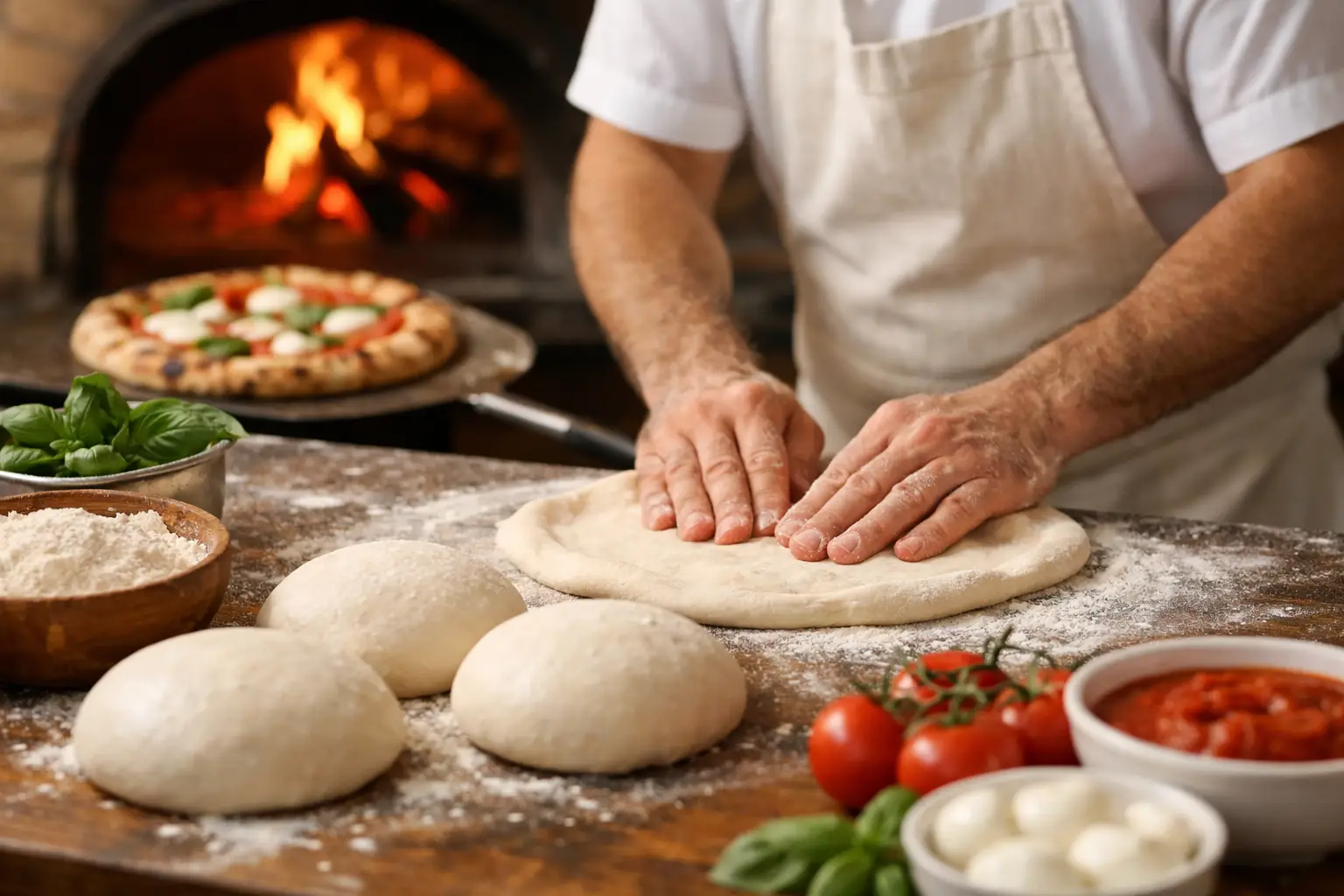
A dough that looks fine in the mixer can still fail on the bench. It can tighten when you shape it, bake up pale, or turn dense and leathery instead of light and tender. That is why a proper neapolitan pizza dough guide has to do more than give you a recipe. It has to explain the decisions behind the dough so you can repeat good results and correct the weak spots.
Neapolitan dough is simple on paper - flour, water, salt, and yeast. What makes it demanding is that each variable affects structure, fermentation, extensibility, and bake performance. When one part is off, the dough usually tells you later, often when service is already underway or guests are already at the table.
What defines Neapolitan pizza dough
Neapolitan pizza dough is built for a specific outcome: a soft, extensible dough that opens by hand, retains gas well, and bakes rapidly into a crust with a tender interior and pronounced rim. It is not a dough designed for crisp, dry crunch or heavy topping loads. If you approach it like a general pizza dough, the balance starts to drift immediately.
The defining quality is restraint. You are not trying to build maximum chew, maximum color, or maximum strength. You are aiming for enough gluten development to hold fermentation, enough extensibility to open the dough without tearing, and enough maturity to produce a light cornicione with clean flavor. That balance is where many formulas go wrong. Stronger is not always better, and more fermentation is not always better either.
A practical neapolitan pizza dough guide to ingredients
Flour is the backbone of the dough, but the right flour depends on your process as much as your target style. For most serious Neapolitan work, a finely milled wheat flour with moderate to strong performance is preferred. If the flour is too weak, the dough may spread excessively, lose gas, and become difficult to handle after fermentation. If it is too strong, the dough can resist opening and eat tougher than it should.
Water matters beyond hydration percentage. Temperature affects final dough temperature, and final dough temperature strongly influences fermentation speed. If your dough is finishing warm, especially in a hot kitchen, the same formula can behave very differently from one batch to the next.
Salt strengthens the dough, regulates fermentation, and sharpens flavor. Reducing salt to speed fermentation is usually a poor trade. You may get a more active dough, but often at the cost of control and overall balance.
Yeast should be treated as a timing tool, not a shortcut. More yeast can make dough rise faster, but rapid expansion is not the same as proper maturation. Well-made Neapolitan dough needs time to develop handling qualities and flavor, not just volume.
Hydration, dough temperature, and mixing
Hydration is one of the most discussed parts of any dough formula, but it only makes sense in context. A 62 percent dough with one flour may feel manageable, while the same percentage with another flour may feel loose and difficult. For many Neapolitan doughs, a moderate hydration range offers the best control, especially for students still learning to read fermentation and shaping.
Higher hydration can improve softness and oven spring, but it narrows your margin for error. The dough becomes less forgiving during balling, bench fermentation, and opening. If your oven setup is modest or your shaping is still inconsistent, pushing hydration too far can create more problems than benefits.
Mixing should develop the dough to a smooth, cohesive state without overworking it. Overmixed dough tends to heat up and tighten. Undermixed dough lacks structure and may tear during opening. The target is a dough that feels organized and elastic, not overly stiff. This is where final dough temperature deserves more attention than it usually gets. If you ignore temperature, your fermentation schedule becomes guesswork.
Fermentation is where most dough quality is won or lost
A strong formula can still produce weak pizza if fermentation is mishandled. Neapolitan dough depends on controlled fermentation to create extensibility, gas retention, and digestibility. That control comes from the relationship between yeast quantity, dough temperature, room temperature, and time.
Bulk fermentation and ball fermentation each shape the final dough differently. A short bulk followed by properly timed ball fermentation often gives the dough a cleaner, more workable structure. But there is no single mandatory schedule. It depends on your flour strength, your environment, and whether you are producing for home baking, class instruction, or commercial service.
The common mistake is reading dough only by the clock. Dough does not care what the recipe promised. It responds to temperature and handling. A dough ball that is fully proofed should feel light, relaxed, and aerated without collapsing into a puddle. If it is tight and dense, it likely needs more time. If it is very gassy and fragile, it may be overproofed or too warm.
Cold fermentation can be useful, especially for scheduling, but it is not automatically superior. Refrigeration slows activity and can support flavor development, yet it also introduces another stage that must be managed carefully. If the dough is not given enough time to recover before opening, it may feel tight and resist stretching. If it warms too long, it may overshoot the ideal point.
Balling and bench management
A well-made dough can be weakened by careless balling. The goal is to create surface tension without degassing the dough excessively or tearing the outer layer. A clean, rounded dough ball ferments more evenly and opens more predictably.
Bench management is where professional discipline shows. Dough balls need enough space, proper coverage, and a stable environment. Dry skin on the surface creates weak spots and tearing. Excess flour in the tray can alter the outer layer. Temperature swings can push one tray into readiness while another lags behind.
Consistency here matters because shaping quality starts long before your hands touch the dough disk. When students struggle with opening, the issue is often not shaping technique alone. It is a dough management problem that began hours earlier.
Shaping without destroying the rim
Neapolitan dough is opened by hand because the gas structure matters. A rolling pin flattens the rim and forces out the air you spent hours building. The center should be pressed deliberately while the outer edge is preserved. That preserved edge becomes the cornicione in the oven.
If the dough snaps back aggressively, the problem is usually under-fermentation, excessive strength, or insufficient relaxation time. If it tears, the issue may be weak gluten development, overproofing, or rough handling. If it sticks constantly, hydration may be too high for your current skill level or your bench flour strategy may be poor.
This is where technique and dough condition meet. Good shaping cannot rescue immature dough, and a well-fermented dough can still be mishandled. You need both.
Baking: the dough is designed for heat
Neapolitan dough is meant to meet intense heat and bake quickly. In that environment, proper fermentation and shaping produce rapid oven spring, leopard spotting, a soft interior, and a balanced bake across the rim and center. When baked too cool or too long, the same dough can dry out before it fully expands.
That does not mean quality is impossible outside a professional pizza oven. It means your dough and bake strategy must align. If your oven runs cooler, you may need to think carefully about dough weight, topping load, and bake surface. A dough designed for a 90-second bake may not behave at its best in a much longer one.
This is one reason serious instruction matters. Authentic technique is not only about ingredients. It is about matching dough design to the realities of fermentation, shaping, and oven performance.
Common faults and what they usually mean
When the crust bakes dense, fermentation is often incomplete or the dough was degassed during shaping. When the pizza turns out pale, the issue can be under-fermentation, flour choice, or an oven lacking sufficient top heat. When the dough feels slack and hard to launch, it may be overproofed or simply too warm.
Gumminess in the center is not always a dough problem. It can come from overloading the pizza, especially with wet mozzarella or excessive sauce. Neapolitan pizza depends on balance. The dough, toppings, and bake must support one another.
A blistered rim with poor interior structure can also mislead people. Surface color does not prove the dough is right. A pizza can look dramatic and still eat poorly.
Why discipline matters more than tricks
There are no secret ingredients carrying great Neapolitan dough. The real difference comes from process control and repetition. Weighing precisely, tracking dough temperature, adjusting yeast to the environment, and learning to judge fermentation by feel are not glamorous steps, but they are the foundation.
That is why serious students progress faster when they stop chasing hacks and start building a consistent system. In a focused training environment like Neapolitan Pizza School, the value is not just being shown a formula. It is learning how to interpret the dough from mix to bake and make informed adjustments instead of random ones.
If you want better Neapolitan pizza, start treating dough as a craft material rather than a recipe card. Once you can read its structure, timing, and limits, your results stop feeling lucky.