
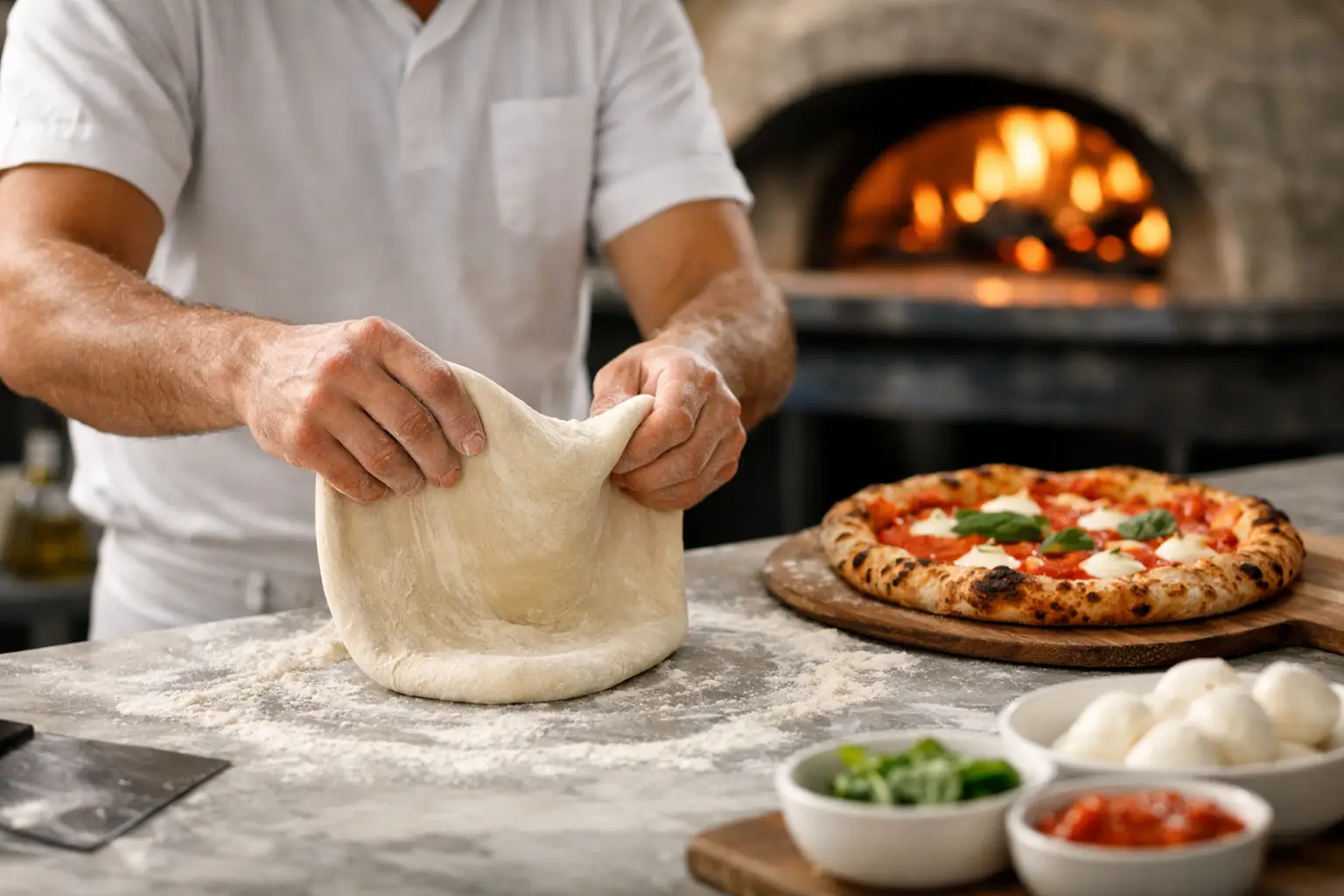
A dough that looks right in the bowl can still fail on the bench. It may resist opening, tear at the rim, or bake dense and pale instead of light, tender, and well structured. That is why neapolitan pizza dough technique matters so much. In this style, dough is not just an ingredient. It is the central system that determines how the pizza handles, ferments, opens, and bakes.
Neapolitan pizza rewards precision, but it does not reward overcomplication. The method is built on a few essential controls - flour choice, hydration, mixing, temperature, fermentation, and handling. If even one of those variables drifts too far, the final pizza begins to move away from the standard that defines the style.
What the neapolitan pizza dough technique is really trying to achieve
The goal is not simply to make dough that rises. The goal is to produce a dough with enough strength to retain gas, enough extensibility to open by hand, and enough maturity to bake quickly in intense heat without becoming tough. That balance is the core challenge.
Authentic Neapolitan dough is lean. It is typically made with flour, water, salt, and yeast, with no oil or sugar in the mix. This matters because the style depends on fermentation and flour quality rather than enrichments. The finished crust should have a soft interior, a developed but delicate cornicione, and light charring from a fast bake. If the dough is mixed too aggressively, under-fermented, or over-proofed, those qualities become harder to achieve.
For serious students, this is the first shift in thinking: dough is not a fixed recipe. It is a managed fermentation process.
Start with flour that fits the style
Flour choice sets the boundaries of your dough. A flour milled for high-temperature pizza baking gives you a better chance of reaching the proper balance of strength and tenderness. In most cases, a finely milled Italian-style "00" flour with appropriate protein strength is preferred, but even within that category, performance varies.
A weaker flour may open easily but struggle during a long fermentation. A stronger flour may tolerate longer proofing but feel tight if your timing or temperatures are off. This is where many bakers get confused. They assume one flour is universally better, when the better flour is actually the one that matches your fermentation schedule, room temperature, and baking conditions.
If you are baking in a true high-heat pizza oven, a flour designed for that environment is usually the right starting point. If you are working with a lower-temperature home setup, the ideal dough profile may shift slightly because your bake is longer and your crust development changes with it.
Mixing: develop the dough, do not overwork it
In Neapolitan production, mixing is about organization, not maximum strength. You want a dough that is cohesive, smooth, and moderately developed, but not one beaten into stiffness. Excessive mechanical mixing raises dough temperature and can over-tighten the gluten network, making later handling more difficult.
Water absorption should be controlled rather than forced. Many bakers chase hydration numbers before they can manage the basics. Higher hydration can improve openness and softness, but only if the flour, mixer, and handling technique support it. Otherwise, it creates stickiness without structure.
A disciplined approach works better. Dissolve the salt properly, incorporate the flour evenly, and mix until the dough is smooth and elastic with a clean finish. Then stop. If the dough is already warming too much in the mixer, your process needs adjustment. Dough temperature after mixing has a direct effect on fermentation speed, and that changes everything that follows.
Fermentation is where technique becomes visible
A proper neapolitan pizza dough technique depends on fermentation that is active but controlled. This is where time, yeast quantity, and dough temperature work together. There is no single schedule that fits every kitchen because ambient conditions differ. What matters is reading the dough correctly and building a process that stays consistent.
Bulk fermentation begins the maturation of the dough mass. During this stage, the dough relaxes, develops flavor, and begins gas retention. After that, dividing and balling create the individual units that will proof and later be opened. Each phase has a purpose. If you shorten bulk too much, the dough may feel immature and elastic. If you overextend the final proof, the dough balls may spread, weaken, and lose their ability to hold a proper rim.
This is why experienced pizzaiolos pay close attention to the relationship between time and temperature. A dough fermented for eight hours in a warm room does not behave like a dough fermented for twenty-four hours under cooler control. Neither is automatically correct or incorrect. The right method depends on your workflow and the result you need.
Balling and bench management
Dividing and balling are not minor steps. Poorly formed dough balls create inconsistent tension, which leads to uneven opening and irregular oven spring. A proper dough ball should be smooth, closed underneath, and organized enough to hold shape during proofing without becoming tight.
Bench management matters just as much. If dough balls sit uncovered, the skin dries and opening becomes difficult. If they are packed too tightly in proofing boxes, they can stick or deform. If they are used too cold, they resist stretching. If they are over-warm, they can become sticky and fragile.
This stage teaches patience. Many dough problems blamed on mixing are actually proofing and handling problems. The dough ball must be mature enough to open with minimal resistance while still carrying enough internal pressure to form a light edge in the oven.
Opening by hand is part of the technique, not just presentation
A true Neapolitan base is not rolled. It is opened by hand to preserve the gas structure in the rim and guide the thickness of the center. This is a technical move, not a romantic one. Rolling pins flatten the dough too aggressively and push out the gas needed for a proper cornicione.
When opening, the aim is to press from the center outward while leaving the edge intact. The center should become thin and even, but not weak. If the dough snaps back, it is either under-proofed or too strong for the stage it is in. If it collapses or tears easily, it may be over-proofed or lacking structure.
A skilled baker can read a lot from this moment. The way a dough opens tells you whether the earlier stages were managed well. Shaping is where fermentation quality becomes visible to the hands.
Topping balance affects the dough outcome
Dough technique does not end when the base is shaped. Neapolitan pizza relies on restraint in topping. Too much sauce, excess mozzarella moisture, or overloaded ingredients can compromise the bake and leave the center wet. Then the dough is judged unfairly for a problem created on top of it.
The classic standard works because it respects the dough. A restrained amount of tomato, properly drained cheese, and balanced distribution allow the crust to bake quickly while preserving softness and structure. When bakers struggle with a gummy center, the issue is often not just fermentation or shaping. It is the full interaction between dough, topping load, and oven heat.
Oven management completes the process
The dough can be excellent and still bake poorly in an unstable oven. Neapolitan pizza requires intense top and bottom heat, but balance is critical. Too much floor heat can burn the underside before the rim develops. Too much top heat can char the crust while leaving the base underdone.
This is where technical discipline separates serious practice from guesswork. The deck temperature, dome heat, launch timing, turning rhythm, and recovery between pizzas all matter. A properly fermented dough responds beautifully in a hot oven, but only if the oven environment supports the style.
Home bakers should recognize the trade-off here. If your oven cannot reproduce a traditional Neapolitan bake, you can still improve dramatically with sound dough management, but the final texture may differ. That is not failure. It is simply a technical limit of the equipment.
The most common mistakes in neapolitan pizza dough technique
Most problems come from imbalance, not from one dramatic error. Too much yeast for the room temperature, dough mixed too warm, proofing that runs too long, flour that does not match the schedule, or handling that degasses the rim - each of these can pull the final pizza away from the style.
Another common mistake is chasing advanced variables before controlling the basic ones. Bakers often focus on hydration percentages, preferments, or extended cold fermentation before they can consistently manage dough temperature and proof maturity. Precision starts with repeatability. Once your process is stable, refinement becomes meaningful.
For students who want real progress, a notebook is often more useful than a new ingredient. Record flour, water temperature, room temperature, mix time, dough temperature, proof duration, and bake behavior. That discipline is central to serious pizza education, and it is one reason a focused training environment like Neapolitan Pizza School can accelerate improvement.
The best closing thought is this: treat the dough as a living process, not a formula to memorize. When you learn to read strength, temperature, fermentation, and timing together, Neapolitan pizza stops feeling unpredictable and starts becoming intentional.