
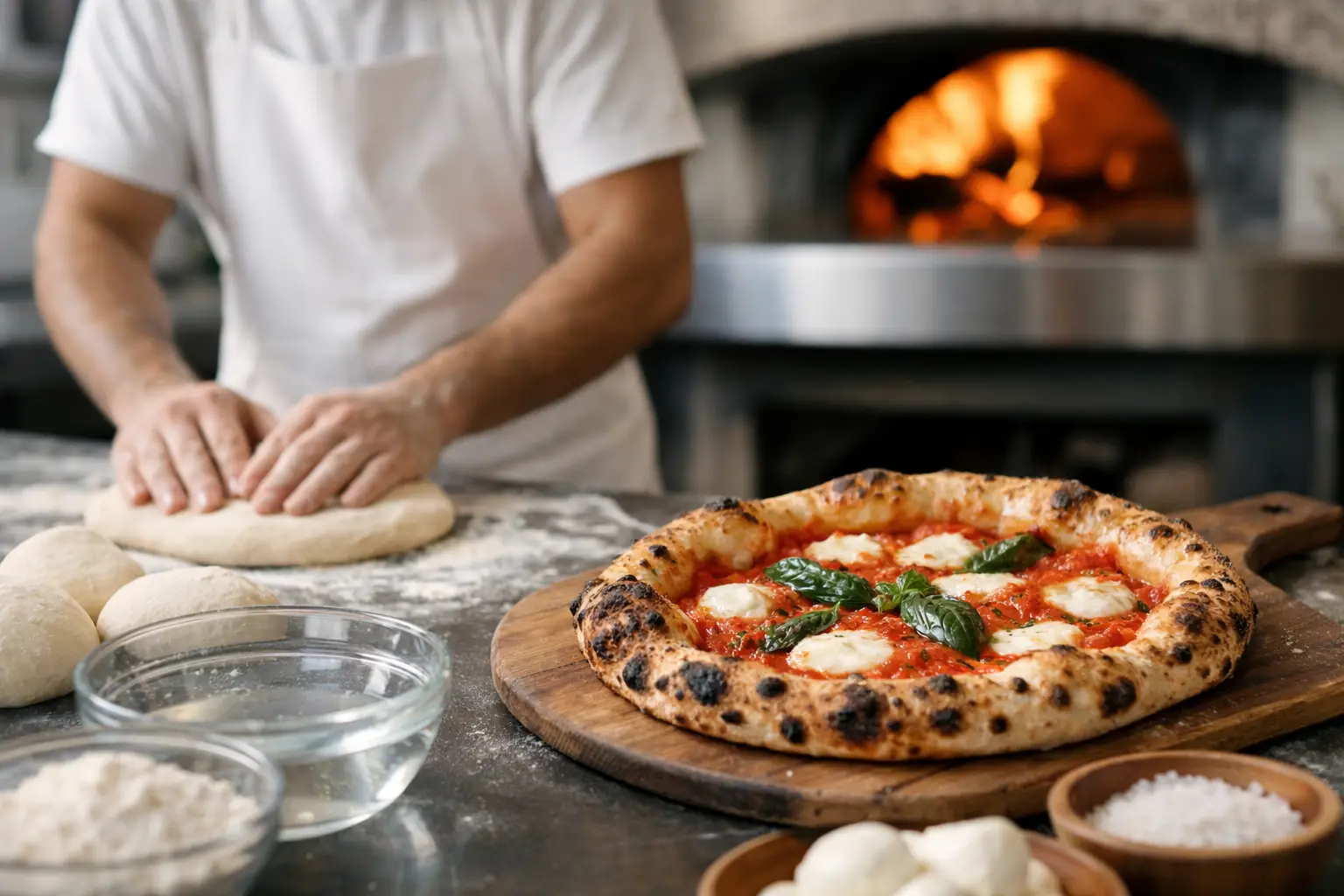
A dough at 60% hydration and a dough at 70% hydration may use the same flour, salt, and yeast, yet they behave like two different systems on the bench. That is why neapolitan pizza hydration percentage matters so much. It influences mixing, fermentation speed, extensibility, gas retention, shaping tolerance, and the final balance between a tender interior and a properly baked crust.
For serious Neapolitan pizza makers, hydration is not a trend metric or a social media flex. It is a control point. When students struggle with sticky dough, weak structure, dense cornicione, or a base that bakes too pale under the center, hydration is often involved. Not always alone, but almost always in the conversation.
What neapolitan pizza hydration percentage actually means
Hydration percentage is simply the weight of water compared to the weight of flour. If you use 1,000 grams of flour and 620 grams of water, the dough is 62% hydration. That number sounds basic, but it has major practical consequences.
In Neapolitan pizza, hydration is not chosen in isolation. It works together with flour strength, room temperature, fermentation schedule, dough ball weight, proofing conditions, and oven performance. A hydration level that produces excellent results in one setup may create avoidable problems in another.
This is where many pizza makers get misled. They hear that higher hydration means lighter pizza, then push water upward without adjusting anything else. The result is often a dough that becomes harder to manage, not better.
The typical hydration range for Neapolitan dough
Most Neapolitan-style doughs fall somewhere around 58% to 65% hydration, with many professionals working comfortably in the low 60s. That range is broad enough to allow adaptation, but narrow enough to reflect the style's structural needs.
A dough around 58% to 60% is usually firmer, easier to handle, and more forgiving during shaping. It can be a smart choice for newer pizza makers, warmer kitchens, or operations where consistency matters more than pushing maximum openness in the rim.
A dough around 61% to 63% often gives a strong balance. It can provide enough softness and extensibility for a well-developed cornicione while still remaining manageable for skilled hands. For many practitioners, this is the practical center of the range.
Once you move toward 64% to 65% and beyond, the dough generally becomes softer, stickier, and more dependent on precision. That does not make it wrong. It simply means the margin for error gets smaller. Flour selection, mixing quality, fermentation control, and oven readiness all need to be in order.
How hydration changes the dough in practice
Water does more than moisten flour. It activates gluten formation, supports enzymatic activity, affects dough temperature, and influences how the dough retains gas during fermentation. More water usually increases extensibility, but if the dough is not developed correctly, that same water can make it feel slack and unstable.
In practical terms, higher hydration tends to produce a softer dough with greater openness in the rim and a more delicate eating texture. It can also improve oven spring when the dough has sufficient strength. But there are trade-offs. A wetter dough is easier to degas during handling, more likely to stick during opening, and less forgiving if fermentation runs long.
Lower hydration tends to create a dough with more immediate structure and cleaner handling. It is often easier to ball, easier to open, and easier to launch. The trade-off is that it can feel tighter, especially if the flour is strong or the dough is under-fermented. In the finished pizza, that may limit the volume and softness many makers want from a classic Neapolitan rim.
Neapolitan pizza hydration percentage and flour strength
Hydration only makes sense when matched to flour. A weak flour generally cannot absorb and organize water the same way a stronger flour can. If you push hydration too high with flour that lacks sufficient strength, the dough may spread excessively, lose shape, or become difficult to handle even before it reaches full fermentation.
With stronger flour, you can often support slightly higher hydration, especially if your process includes longer fermentation. But stronger flour also changes the feel of the dough. If not matured properly, it can create resistance during opening, even at a hydration percentage that looks generous on paper.
This is why copying someone else's formula rarely works perfectly. Their flour, storage conditions, water temperature, and fermentation timeline may differ from yours in ways that make the same hydration percentage behave differently.
Fermentation changes how hydration feels
A 62% dough mixed in the morning for same-day service does not handle like a 62% dough fermented over a longer schedule. As fermentation progresses, gluten relaxes, gas accumulates, and the dough becomes more extensible. That means hydration is experienced through time, not just measured at the mixer.
If your dough regularly feels too wet late in the process, the problem may not be that hydration is objectively too high. It may be that fermentation is running too far for your room temperature and yeast level. On the other hand, if the dough feels dry and tight, hydration may be too low, or fermentation may be underdeveloped.
Well-trained pizza makers read these factors together. They do not diagnose every issue by changing one number.
Choosing the right hydration for your setup
The right target depends on what kind of control you have. A home pizza maker in a warm kitchen, working with limited dough management experience, may get better results at 60% to 61% than at 65%. A professional with controlled temperatures, appropriate flour, and strong bench skills may prefer a slightly wetter dough.
Your oven matters too. In a properly heated pizza oven, a dough with balanced hydration can expand quickly and set with a soft but structured crust. If the oven floor is underpowered or the top heat is lacking, a wetter dough may struggle to bake cleanly before the structure weakens. That often shows up as gumminess near the center or excessive softness under the toppings.
Topping load also matters. Neapolitan pizza depends on restraint. A dough that handles beautifully on its own can collapse under too much sauce, cheese, or moisture-heavy garnish. Higher hydration leaves less room for excess weight on top.
Common mistakes when adjusting hydration
One common mistake is adding flour during opening because the dough feels sticky, then assuming the original hydration was the problem. Excess bench flour can change the exterior behavior of the dough, affect browning, and create a dusty or bitter finish. Stickiness may come from over-fermentation, weak gluten development, or poor handling technique rather than water percentage alone.
Another mistake is increasing hydration without improving the mix. More water requires stronger process control. If the dough is under-mixed, its structure may never organize well enough to hold the added water. The maker then interprets the result as high hydration being advanced or superior, when in reality the dough was simply underdeveloped.
Temperature management is another overlooked issue. Dough temperature after mixing has a direct effect on fermentation pace. If your final dough temperature is too warm, a moderate hydration dough can behave like an overly wet one by the time service begins.
A practical way to test neapolitan pizza hydration percentage
If you want to improve consistency, change hydration in small increments. Move by 1% at a time and keep everything else as stable as possible. Use the same flour, same mixing method, same dough ball weight, same fermentation timing, and same oven conditions.
Then evaluate the full process, not just the baked crust. Ask how the dough felt during mixing, balling, opening, topping, launching, and baking. A hydration percentage is only useful if it supports the entire workflow.
For many pizza makers, the ideal number is not the highest one they can physically manage. It is the one that gives repeatable quality under real conditions. That distinction matters, especially in professional settings where speed and consistency are part of craftsmanship.
What students should aim to understand
Hydration is one of the clearest examples of why Neapolitan pizza requires technique rather than approximation. There is no single best percentage that guarantees authenticity or quality. There is a working range, and within that range, the correct choice depends on flour, fermentation, temperature, and execution.
At Neapolitan Pizza School, this is exactly the kind of variable we teach students to interpret rather than memorize. The goal is not to chase a fashionable number. The goal is to understand what the dough is telling you and make informed decisions before inconsistency becomes a habit.
If your dough has been unpredictable, do not start by asking what hydration percentage everyone else uses. Start by asking what your process can actually support. That question usually leads to better pizza.