
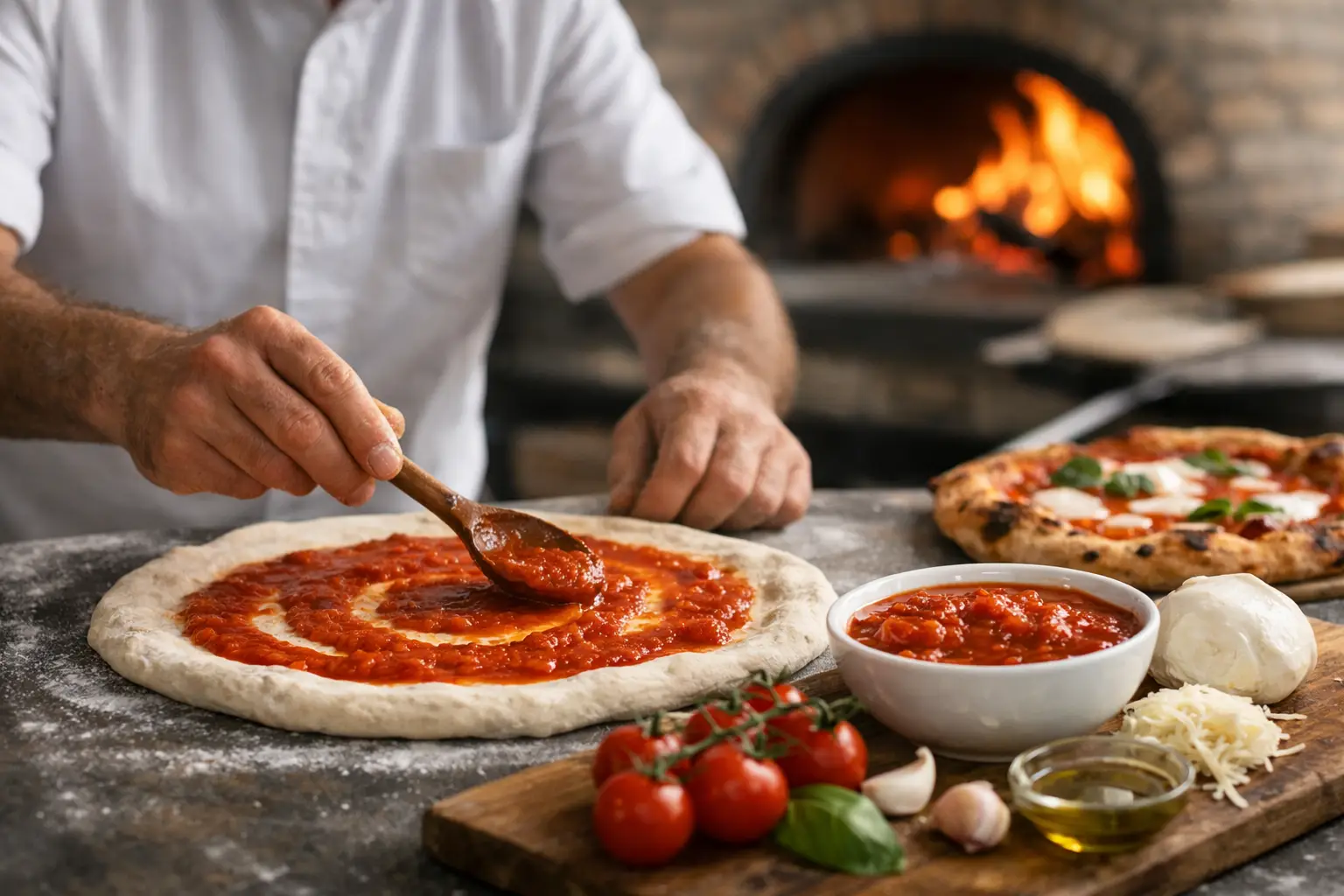
A properly made Neapolitan pizza sauce should not announce itself before the dough, cheese, and blistered cornicione have a chance to speak. It should taste vividly of tomato, carry enough salt to support the pie, and remain light enough to bake in less than 90 seconds without flooding the center.
That restraint is often misunderstood as simplicity without skill. In fact, sauce is one of the clearest tests of a pizzaiolo's judgment. Too much processing, seasoning, or moisture can turn a well-fermented dough into a heavy, wet pizza. The goal is not to make the most elaborate tomato sauce. The goal is to make the tomato perform correctly in a very hot oven.
What Neapolitan Pizza Sauce Is Designed to Do
Neapolitan pizza is built around balance. The dough provides structure, aroma, and a tender chew. Fresh mozzarella contributes richness and moisture. The oven creates char, lift, and rapid caramelization. The sauce has a specific role within that system: it provides acidity, sweetness, color, and freshness without adding excess water or weight.
This is why a traditional sauce for a Margherita is usually uncooked. It is not a reduced pasta sauce applied to pizza. There is no need to build a base with sauteed garlic, onions, dried herbs, sugar, tomato paste, or a long simmer. Those techniques can make sense for other pizza styles, especially where the bake is longer and the crust is firmer. They work against the character of a Neapolitan pie.
In a wood-fired oven approaching 800 to 900 F, the tomato changes quickly. Its water begins to evaporate, its natural sugars concentrate, and its raw brightness settles into the fat from the cheese and olive oil. Start with a sauce that is already sweet, thick, and heavily seasoned, and the finished pizza can taste dull, salty, or jam-like.
Start With Tomatoes Worth Leaving Alone
The shortest ingredient list demands better ingredients. Canned whole peeled tomatoes are generally the most reliable starting point because they are processed at peak ripeness and retain a fuller tomato character than many pre-crushed products.
Look for tomatoes with a clean aroma, balanced sweetness, and enough natural acidity to remain lively after baking. They should be red without looking artificially thick or overly watery. Whole peeled tomatoes packed in tomato juice or puree are both common, but the liquid in the can should be evaluated rather than automatically added. Some cans contain a light, flavorful juice. Others carry enough loose water to make the sauce difficult to control.
San Marzano tomatoes are often associated with Neapolitan pizza, and quality examples can be excellent. But the name on the label is not a guarantee of performance. A protected designation, when legitimately used, identifies origin and production standards, not whether a particular can suits your oven, mozzarella, dough formula, and service conditions. Taste every product you use. The best tomato is the one that gives you a balanced pizza consistently.
Avoid treating low-quality tomatoes as a problem that can be fixed with sugar and herbs. Sugar may soften sharp acidity, but it also changes how the sauce browns in a high-heat bake. If the tomatoes need substantial correction before they reach the pizza, select a different product.
Whole, crushed, or milled?
For most Neapolitan applications, whole peeled tomatoes crushed by hand are the most useful format. Hand-crushing breaks the tomato down while preserving a slightly irregular texture. That texture matters: it allows the sauce to spread easily without becoming a thin liquid that runs into the center of the pie.
A food mill is also appropriate when you want a more uniform sauce, particularly in a professional setting where consistency across service matters. A blender requires more caution. High-speed blending can create an overly smooth, airy puree and release more liquid from the tomato. If a blender is used, pulse briefly rather than processing the tomatoes into foam.
The right texture depends partly on the tomato itself. Meaty fruit may need a little more crushing. Softer tomatoes may need only a gentle break-up and some draining. Sauce texture should be judged by how it spreads on stretched dough, not by whether it resembles a familiar jarred sauce.
Seasoning Is a Matter of Discipline
For a classic Margherita-style application, tomatoes and salt are the foundation. A practical starting point is 8 to 10 grams of fine sea salt per kilogram of crushed tomatoes, then adjust based on the natural salinity and acidity of the product. Mix, taste, and allow the sauce to sit for several minutes before making a final decision. Salt needs time to dissolve and integrate.
Fresh basil and extra-virgin olive oil belong naturally on the pizza, but their placement is part of the composition. Basil is often added as leaves rather than blended into the sauce. Olive oil is usually applied sparingly over the topped pizza. This keeps both ingredients aromatic instead of burying them in the tomato.
Garlic and oregano have a legitimate place on a pizza marinara, where they are defining elements of the topping. That does not mean every Neapolitan pizza sauce should contain them. A sauce should serve the pizza being made. The discipline is not about refusing flavor. It is about using each flavor where it belongs.
Control Moisture Before It Controls the Pizza
A wet center is not always a dough problem. It may be a sauce problem, a mozzarella problem, an application problem, or a combination of all three.
Before service, assess the tomatoes for free liquid. If the can is especially loose, crush the tomatoes in a bowl and hold back some of the packing liquid. You can always add it back if the sauce feels too dense. If the sauce separates while resting, stir it before each use. Separation is normal with minimally processed tomatoes; ignoring it is what creates inconsistent pizzas.
Portioning matters as much as recipe development. For an 11- to 12-inch Neapolitan pizza, roughly 70 to 80 grams of sauce is a reliable starting range. The correct amount depends on the dough size, the hydration of the mozzarella, and the temperature and behavior of the oven. A pie topped with high-moisture fresh mozzarella may need less sauce than one using a drier cheese.
Spread the sauce from the center outward in a controlled spiral, leaving a clear rim. Do not press aggressively into the dough, and do not create a thick pool in the middle. The sauce should be an even, thin layer with a little variation in texture, not a blanket that hides the dough beneath it.
Let the Oven Finish the Sauce
The final quality of Neapolitan pizza sauce cannot be judged from the mixing bowl alone. It must be evaluated after baking. A sauce that tastes slightly sharp when raw may become perfectly balanced once it meets heat, cheese, and olive oil. Conversely, a sauce that seems pleasant on a spoon may become too sweet or too salty after a fast bake.
Train yourself to diagnose the finished pie. If the center is soupy, reduce the sauce portion, assess the cheese moisture, or hold back more tomato liquid. If the pizza tastes flat, first consider whether the tomatoes lack character before adding more seasoning. If the sauce tastes harsh, examine the tomato quality and salt level, then consider whether the pizza is receiving an even bake.
This is also where repetition becomes valuable. Change one variable at a time: tomato brand, salt percentage, crushing method, sauce weight, or mozzarella drainage. When several variables change at once, it is difficult to identify the reason a pizza improved or failed.
The Standard Is Balance, Not Decoration
A Neapolitan sauce should show confidence in the tomato and respect for the pizza as a whole. It is not meant to be a signature flourish that overwhelms the dough or distracts from the bake. Its best version is fresh, lightly seasoned, properly textured, and applied with precision.
For the serious pizzaiolo, that makes sauce work worth practicing. Taste it raw, observe it in the oven, and judge it only when the pizza reaches the table. The next better pie may come not from adding another ingredient, but from having the discipline to leave one out.