
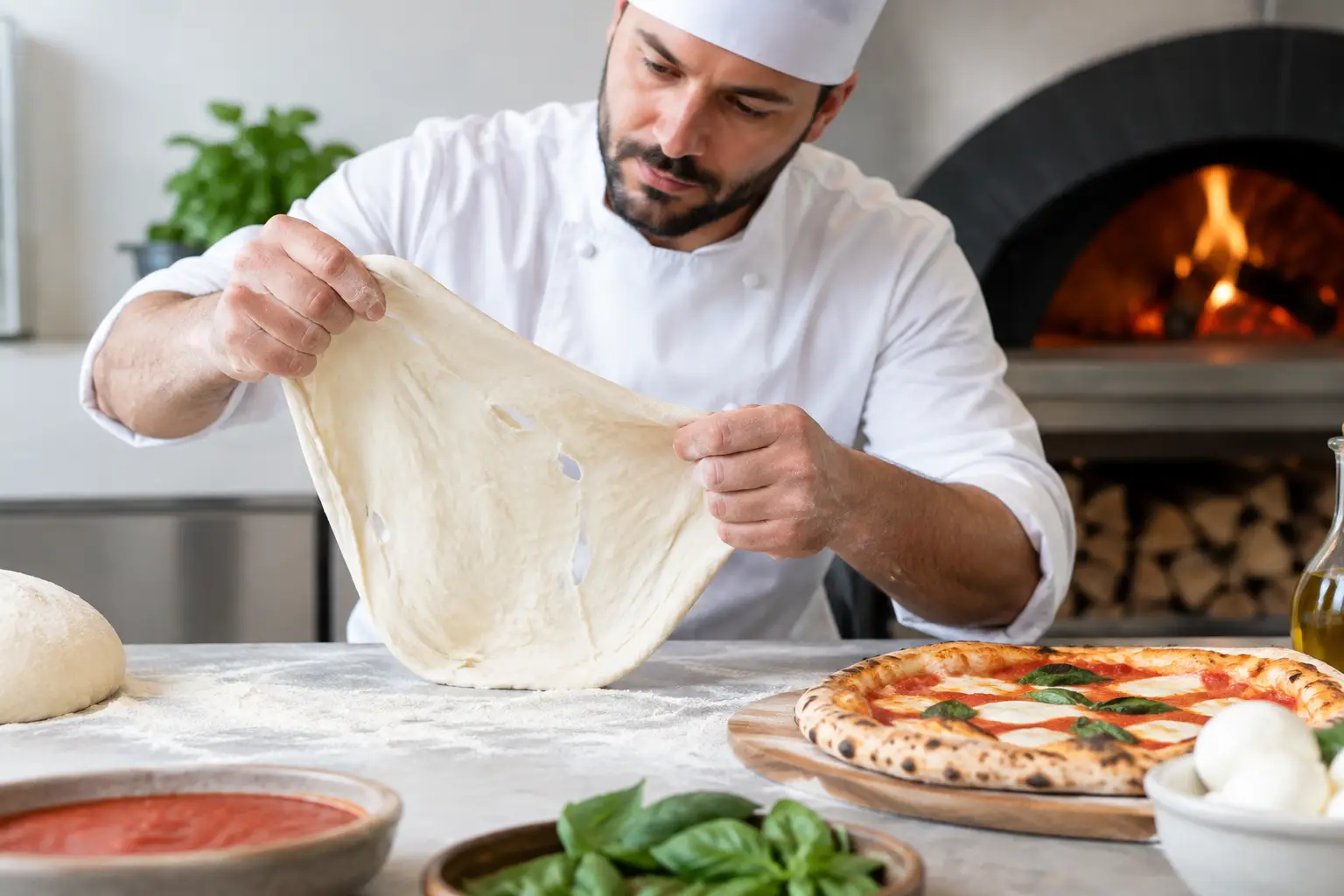
A dough ball that tears halfway through opening is not asking for more force. It is giving you information. Effective pizza dough tear troubleshooting begins by reading that information correctly: a weak, over-fermented dough behaves differently from a tight, under-rested one, and both require different corrections at the bench.
For Neapolitan pizza, the goal is a dough that opens easily from the center outward, retains a defined cornicione, and becomes thin without rupturing. That outcome starts well before the final stretch. Flour selection, dough temperature, fermentation timing, ball handling, and bench technique all determine whether the gluten network will extend or fail.
Pizza Dough Tear Troubleshooting Starts With the Tear
Before changing a formula, look at where and when the tear occurs. A hole developing in the center during the first few presses often points to a dough that lacks strength. A tear along the outer edge may be the result of pressing too close to the rim or leaving an unevenly thin section. Dough that feels dry, rough, and resistant before it suddenly splits is usually tight or under-relaxed.
The texture of the dough matters as much as the location of the damage. A properly fermented Neapolitan dough ball should feel soft and aerated, but not slack or fragile. It should release from the dough box with minimal resistance and tolerate gentle handling. If it puddles, sticks aggressively, or breaks with little extension, fermentation has likely moved too far. If it springs back hard and fights every movement, it needs more time to relax or was developed too aggressively.
Do not diagnose from one damaged pizza alone. Consider the entire batch. When every dough ball tears, the cause is usually upstream in mixing, fermentation, or temperature management. When one ball tears while the others perform well, uneven balling, drying, or rough handling is more likely.
Check Fermentation Before Blaming Your Stretching
Over-fermentation is one of the most common causes of weak dough. As fermentation continues, acids and enzymes gradually weaken the gluten structure. The dough may look beautifully expanded in the box, but it becomes excessively soft, sticky, and difficult to lift. When opened, it may stretch briefly and then tear without warning.
This is particularly common when dough temperature runs warmer than intended. A few degrees can significantly accelerate fermentation, especially during a long room-temperature proof. High ambient temperatures, warm mix water, a warm mixer bowl, or dough boxes stacked tightly can all push dough beyond its ideal point.
If over-fermentation is the issue, reduce the fermentation time, lower the finished dough temperature, or revise the yeast quantity for your schedule. Refrigeration can provide control, but it is not automatically a solution. Cold dough that has not fully relaxed will still resist opening, while cold dough held too long can also become weak. The useful question is not whether the dough was refrigerated, but whether it reached the bench at the right maturity and temperature.
Under-fermentation produces the opposite problem. The dough feels dense, tight, and reluctant to expand. It may snap back after pressing, and a pizzaiolo may compensate by pulling harder. That force concentrates stress in one area and creates a tear. Give underproofed dough more time at room temperature, rather than trying to force it into shape.
Use the Dough Ball as Your Reference
A mature dough ball should be slightly domed, smooth, and visibly aerated. It should not have a dry skin, a collapsed top, or large uncontrolled bubbles. When gently pressed, it should yield and slowly recover without feeling rubbery.
These visual and tactile signals are more reliable than the clock alone. A fermentation schedule is a framework, not a guarantee. Flour strength, room temperature, water temperature, and dough mass all affect the actual pace of fermentation.
Build Enough Strength During Mixing
A dough cannot be repaired at the bench if it never developed a coherent gluten network. Insufficient mixing can leave the dough weak and prone to tearing, especially at the center where it is stretched thinnest. The dough may feel soft, but it will lack the extensibility needed to open into a full pizza.
At the same time, excessive mixing creates its own problems. Overmixed dough can become too warm and overly elastic. It fights the opening process, then tears when stretched past its limit. This is why disciplined mixing matters more than simply mixing longer.
Aim for a dough that is smooth, cohesive, and moderately developed at the end of mixing. It should not be grainy, shaggy, or prone to splitting when pulled gently. Monitor finished dough temperature every time you mix. If you are troubleshooting repeated tears, this single measurement often explains why a formula that worked last week fails today.
Flour also affects strength. Traditional-style Neapolitan dough is generally made with finely milled wheat flour suited to long fermentation and high-heat baking. A very weak flour may not tolerate your hydration level or fermentation schedule. A very strong flour may produce a tight dough unless the process is adjusted to allow sufficient maturation. There is no universally correct flour strength independent of time, temperature, and hydration.
Protect the Dough During Balling and Proofing
A dough ball can tear because its surface dried out before service. Even a thin skin changes how the dough opens. Instead of stretching smoothly, the dry area resists movement and can split, often near the edge.
Keep dough balls covered in proofing boxes with lids that fit properly. Avoid excessive bench flour when balling, since loose flour can interfere with seam closure and dry the surface. Form each ball with enough surface tension to hold its shape, but do not cinch it so tightly that the outer layer becomes stressed and restrictive.
When removing dough from the box, use a dough scraper or gentle fingers to release it. Pulling a dough ball from the edge can create a thin, damaged section before shaping even begins. If the dough is sticking heavily to the box, resist adding large amounts of flour directly onto its top surface. Free it carefully, then use only enough bench flour to prevent sticking during the opening.
Open the Dough Without Creating Thin Spots
Good stretching technique distributes pressure. Begin by placing the dough in flour, turning it once or twice, and removing excess flour. Start pressing from the center outward with your fingertips, deliberately leaving a wider rim untouched. This preserves the gas that will become the cornicione and prevents the edge from becoming too thin.
The most frequent handling error is pressing or stretching one area repeatedly. Every additional pass thins that section. Once a translucent spot appears, stop pulling there. Support the dough from underneath and direct any remaining expansion into thicker areas.
Avoid rolling pins for Neapolitan pizza. A pin compresses the rim and drives gas from the dough, but it also prevents you from feeling thin spots as they develop. Your hands provide necessary feedback. Use them to guide, not flatten, the dough.
If you use a lift-and-stretch motion, keep the dough moving. Let gravity assist, but do not let the full weight hang from a narrow point. Rotate frequently, support the rim with both hands, and return the dough to the bench when it begins to feel too thin. A controlled bench finish is often safer than continuing to stretch in the air.
What to Do When a Hole Appears
A small hole does not automatically end the pizza. Lay the dough flat, bring a small amount of surrounding dough over the opening, and press gently to seal. Do not pinch a thick knot into the center, which will bake unevenly. Use this as a practical recovery, not a normal shaping method.
If the dough repeatedly tears in multiple places, start again with another ball and examine the cause. Repeated patching masks a process problem and often produces a heavy, uneven crust.
Adjust Hydration With Restraint
Higher hydration can improve extensibility and oven spring, but it narrows the margin for handling errors. A dough that is manageable at 62% hydration may become sticky and fragile at 67% unless flour, mixing, fermentation, and technique are all suited to the change.
When troubleshooting, avoid changing hydration, yeast, flour, salt, mix time, and fermentation length all at once. Change one meaningful variable, record the result, and repeat the process. This is how a pizzaiolo builds a dependable system rather than chasing a different answer every session.
A practical first adjustment is often to reduce hydration slightly while refining fermentation and opening technique. Once the dough consistently opens without tearing, increase hydration only if it serves a clear goal in your finished pizza.
Train Your Hands to Read the Dough
The strongest answer to torn dough is not a single percentage or a fixed proofing schedule. It is the ability to recognize the difference between dough that needs more rest, dough that has gone too far, and dough that is being stretched unevenly.
Treat each tear as a useful record of the process. With careful observation, precise temperature control, and patient handling, the dough will begin to tell you exactly when it is ready to become pizza.