
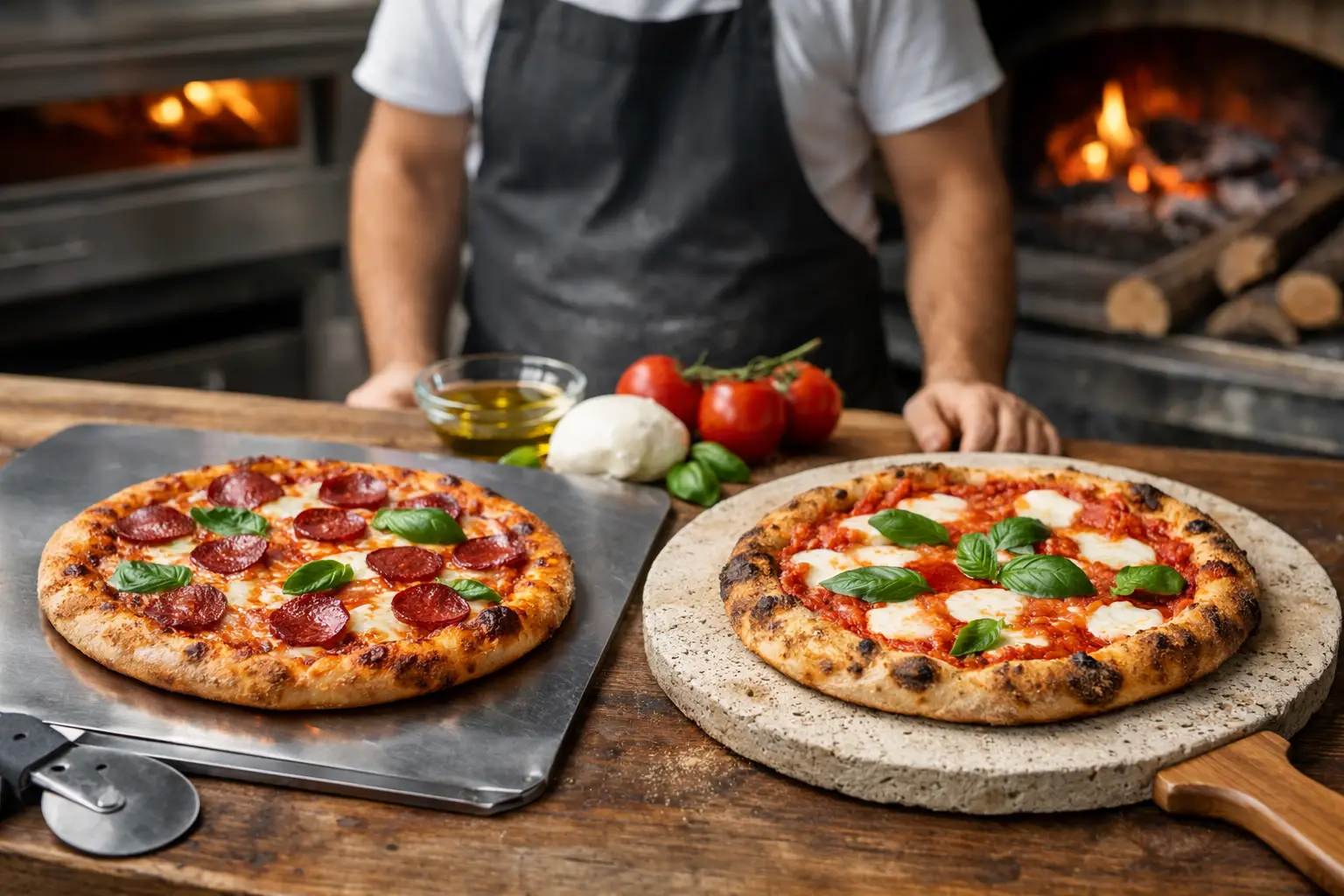
A pizza that looks right but bakes pale underneath usually has a heat-transfer problem, not a dough problem. That is why the pizza steel vs stone debate matters more than many home bakers realize. The baking surface determines how quickly the base sets, how much oven spring you get at the rim, and whether your pizza finishes with leopard spotting or a dry, overbaked crust.
For anyone serious about Neapolitan-style pizza, this choice is not a minor equipment detail. It affects technique. A stone and a steel store and deliver heat differently, so they reward different doughs, different bake profiles, and different ovens. If your goal is more control and more consistent results, you need to understand what each one actually does.
Pizza steel vs stone: the core difference
The simplest distinction is material. A pizza stone is usually made from ceramic, cordierite, or a similar porous material. A pizza steel is a thick slab of steel, often carbon steel, with far greater thermal conductivity. Both absorb heat from the oven and transfer it into the dough, but they do not do it at the same speed.
A steel gives heat aggressively. When the dough lands on it, the bottom crust starts setting and browning almost immediately. This is why steels are popular in standard home ovens that top out around 500 to 550 degrees Fahrenheit. They compensate for the oven’s limited heat by pushing more energy into the underside of the pizza.
A stone transfers heat more gently. It still gets hot enough to bake excellent pizza, but it does not drive bottom browning as fast. That can be an advantage when you want the top and bottom to finish in better balance, especially in ovens where the ceiling heat is already strong.
What that means for Neapolitan-style pizza
Authentic Neapolitan pizza is traditionally baked on the floor of a very hot oven, with intense top heat and a short bake. In that environment, the floor must be hot, but it cannot scorch the bottom before the rim and toppings finish. That is one reason many serious pizza makers still prefer stone or refractory baking surfaces when chasing a true Neapolitan balance.
In a home kitchen, though, conditions are different. Most domestic ovens do not produce enough ambient heat from above to mimic a wood-fired Neapolitan oven. This is where steel earns its reputation. It can help create stronger oven spring and faster bottom browning, making a home oven feel more capable than it actually is.
The trade-off is just as important. On a steel, a Neapolitan-style dough can overbrown underneath before the cornicione fully develops, especially if the dough is thin, the hydration is moderate, or the steel is preheated too long. If you are aiming for a soft, tender, lightly charred base rather than a crisp New York-style underside, steel may require more adjustment.
When a pizza steel makes more sense
If you bake in a conventional home oven and want stronger bottom heat, steel is often the practical choice. It tends to produce better spring, more assertive browning, and a more reliable bake on pizzas that would otherwise come out blond and underdone underneath.
It is especially useful for bakers working at 500 to 550 degrees Fahrenheit with limited broiler performance. In that setup, the steel helps close the gap between the weak thermal environment of the oven and the energy a pizza needs in the first minute of baking.
Steel also suits styles that benefit from a firmer, crisper base. If you make New York-style pizzas, hybrid artisan pies, or longer-bake home oven pizzas, the responsiveness of steel is often an asset. It recovers heat relatively well between bakes too, which matters if you are making several pizzas in a session.
That said, steel demands attention. You may need to move the pizza higher in the oven to improve top browning, shorten the bake, or switch to broil for part of the process. Without those adjustments, the bottom can outrun the top.
When a pizza stone is the better tool
A stone is often the better match when your oven already runs hot enough, or when your priority is a more balanced and traditional bake character. The gentler heat transfer can be more forgiving with high-hydration doughs and delicate fermentation work, where preserving tenderness matters as much as color.
For Neapolitan-inspired pizza in a high-performance outdoor oven, many bakers prefer stone because it behaves more like the refractory floor used in traditional ovens. It allows the base to cook through without becoming hard or brittle too quickly. That softer, more integrated bake is difficult to appreciate until you compare both surfaces side by side.
Stone also offers some practical advantages. It does not rust, it does not weigh quite as much as a comparable steel in some cases, and it is less likely to produce an aggressively dark bottom before you are ready. For students developing shaping, topping balance, and bake timing, that margin can be helpful.
The weakness is recovery and speed. Stones generally need a thorough preheat and can lose heat more noticeably between pizzas, particularly thinner or lower-density models. In a busy service setting or a long home session, that can slow you down.
Pizza steel vs stone in a home oven
For most US home bakers using a standard residential oven, the honest answer is that steel usually delivers quicker gains. It solves the common complaint of pale bottoms. It also helps beginners feel the immediate benefit of proper preheating and strong conductive heat.
But better is not always the same as more authentic. If your goal is specifically Neapolitan pizza, you are trying to balance bottom heat with rim expansion, top cook, moisture management, and softness at the center. A steel may improve one part of that equation while making another part harder to control.
A good stone asks more patience from the oven, but it often gives a more measured bake. If you use the broiler well, bake near the top of the oven, and manage launch speed and topping load carefully, a stone can produce beautiful results with a crust texture many serious pizza makers prefer.
How dough style changes the answer
The right surface depends partly on your dough. A lean dough with modest hydration and little sugar can benefit from steel in a weak oven because it needs help browning. A highly fermented dough with strong extensibility may already color fast enough and can become too dark on the bottom if the steel is excessively hot.
Topping load matters too. A lightly topped Margherita bakes very differently from a heavier pizza with extra cheese or vegetables. The heavier the topping load, the more valuable strong bottom heat becomes. But with Neapolitan pizza, restraint is part of the craft. Proper topping balance reduces the need to force the bake from below.
This is where disciplined process matters more than gear debates. If the dough is overproofed, underdeveloped, or topped too heavily, neither steel nor stone will rescue the pizza. The baking surface can improve execution, but it cannot replace sound technique.
Practical recommendations for serious bakers
If you have a standard home oven and want the most noticeable improvement quickly, start with a steel if your current problem is weak spring or a pale bottom. Place it high enough in the oven that the top can color, and learn how your broiler interacts with the bake.
If you use a dedicated pizza oven, or if your goal is closer adherence to Neapolitan texture and bake character, a quality stone is often the more appropriate choice. It supports a softer bottom structure and a more traditional relationship between floor heat and top heat.
If you are choosing only one, let your oven decide. Weak home oven with limited top heat - steel is usually more helpful. Hotter oven with strong live flame or strong upper heat - stone is often the better fit.
Thickness matters for both. A very thin steel can be too intense and lose heat faster than expected. A poor-quality stone can crack or struggle with recovery. Material quality and oven setup matter at least as much as the category itself.
The real standard is the finished pizza
Serious pizza making is full of debates that sound absolute until you put dough in the oven. Pizza steel vs stone is one of them. Neither tool is inherently superior in every setting. Each changes the relationship between heat, dough, and time.
The better question is not which surface wins. It is which surface helps you produce the pizza you are actually trying to make, in the oven you actually own, with the dough you actually understand. When you judge the bake by structure, tenderness, color, and balance instead of hype, the right choice becomes much clearer.
If your ambition is to make better Neapolitan-style pizza, treat the baking surface as part of your method, not a shortcut. The strongest results come when equipment, dough, and oven management are working toward the same style of pie.