A pizza class can be a pleasant evening and still teach very little about pizza. When people search for pizza workshops near me, they often find everything from social cooking events to serious technical instruction under the same label. The difference matters if your goal is a consistently light, properly fermented Neapolitan pizza rather than one successful pie made under someone else’s supervision.
A worthwhile workshop should make the process clearer, not merely more entertaining. You should leave knowing what to observe in your dough, how to make adjustments, and why the oven produced the result it did. Those skills are what travel home with you, whether you are baking for family, preparing for a restaurant opening, or building the foundation for a professional pizza career.
What Pizza Workshops Near Me Should Actually Teach
Authentic Neapolitan pizza is deceptively simple. Flour, water, salt, yeast, tomatoes, cheese, heat. Yet each element affects the next, and small errors can become obvious in a pizza baked in 60 to 90 seconds. A serious workshop treats the pizza as a system rather than a recipe.
Dough is more than a list of ingredients
Look for instruction that explains flour selection, hydration, dough temperature, salt percentage, yeast quantity, mixing sequence, bulk fermentation, and final proofing. These are not separate topics. Dough temperature influences fermentation speed; fermentation affects extensibility; extensibility determines whether the dough can be opened without tearing or losing its internal gas.
A strong instructor should be able to explain why a dough feels tight, sticky, weak, or over-fermented. They should also discuss variables that change from kitchen to kitchen, including room temperature, refrigeration, flour strength, water temperature, and scheduling constraints. There is no single fermentation schedule that works identically in every environment.
For home cooks, this knowledge replaces guesswork with useful observation. For future operators, it creates a process that staff can repeat and troubleshoot during service.
Shaping and topping require restraint
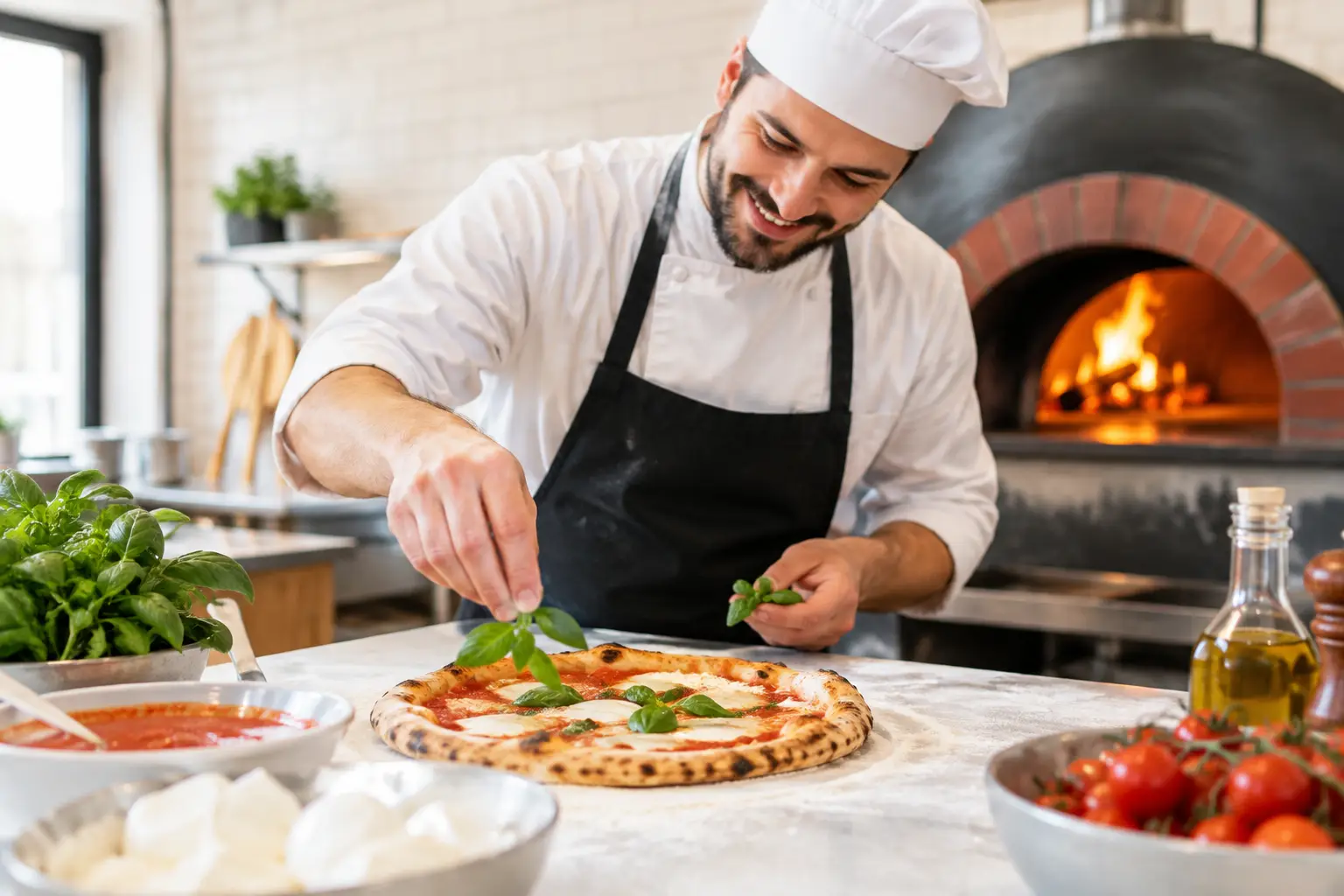
The characteristic raised edge of a Neapolitan pizza is not created by forcefully forming a crust. It comes from handling the dough in a way that moves fermentation gases outward while preserving them. A workshop should give students time to practice opening dough by hand, controlling thickness, and transferring the disk without stretching it out of shape.
Topping instruction deserves the same precision. Proper topping is about balance, moisture, weight, and placement. Too much sauce can prevent the center from setting. Excess cheese can release water and grease. Heavy toppings can make a pizza difficult to launch and leave the center wet after baking. Traditional pizza rewards disciplined choices, not an overloaded surface.
Oven management cannot be an afterthought
An oven is not simply set to a temperature and ignored. The deck temperature, dome heat, flame position, recovery time, and placement of the pizza all influence the bake. In a live-fire oven, an experienced pizzaiolo reads the oven continually. In a gas or electric oven, the same principle applies, though the controls differ.
Good workshops explain how to judge whether the deck is too hot or too cool, when to move a pizza, how to turn it without damaging the rim, and how to recognize proper baking before the bottom burns. If the class includes hands-on oven work, ask how many pizzas each student will bake. Watching an instructor manage fire is valuable; doing it yourself is where judgment develops.
How to Evaluate a Local Pizza Workshop Before Booking
The best class for you depends on your starting point and purpose. A first-time home baker does not need the same depth as a restaurant founder, but both should expect accurate instruction and meaningful practice.
Start with the curriculum. Vague promises such as “learn to make artisan pizza” do not tell you whether the session covers dough fermentation, hand shaping, oven operation, or only assembly. A detailed curriculum is usually a sign that the instructor understands the sequence of the craft and has designed the class around measurable skills.
Then consider class size. A larger group can be enjoyable, but it limits individual feedback, particularly during dough handling and baking. Pizza technique is physical. An instructor often needs to see your hand pressure, your dough tension, your launch angle, and the way you turn a pie. Smaller groups generally create more opportunities for correction, though they may cost more.
Instructor experience matters as well. Seek someone who can teach the reasoning behind traditional methods, not just demonstrate a personal routine. The strongest educators distinguish between non-negotiable fundamentals and choices that depend on flour, equipment, climate, or business model. They respect Neapolitan standards while helping students work intelligently within their own constraints.
Finally, review the equipment. Training on a high-temperature pizza oven is valuable, but a class should also help you translate techniques to the oven you own or plan to buy. A home pizza oven, a commercial gas deck oven, and a wood-fired oven require different workflows. An honest program addresses those differences instead of promising identical results from every setup.
Recreational Class or Technical Workshop?
There is nothing wrong with a recreational pizza class. It can be an excellent introduction to hand stretching, ingredient quality, and the pleasure of cooking with others. It is the right choice when the main goal is a shared experience and a good meal.
A technical workshop is different. It is designed for repetition, diagnosis, and process control. Students may mix dough, compare fermentation outcomes, bake multiple pizzas, and receive direct feedback on their execution. The atmosphere can still be welcoming, but entertainment is not the primary outcome.
If you want to make better pizza at home, a focused one-day workshop may be enough to correct the habits causing inconsistent results. If you plan to sell pizza, pursue additional training that addresses production planning, dough management across service, oven capacity, menu discipline, and quality control. A beautiful pizza made slowly in a class is not yet proof of a reliable service system.
Neapolitan Pizza School approaches instruction from this technical, tradition-based perspective: students learn the decisions behind the finished pizza, not only the motions required to produce one.
Questions Worth Asking Before You Attend
Before committing your time and tuition, ask a few direct questions. Will you mix and ferment dough yourself, or work with dough prepared in advance? How much individual oven time will you receive? What style and type of oven will be used? Is the class built for beginners, working cooks, or prospective business owners?
Also ask what happens after the session. A useful program provides a clear formula, process notes, or practical guidance that helps students continue training at home. Pizza improves through repetition. You need a way to record changes in fermentation time, dough temperature, bake performance, and finished texture so that each session teaches you something.
Be cautious of any workshop that presents authenticity as a costume rather than a discipline. Italian terminology, a dramatic oven, and premium ingredients can create the appearance of expertise. They do not automatically mean the class teaches fermentation control, proper dough handling, or balanced baking. Respect for tradition is visible in method, accuracy, and attention to detail.
Turn a Workshop Into Lasting Skill
Attend with a specific problem in mind. Perhaps your dough tears during stretching, your cornicione lacks volume, or your pizza browns before the center sets. Tell the instructor. Targeted feedback is more valuable than trying to absorb every detail at once.
Afterward, repeat the process with one controlled change at a time. Do not change flour, hydration, yeast, proof time, and oven temperature all in the same bake. Keep notes, take photos of the dough and finished pizzas, and learn to connect cause with result. A pizza workshop can give you a correct framework, but your hands develop confidence through deliberate practice.
The right class should leave you with more than a recipe and a photograph. It should give you the ability to look at dough, heat, and finished pizza with a trained eye - and the discipline to improve the next one.