
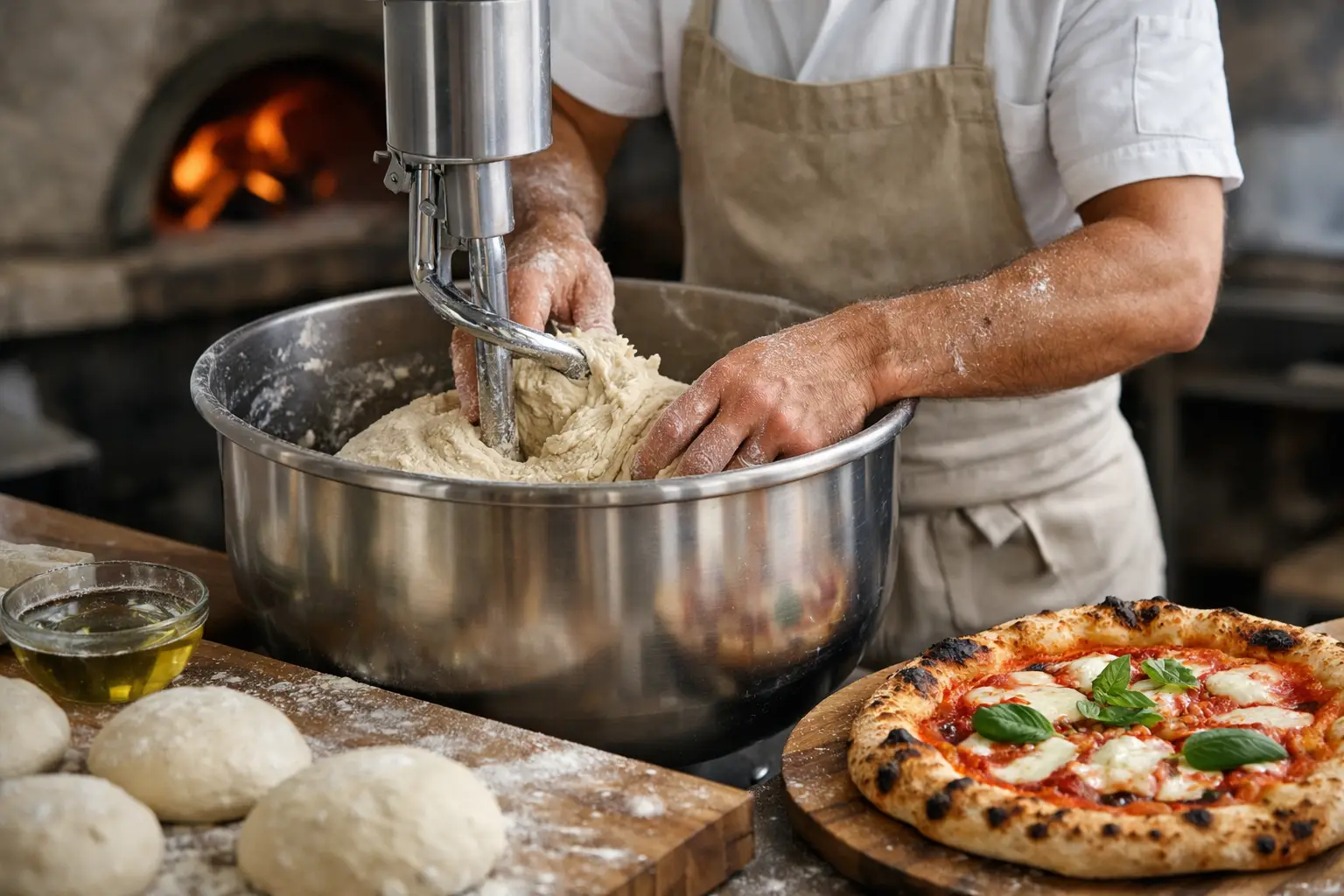
A Neapolitan dough can look properly mixed and still fail at the bench. It may tear during opening, resist extension, bake pale, or develop a dense rim because the dough temperature, gluten development, or mixing sequence was wrong before fermentation even began. This professional pizza dough mixing guide focuses on the stage that determines how every later decision performs.
For serious pizzaiolos, mixing is not simply combining flour and water. It is the controlled formation of a dough with enough strength to retain gas, enough extensibility to open by hand, and enough balance to mature predictably. The goal is not the longest possible mix. It is a smooth, cohesive dough that reaches the desired final dough temperature without being overworked.
Start With a Formula You Can Measure
Professional mixing begins with baker’s percentages, not cups or visual estimates. Flour is always 100 percent; water, salt, and yeast are expressed as percentages of the flour weight. This makes it possible to adjust production size while preserving the character of the dough.
For a classic Neapolitan-style dough, hydration often sits in a range where the dough remains manageable by hand but can still produce a light, open cornicione. The right number depends on the flour, room conditions, fermentation schedule, and the capability of the oven. A flour that absorbs water readily may perform well at a higher hydration, while a softer flour or a warmer production environment may call for restraint.
Salt contributes more than flavor. It strengthens the gluten network, affects fermentation speed, and helps the dough maintain structure. Yeast should be selected according to time and temperature rather than used as a fixed amount for every batch. A same-day dough and a longer cool fermentation require different yeast levels, even if the flour and hydration are identical.
The point is consistency. Record flour temperature, water temperature, room temperature, dough temperature, mixing time, and fermentation plan. When a dough improves or fails, those notes tell you why.
The Professional Pizza Dough Mixing Guide: Temperature First
Final dough temperature is one of the most useful controls in professional production. It influences yeast activity, gluten development, and the speed at which fermentation begins. If the dough leaves the mixer too warm, it can ferment ahead of schedule and become weak or sticky by service. If it is too cool, fermentation may lag and the dough can remain tight when it is time to open.
Many Neapolitan operations work toward a final dough temperature in the mid-70s Fahrenheit, often around 75 to 78 degrees. That is a working range, not a universal rule. Your fermentation room, flour choice, and proofing schedule may justify a slightly different target. What matters is choosing a target and repeatedly reaching it.
Water temperature is your primary adjustment. Flour and room temperatures change daily, while a spiral mixer adds friction and heat. On a hot day, cooler water may be necessary. In a cold kitchen, slightly warmer water can keep the dough from finishing below target. Ice water is not a badge of professionalism. Use it only when the friction factor and ambient conditions require it.
A digital probe thermometer is more valuable than guessing by touch. Check the dough immediately after mixing, then compare the result with its condition during balling, proofing, opening, and baking. Over time, this creates a reliable temperature map for your own process.
Choose a Mixing Sequence That Protects the Dough
The traditional sequence is straightforward: add water to the bowl, dissolve the salt, incorporate most of the flour, add yeast according to the chosen method, then bring the dough together with the remaining flour. This order distributes salt effectively and gives the flour an opportunity to hydrate before the dough becomes too firm.
There is room for informed variation. Some pizzaiolos prefer to add yeast to the water before flour. Others introduce it after an initial flour addition, especially when managing a particular fermentation schedule. Neither choice replaces attention to temperature and development. The dough must be mixed according to its intended use, not according to a ritual performed without context.
In a spiral mixer, begin at low speed until the ingredients form a rough, shaggy mass and no dry flour remains. This is the incorporation phase. Once the dough has united, increase speed only as needed to develop strength and create a cleaner surface. A planetary mixer can work for small batches, but it generally introduces more friction and can be less gentle on pizza dough. It demands closer temperature monitoring.
Hand mixing remains a valuable skill, especially for understanding hydration and gluten formation. It is slower and offers excellent tactile feedback, but it may be less practical for high-volume service. The trade-off is control versus capacity. A mixer should improve repeatability, not remove the pizzaiolo’s judgment.
Know When Gluten Development Is Enough
A properly mixed Neapolitan dough should feel cohesive, elastic, and smooth, with a surface that begins to tighten around the mass. It should pull away from much of the bowl without appearing dry or stiff. When stretched gently, it should extend without immediate tearing, but it does not need the extreme windowpane associated with enriched bread dough.
Under-mixed dough lacks organization. It can feel rough, tear during balling, and spread unevenly as it ferments. Over-mixed dough is a different problem. It becomes overly warm, excessively tight, and prone to oxidation. The finished pizza may show reduced color and a less expressive dough flavor. Overmixing can also leave the dough difficult to relax, forcing the pizzaiolo to fight it during opening.
Do not judge development by minutes alone. A five-minute mix in one machine may equal a much longer mix in another. Batch size, speed, hydration, flour strength, and mixer geometry all change the result. Watch the dough, feel it, and confirm its temperature.
The Windowpane Test Has Limits
A small stretch test can be useful, but it should not become the only standard. If a thin piece of dough stretches into a translucent membrane before tearing, the gluten network has developed significantly. For pizza, however, the desired endpoint is a dough that will mature gracefully through fermentation, not a dough pushed to its maximum possible elasticity in the mixer.
If your dough opens easily at first but collapses or lacks rim volume after baking, the issue may be insufficient strength. If it snaps back aggressively and needs repeated resting at the bench, it may be too tight from overdevelopment, low dough temperature, or an immature fermentation. Mixing is only one variable, but it establishes the starting condition.
Rest Before Dividing When the Dough Needs It
After mixing, a short covered rest allows the gluten network to settle and the flour to finish hydrating. Depending on your method, this may be a brief bench rest before bulk fermentation or the beginning of a longer controlled fermentation. The correct duration depends on your formula and schedule.
Avoid treating every dough as though it needs the same immediate divide-and-ball process. A dough mixed to moderate development may benefit from time in bulk before division. Another dough, designed for a different fermentation rhythm, may be divided sooner. The practical question is whether the dough balls will have the right balance of strength, gas retention, and extensibility at bake time.
When dividing, work cleanly and decisively. Rough handling can degas the dough and create weak seams. Form balls with a taut but not over-tightened surface, then place them in covered containers that prevent drying while allowing adequate space for expansion.
Correct Common Mixing Problems at Their Source
Sticky dough is not automatically too wet. It may be too warm, insufficiently developed, overfermented, or handled with excessive flour after mixing. Adding flour mid-mix can distort the formula and leave dry, uneven areas. First check actual hydration and final dough temperature before changing the recipe.
A dough that tears during opening may be under-mixed, underfermented, or too cold. A dough that snaps back may be over-mixed, too cold, or not sufficiently relaxed. A dough with poor oven spring may have weak gluten, excessive fermentation, or an opening technique that pressed out too much gas. These are different problems, so they require different corrections.
Change one variable at a time. If you lower hydration, reduce mixing time, change water temperature, and alter yeast all in the same batch, the lesson is lost. Professional progress comes from controlled repetition.
At Neapolitan Pizza School, this disciplined approach is central to dough training: learn to read the dough before it reaches the peel. Keep a written record for each batch, make one deliberate adjustment, and let the baked pizza confirm what the mixer began.