
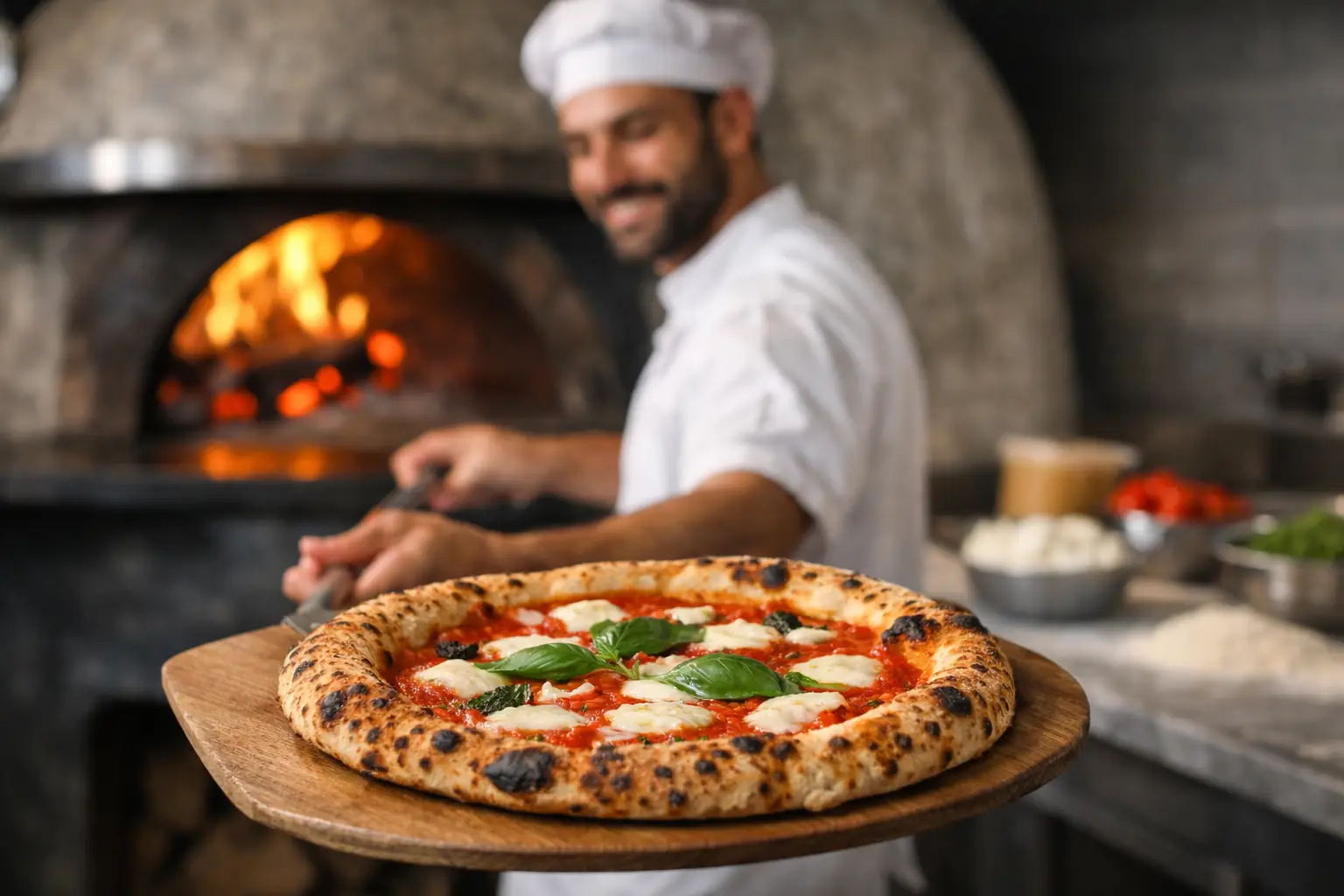
If your dough looks strong at mixing but collapses at service, or your pizza blisters unevenly and bakes pale at the rim, the problem usually is not effort. It is method. A neapolitan pizza training course exists to close that gap between enthusiasm and execution by teaching the exact technical decisions that shape authentic results.
Neapolitan pizza is one of the most imitated styles in the world and one of the least forgiving when handled casually. The ingredient list is simple, but the process is not. Dough strength, fermentation timing, hand shaping, topping balance, and oven management all affect the final pizza within minutes, and often within seconds. That is why serious training matters. It gives structure to a craft that many people try to learn through fragments.
Why a neapolitan pizza training course matters
A focused course does more than show a recipe. It teaches a system. That distinction matters because Neapolitan pizza depends on relationships between variables, not isolated steps. Flour choice affects hydration tolerance. Hydration affects handling. Fermentation affects extensibility and oven spring. Topping moisture affects bake performance. Oven temperature affects everything.
Without formal instruction, many students end up troubleshooting symptoms instead of understanding causes. They add more flour because the dough feels sticky, then wonder why the crust bakes dense. They increase fermentation time without understanding temperature control, then struggle with over-proofed dough. They overload toppings in search of flavor, then lose structure in the center.
A serious course brings those issues into a clear sequence. You learn not only what to do, but why the method works and when to adjust it.
The real skills behind Neapolitan pizza
There is a tendency to treat Neapolitan pizza as a rustic craft that comes together by instinct. Instinct matters, but it is built on repetition and technical understanding. Good training makes that visible.
Dough formulation and mixing
The first skill is reading dough beyond the recipe. A proper course teaches how flour strength, water percentage, salt, and yeast interact under specific room conditions and production goals. That matters for both home cooks and operators. A dough designed for a same-day service window is not managed the same way as one intended for longer fermentation.
Mixing is another area where students often underestimate the craft. Under-mixed dough lacks structure. Over-mixed dough can heat up and lose balance before fermentation even begins. In a training environment, students learn how to judge dough development by feel, surface texture, and temperature, not by guesswork.
Fermentation and timing
Fermentation is where many promising pizzas fail. A true course should teach controlled fermentation, not vague advice about letting dough rest until it "looks ready." Time and temperature must be understood together. Bulk fermentation, balling, proofing, and service readiness all have distinct roles.
This is especially valuable for anyone planning commercial production. In a restaurant setting, fermentation is not just about flavor. It is about consistency, workflow, and the ability to produce dough that opens cleanly and bakes predictably across service.
Shaping without losing the rim
Neapolitan pizza requires hand shaping that preserves the gas structure built during fermentation. This is one of the clearest differences between authentic training and casual pizza classes. Students need to learn how to press and open the dough without degassing the edge, tearing the center, or creating an uneven thickness that causes weak spots.
This part of training often changes everything for students who have struggled with misshapen pizzas or crusts that feel flat. Shaping is not decoration. It is structural control.
Topping balance and restraint
The simplicity of Neapolitan pizza creates a strict standard for topping discipline. Sauce quantity, cheese distribution, and ingredient moisture all affect how the pizza bakes. Too much tomato or fresh mozzarella can flood the center. Too many toppings can overwhelm the dough and mute the contrast between crumb, char, and tenderness.
A strong course teaches balance, not abundance. That is often a mindset shift, especially for students coming from other pizza styles where loading the pie is seen as value. In Neapolitan pizza, restraint is part of quality.
Oven management and baking execution
High-heat baking is where all prior work is either confirmed or exposed. Whether students are using a traditional wood-fired oven, a gas oven, or a modern specialty deck, they need to understand heat behavior. Floor temperature, dome heat, flame position, launch technique, turning rhythm, and bake timing all shape the result.
This is one area where video clips and recipes rarely help enough. Baking Neapolitan pizza requires reading the oven in real time. A course should train the eye as much as the hand. You need to recognize when the base is setting too slowly, when the top is coloring too fast, and when the pizza needs rotation or repositioning.
Who benefits most from this kind of course
A neapolitan pizza training course can serve very different students, but the strongest candidates tend to share the same frustration: they know enough to care, but not enough to be consistent.
For home cooks, the benefit is control. Instead of relying on luck, they begin to understand how to repeat a result and improve it. For aspiring pizzaiolos, training builds the habits and standards expected in serious pizza environments. For restaurant founders, it provides a foundation for product quality before menu expansion, staffing, and service complexity begin to dilute focus.
Hospitality professionals also benefit because Neapolitan pizza is operationally demanding. It can look simple from the dining room, but behind the pass it requires disciplined prep, timing, and oven awareness. Training reduces expensive trial and error.
What to look for in a neapolitan pizza training course
Not every course with flour and fire delivers real craft education. The most useful training is specific, practical, and standard-driven.
Look for instruction that covers the full process from formulation to bake, rather than isolating one appealing segment such as stretching or oven use. A strong course should explain technique in a way that students can apply under different conditions, including variable room temperatures, different flour behaviors, and changes in production volume.
It should also address mistakes directly. Real training does not pretend every dough behaves perfectly. It teaches what to do when fermentation runs ahead of schedule, when dough lacks strength, or when an oven does not bake as expected. Those corrections are where much of the value lies.
Finally, the course should respect the tradition enough to define what makes the style distinct. There is room for adaptation, especially in modern equipment environments, but adaptation only has value when the original benchmark is understood first.
Training versus collecting tips
Many students arrive after months or years of piecing together information from scattered sources. They have seen formulas, watched shaping demonstrations, tested different flours, and still cannot explain why one pizza succeeds and the next falls short.
That is the limitation of tip-based learning. It gives fragments without hierarchy. A training course organizes the craft in the right order. You learn which variables matter most, which changes are cosmetic, and which mistakes create downstream problems that appear later at the bench or in the oven.
This is why specialized schools such as Neapolitan Pizza School stand apart from general cooking instruction. The subject is narrow by design, and that is a strength. Students are not there for a broad culinary sampler. They are there to build competence in a style that rewards precision.
The standard is demanding, and that is the point
Neapolitan pizza attracts serious students because the style sets a high bar while appearing deceptively minimal. Flour, water, salt, yeast, tomato, cheese, basil, heat. Nothing hides. Every decision is visible in the crust, the center, the aroma, and the bite.
That is exactly why formal training has lasting value. It teaches you to see the pizza clearly. Not as a trend, not as a social media performance, but as a disciplined product shaped by method and repetition.
If you are committed to making authentic Neapolitan pizza well, a course should do more than inspire you for a day. It should sharpen your standards enough that every dough you mix after that is judged with better eyes and better hands.