
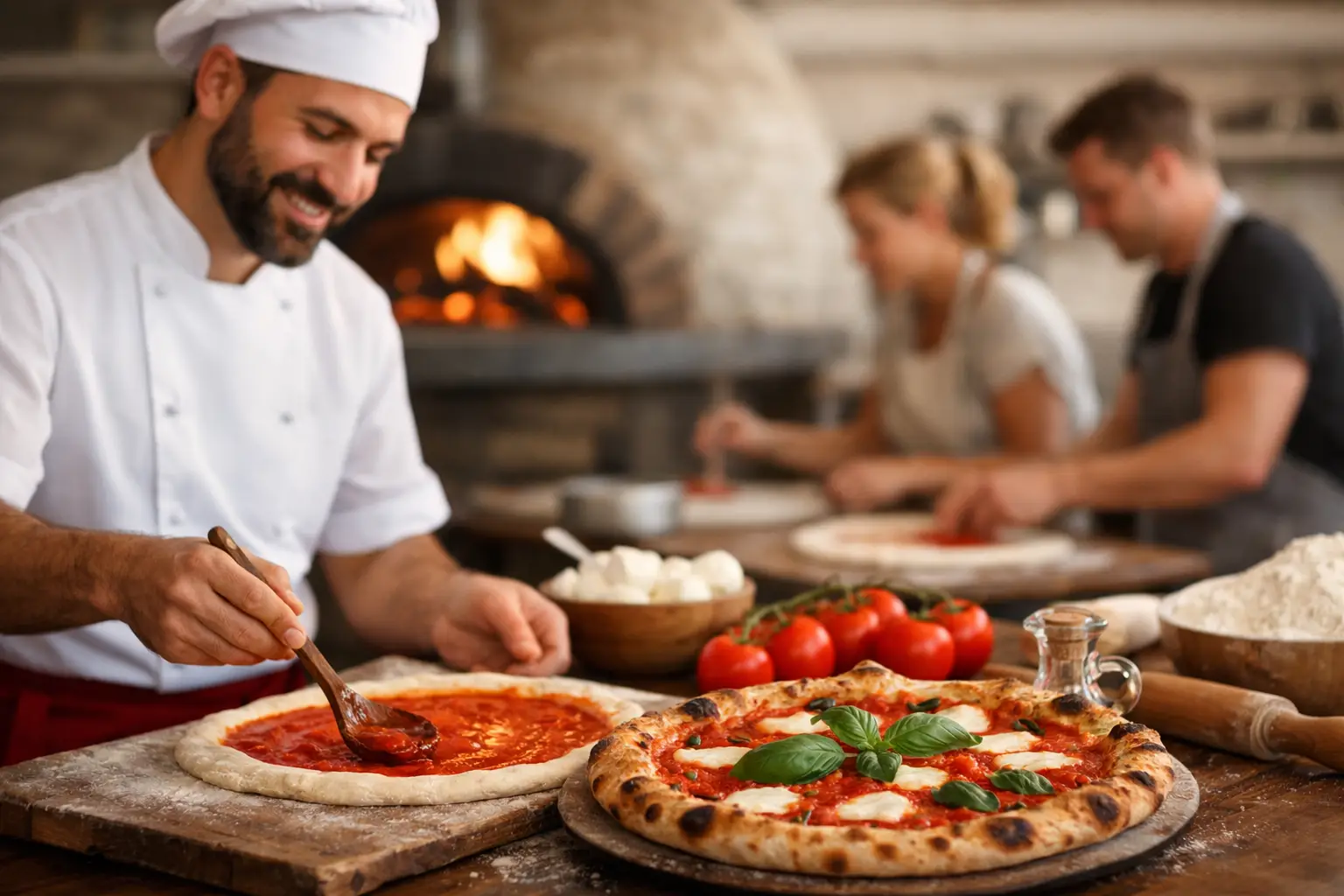
Most people realize their pizza technique is incomplete the moment the dough fights back. It tears when stretched, proofs unevenly, or bakes into something dense, pale, or over-topped. That is exactly where an authentic pizza making class proves its value - not by offering a fun afternoon around a hot oven, but by teaching a disciplined system built on technique, repetition, and standards.
For anyone serious about Neapolitan pizza, the difference matters. This style looks simple from the outside: flour, water, yeast, salt, tomatoes, mozzarella, heat. In practice, every stage affects the next. Dough strength influences shaping. Fermentation affects extensibility, color, flavor, and digestibility. Topping quantity changes bake performance. Oven management determines whether the pizza emerges balanced or compromised. Good instruction connects those variables instead of treating them as separate tricks.
Why an authentic pizza making class matters
A true class in Neapolitan pizza should do more than help students make one good pie in one controlled setting. It should explain why the pizza works when it works, and why it fails when it fails. That distinction is what separates serious training from a recreational workshop.
Many pizza classes are designed around immediate enjoyment. Students mix something quickly, add generous toppings, and leave with photos and enthusiasm. There is nothing wrong with that format, but it does not solve the real problems most learners face. Home cooks want consistency. Aspiring pizzaiolos need repeatable dough management. Restaurant founders need a method that holds up under service conditions, not only during a class demonstration.
Authentic instruction gives structure to a craft that can otherwise feel frustratingly vague. Students stop relying on guesswork and start understanding dough temperature, fermentation timelines, bench rest, shaping pressure, and the relationship between oven floor heat and top heat. That knowledge builds confidence because it is transferable.
What an authentic pizza making class should cover
If the class is centered on authentic Neapolitan pizza, the curriculum should be specific. General pizza knowledge is not enough. Neapolitan pizza is defined by a distinct method and outcome, so the training should reflect that precision.
Dough formulation and ingredient function
The first serious shift in learning usually happens with the dough itself. Students often come in focused on recipes, but recipes alone rarely fix inconsistent results. A strong class teaches the role of each ingredient and how small adjustments affect the finished pizza.
Flour choice matters because protein level, milling, and absorption influence structure and handling. Water is not just a quantity - it affects hydration, dough temperature, and final texture. Salt regulates fermentation and strengthens dough. Yeast use is tied to time, temperature, and schedule. When these elements are explained clearly, students begin to understand that dough is not a static formula. It is a managed process.
Fermentation, timing, and control
Fermentation is where many students either gain control or lose it. Dough that looked promising at mixing can become weak, overactive, underdeveloped, or difficult to open if fermentation is not managed well.
A credible authentic pizza making class should teach bulk fermentation, balling, proofing, and maturation in practical terms. That includes recognizing readiness by touch and appearance, not only by the clock. Time matters, but time alone is not enough. Room temperature, dough temperature, and production goals all influence the schedule.
This is also where trade-offs should be discussed honestly. A longer fermentation may improve flavor and handling, but only if the dough remains properly controlled. More hydration may support a lighter structure, but it can also make shaping harder for less experienced students. Serious instruction does not pretend there is one perfect number for every situation.
Shaping without damaging the dough
Shaping is one of the clearest markers of training quality. Inexperienced pizza makers often use a rolling pin, press out the gas entirely, or force the dough outward with uneven pressure. The result is usually flat, dense, and disconnected from the style they are trying to produce.
In a proper class, shaping is taught as a tactile skill. Students learn how to preserve the rim, move gas toward the cornicione, and open the disk with control rather than aggression. This stage cannot be mastered through explanation alone. It requires demonstration, correction, and repetition.
That matters because shaping errors are often mistaken for recipe problems. In reality, a well-fermented dough can still bake poorly if it has been mishandled on the bench.
The role of topping discipline in authentic pizza making
One of the most common misconceptions about pizza is that more topping means more quality. In Neapolitan pizza, the opposite is often true. Balance is essential.
A strong class should teach not only what goes on the pizza, but how much, in what condition, and in what sequence. Tomatoes should complement the dough rather than flood it. Mozzarella should melt cleanly without releasing excess moisture. Oil, basil, and finishing ingredients should support the bake, not compete with it.
This is where authenticity becomes practical rather than abstract. Traditional topping logic is not just about heritage. It is about bake performance. Overloaded pizzas struggle to cook properly in the short bake environment associated with Neapolitan technique. The center can turn soupy while the rim finishes too quickly. Students need to understand that restraint is part of craftsmanship.
Oven management is where theory becomes real
The oven exposes every weakness in the process. Dough that is slightly underproofed, poorly shaped, or heavily topped may still look acceptable before baking. Once it hits the oven, those issues become obvious.
A serious class should cover heat management in a way that matches the student’s real-world goals. Wood-fired ovens are central to traditional Neapolitan baking, but many students also work with gas, electric, or compact high-heat ovens. The principles remain consistent even when the equipment changes: floor temperature, dome or upper heat, launch technique, turning rhythm, and bake judgment all matter.
This is another area where superficial instruction falls short. It is easy to tell students that pizza bakes fast. It is more useful to show them how to read the bake in real time. Is the underside setting too quickly? Is the rim coloring before the center is ready? Is the oven recovering properly between pizzas? These are operational questions, not decorative details.
For restaurant operators and hospitality professionals, this part of training is especially important. Producing one excellent pizza is different from maintaining standards over a full service.
Who benefits most from an authentic pizza making class
The short answer is simple: anyone who wants repeatable results rather than occasional luck.
Home cooks benefit because focused instruction shortens the trial-and-error cycle. Instead of spending months changing flour brands, hydration percentages, or fermentation times at random, they can build a clear technical foundation.
Aspiring pizzaiolos benefit because they need more than a recipe. They need process discipline, speed, and consistency. Those skills develop faster in an environment where technique is observed and corrected.
Restaurant founders benefit because pizza quality is operational, not theoretical. A menu concept can look strong on paper and still fail if the dough system is unstable or the bake process is unreliable. Training helps translate a traditional style into something executable.
Even experienced cooks benefit if their background is broad rather than specialized. Neapolitan pizza has its own standards, workflow, and performance demands. General kitchen skill helps, but it does not replace style-specific training.
How to judge whether a class is truly authentic
The word authentic gets used loosely, so it is worth being selective. A class does not become authentic because it mentions Italy, uses a wood-fired oven, or serves attractive pizza at the end.
Look for evidence of method. Does the instruction explain fermentation in depth? Does it teach shaping by hand? Does it address topping balance, dough handling, and heat control as an integrated system? Does it respect the discipline of Neapolitan pizza rather than blending every style into one vague experience?
The best programs also acknowledge context. Students in the US and abroad may not all use the same flour, ovens, or climates. Good teaching respects the tradition while helping students adapt without losing the core principles. That balance matters. Pure theory can become impractical, but excessive adaptation can strip the style of its identity.
At Neapolitan Pizza School, that commitment to craft-based instruction is what defines the educational experience. The goal is not novelty. It is technical understanding that holds up beyond the classroom.
The right class leaves you with more than a finished pizza. It changes how you see every stage of the process - and once that happens, your standards tend to rise for good.