
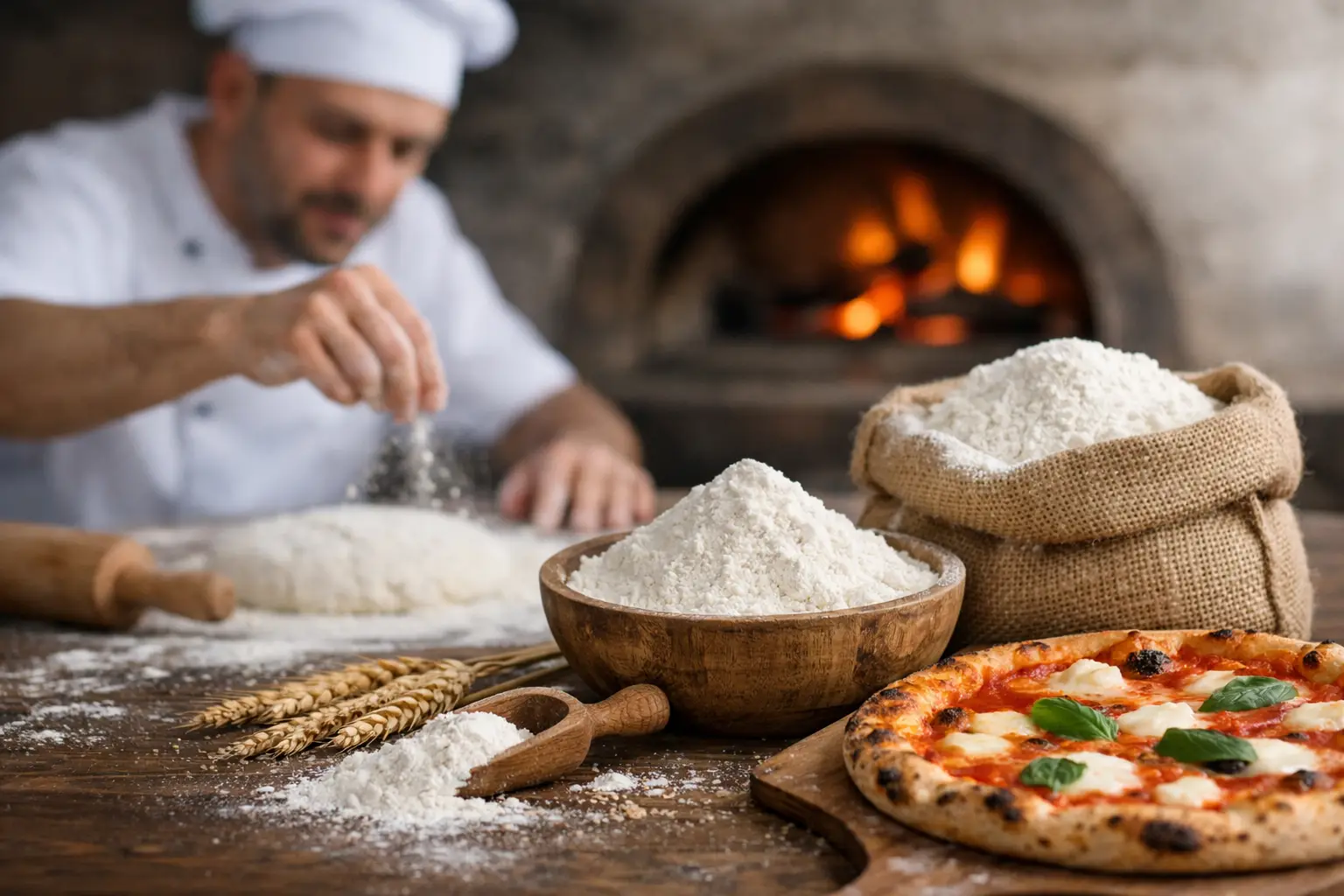
If you have spent any time trying to improve your pizza dough, you have probably heard someone say that the secret is 00 flour. That raises a fair question - what is doppio zero flour, and does it actually make a better Neapolitan pizza, or is it just Italian labeling wrapped in mystique?
The short answer is that doppio zero, written as 00, refers to how finely the flour is milled in the Italian system. It does not automatically tell you the protein level, the strength of the flour, or whether it is right for your dough. Those details still matter. For serious pizza makers, especially anyone pursuing authentic Neapolitan results, understanding what 00 means and what it does not mean is far more useful than treating it as a magic ingredient.
What is doppio zero flour in practical terms?
Doppio zero flour is a highly refined wheat flour milled to a very fine texture. In Italy, flour grades are commonly classified as 2, 1, 0, and 00. The closer you get to 00, the finer and more sifted the flour tends to be, with less bran and germ remaining.
That fine milling affects how the flour feels in the hand and how it behaves in dough. It is soft, smooth, and powdery, and it can produce dough that stretches cleanly and bakes with delicacy rather than heaviness. For pizza, that matters because Neapolitan dough depends on extensibility, controlled fermentation, and a baked crust that is tender, light, and well developed rather than dense.
Still, 00 is not a synonym for high performance. You can have one 00 flour designed for pastries and another 00 flour designed for long-fermented pizza dough. They may share the same fine texture while performing very differently in the mixer, during fermentation, and in the oven.
What 00 flour tells you - and what it does not
This is where many pizza makers get tripped up. The 00 designation tells you about refinement and grind, not the full baking profile of the flour.
If you want to predict how a flour will behave in pizza dough, you also need to consider protein content and flour strength. Strength is often expressed in Italian flours as the W value. A stronger flour generally tolerates longer fermentation and higher hydration, while a weaker flour may be better for shorter processes or softer baked goods.
That means two bags labeled 00 can lead to very different doughs. One may be ideal for a same-day pizza baked at moderate temperatures. Another may be intended for a 24 to 48 hour fermentation and the intense heat of a proper Neapolitan oven. Without that context, buying 00 flour alone does not guarantee the result you want.
For students of pizza, this is one of the most useful mindset shifts. Flour selection is not about prestige. It is about matching the flour to your process.
Why doppio zero flour is associated with Neapolitan pizza
The connection is not accidental. Traditional Neapolitan pizza relies on a dough that must open easily by hand, hold gas without becoming tough, and bake quickly at very high heat. A suitable 00 flour supports that balance well because the fine grind contributes to a smooth dough structure and refined crumb.
In a hot oven, usually far hotter than a standard home oven, the dough needs to rise quickly at the rim and remain tender in the center. The right 00 flour can help create that classic contrast - a soft, elastic interior with a light, leopard-spotted cornicione.
That said, flour is only one part of the system. Fermentation, dough temperature, mixing, salt percentage, hydration, and baking environment all shape the final pizza. It is common for beginners to blame flour when the real issue is underdeveloped dough, poor fermentation control, or an oven that is not producing the right bake.
Is doppio zero flour better than all-purpose flour?
Sometimes yes, sometimes no. It depends on your goal.
If your target is authentic Neapolitan pizza, a well-chosen 00 flour is usually the better tool. It is built for the style. It supports the texture and handling qualities that define the dough, especially when paired with proper fermentation and high-heat baking.
If you are baking in a standard home oven at lower temperatures, the answer gets more nuanced. Some 00 flours can still perform very well, but others may not brown as effectively or may be better suited to a hotter oven than the one you have. In those conditions, a good bread flour or a strong all-purpose flour can sometimes give more predictable color and structure.
This is why blanket statements about flour are rarely useful. Better flour is the flour that suits your method. A serious pizza maker pays attention to the entire process, not just the label on the bag.
How doppio zero flour affects dough handling
One reason pizza professionals value 00 flour is how it feels during production. A quality pizza 00 flour can make dough feel supple, cohesive, and easier to open without tearing. That is especially important in Neapolitan pizza, where the dough is stretched by hand and the rim is preserved rather than rolled flat.
The fine grind also contributes to a cleaner mouthfeel in the finished crust. When the dough is fermented and baked correctly, the texture can seem more delicate than dough made with a coarser flour. That delicacy is part of the appeal.
But there is a trade-off. Some pizza makers assume 00 flour will forgive weak technique. It will not. In fact, because Neapolitan dough is relatively simple, flour choice can highlight mistakes rather than hide them. Overproof the dough, mishandle the balls, or bake in insufficient heat, and the result will still fall short.
How to choose the right 00 flour for pizza
If you are shopping for 00 flour, read beyond the front of the bag. Look for clues about intended use. A flour meant for pizza should usually mention pizza, long fermentation, or professional baking applications. Protein level and W value, if provided, are useful indicators.
For many pizza makers, a medium-to-strong 00 flour works well for Neapolitan dough, particularly if you are fermenting overnight or longer. If your process is short and your environment is warm, an overly strong flour can be harder to manage. If your process is long and your flour is too weak, the dough may lose structure.
This is where craft matters more than slogans. The best flour for your pizza is the one that fits your fermentation schedule, hydration, room temperature, and oven.
Can you make authentic Neapolitan pizza without 00 flour?
You can make very good pizza without 00 flour. Whether it meets the standard of authentic Neapolitan pizza is a different question.
For pizza makers pursuing the traditional style as closely as possible, 00 flour remains the reference point because it aligns with the flour profile commonly used in that tradition. If authenticity matters to you, using an appropriate 00 flour is part of taking the craft seriously.
But authenticity is not achieved by flour alone. You also need disciplined fermentation, correct dough balling, careful hand stretching, restrained topping, and proper baking. A bag of Italian flour cannot compensate for a process that is out of balance.
At Neapolitan Pizza School, this is exactly why flour is taught as part of a larger system rather than as a shortcut. Students do not just learn what ingredient to buy. They learn how ingredient choice interacts with method.
Common misconceptions about doppio zero flour
The first misconception is that 00 means high protein. It does not. The second is that all 00 flour is intended for pizza. It is not. The third is that using 00 flour guarantees an authentic result. It does not.
Another common misunderstanding is that 00 flour is always superior to domestic flour. Not necessarily. There are strong American flours that perform very well for certain pizza styles and ovens. The real question is not whether a flour sounds more traditional. The question is whether it behaves correctly in your process.
For a pizza maker who wants precision, this distinction matters. Romantic language around ingredients can be appealing, but dough responds to technical realities.
So, what is doppio zero flour really?
It is a finely milled Italian flour classification that plays an important role in traditional pizza making, especially for Neapolitan dough. It is valuable because of how it handles, stretches, and bakes when matched to the right process. It is not valuable because of the label alone.
If you are serious about making better pizza, treat 00 flour as a technical ingredient, not a status symbol. Learn what the flour was designed to do, then build your fermentation and baking around it. That is where better dough begins - not with hype, but with understanding.