
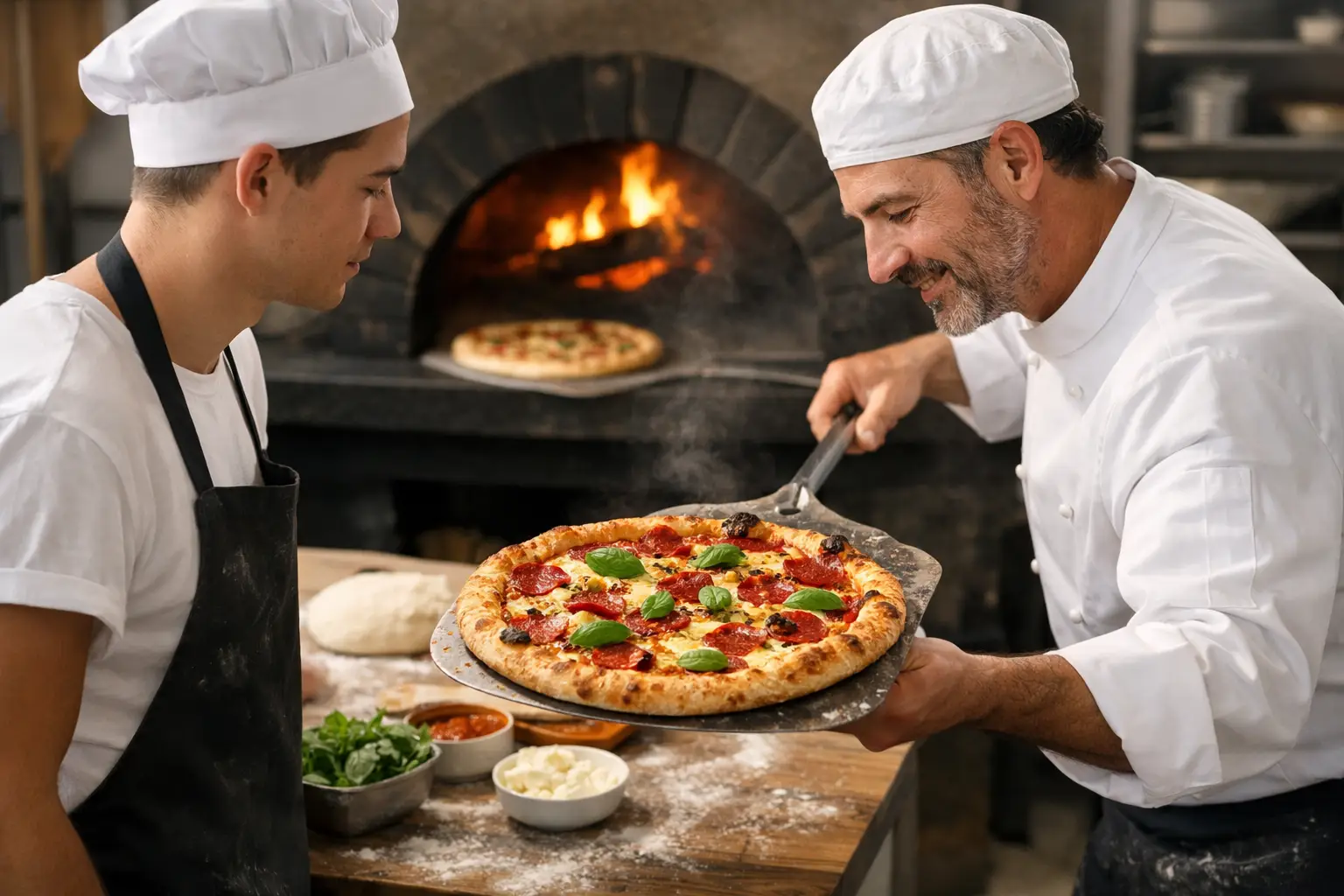
A pizza that looks right can still reveal weak technique at the first bite. The rim may be pale, the center may be wet, or the dough may taste flat despite expensive flour and a hot oven. That is why serious students look beyond casual cooking classes. The best pizza schools teach the decisions behind the pizza, not just a sequence of ingredients.
For Neapolitan pizza, those decisions begin long before a pie enters the oven. Flour selection, water temperature, fermentation timing, dough strength, bench work, topping restraint, and heat management all affect the final result. A worthwhile school gives students a system for understanding those variables, then enough guided repetition to recognize and correct mistakes.
Pizza Schools Should Teach a Complete Process
A focused pizza education treats the pie as a connected process. Dough is not a separate lesson from baking, and topping is not simply a matter of personal preference. A change in hydration, fermentation schedule, or dough-ball temperature can change how the dough opens, how quickly it colors, and how much moisture it can carry at the center.
Students should leave training able to explain cause and effect. If a dough tears while opening, was it underdeveloped, too cold, overproofed, or handled poorly? If the cornicione fails to rise, did the dough lack fermentation, did the shaping press out too much gas, or was the oven floor not properly managed? Good instruction does not offer one answer for every failure. It teaches a method for diagnosing the problem.
That distinction matters for home cooks and professionals alike. A home pizzaiolo may be working with a compact electric oven or a backyard gas oven. A restaurant founder may be planning production around a wood-fired, gas-fired, or electric commercial oven. The equipment changes, but the need to read dough and heat remains constant.
Dough Formula Is Only the Starting Point
Many students arrive with a formula they found online and expect it to solve their inconsistency. A formula is useful, but it is only a record of proportions. It cannot account for flour behavior, room temperature, refrigeration capacity, mixing method, or the pace of a working kitchen.
A serious course should cover the function of each ingredient and the role of baker’s percentages. Students need to understand hydration in practical terms: higher hydration can support a lighter structure, but it can also make handling more demanding and increase the risk of a soft center. Salt affects flavor and fermentation activity. Yeast quantity must relate to time and temperature, not to a fixed rule copied from another kitchen.
Mixing deserves equal attention. The goal is not simply to combine ingredients until the dough looks smooth. Students should learn how development affects extensibility and strength, when to stop mixing, and how to assess dough condition by touch. This is the foundation for producing dough that opens without a rolling pin and holds its shape without becoming tough.
Fermentation Requires Judgment, Not Guesswork
Fermentation is where many promising pizzas lose their balance. A dough can be technically mixed well and still perform poorly because its schedule did not match the conditions around it. Room temperature, dough temperature, yeast level, flour strength, and time all work together.
Strong pizza instruction explains both same-day and longer fermentation approaches, including where each approach makes sense. A shorter schedule may fit a busy service model or a last-minute home session. A longer cold fermentation can improve planning flexibility and flavor development, but it also requires control. Refrigerators vary, and dough does not follow a clock with perfect obedience.
Students should practice reading fermentation signs: volume increase, surface condition, gas retention, aroma, and the way a dough ball relaxes during opening. They should also learn the consequences of pushing dough too far. Overfermented dough may spread too easily, lose structure, and bake with poor lift. Underfermented dough can resist opening, remain dense, and lack the lightness associated with a well-made Neapolitan pie.
The practical value is confidence. Instead of discarding a batch because it is not behaving exactly as expected, a trained pizzaiolo can adjust the day’s plan, modify handling, and make an informed judgment about what the dough can still produce.
Shaping Protects the Dough’s Internal Structure
Authentic Neapolitan shaping is not decorative theater. It is a controlled way to move gas outward while preserving the structure that will become the cornicione. The center is gently flattened, the rim is protected, and the disk is opened to an even thickness without crushing it.
This stage is difficult to learn from video alone because small movements matter. Excess flour on the bench can burn in the oven. Too much pressure at the rim removes the gas needed for expansion. Uneven opening creates a thick patch that remains underbaked beside a thin area that dries out. Students need repeated practice with an instructor who can identify what their hands are doing.
A school should also teach launching as part of shaping. A properly opened pizza can still fail if it sticks to the peel or is overloaded during transfer. The student needs to know how to use bench flour sparingly, how to check movement before launching, and how to recover when a pizza begins to cling to the peel. These are operational skills, not minor details.
Topping Balance Is a Technical Standard
The defining ingredients of a Neapolitan pizza are simple, which makes proportion more visible. Sauce, cheese, oil, and basil should support the dough rather than bury it. A pie with too much sauce can become watery. Too much cheese can release fat and moisture faster than the center can bake. Thick or cold toppings can slow the bake and disrupt the balance between char, tenderness, and lift.
Students should learn to evaluate ingredients for moisture, temperature, cut size, and distribution. This applies whether they are preparing a classic Margherita or developing a menu for a restaurant. Creativity has a place, but it works best after a student understands what the dough and oven can support.
This is also where tradition provides useful discipline. Neapolitan pizza is not defined only by a few familiar toppings. It is defined by proportion, speed, texture, and respect for a style built around a high-heat bake. Learning those standards gives students a clearer foundation for making purposeful variations later.
Oven Management Separates Baking From Guessing
A hot oven is not automatically the right oven. Neapolitan pizza depends on the relationship between radiant heat from above, conductive heat from the floor, and the pizza’s brief time in the chamber. If the floor is too hot, the base can scorch before the rim fully expands. If the dome temperature is too low, the pizza may bake slowly, drying the crust and leaving the top undercolored.
Effective training should include oven preparation, heat assessment, launch position, turning, and recovery between pizzas. Students need to see how an oven changes during a session, especially when several pizzas are baked in succession. The correct position for one pizza may not be correct for the next if the floor has accumulated heat or the fire has shifted.
The same principles apply across equipment, though the execution differs. A wood-fired oven demands fire and floor management. Gas and electric ovens offer other forms of control, but they still require attention to top heat, bottom heat, recovery, and bake time. The best instruction avoids pretending that one setup produces identical results to another. It teaches students how to work accurately with the oven they have.
How to Choose Among Pizza Schools
Before enrolling, examine what happens after the demonstration. A school may produce an impressive pizza in front of the class, but students need hands-on time to mix, ball, open, top, launch, turn, and evaluate their own work. Observation can inspire. Repetition builds skill.
Look for a curriculum that explains standards as well as techniques. It should address dough troubleshooting, not only successful batches. It should make room for questions about production volume, equipment limits, and ingredient handling. For aspiring operators, it should also connect craft decisions to service realities: consistency, timing, waste, and the ability to reproduce quality during a busy shift.
Class size matters as well. A large workshop can be enjoyable, but individual correction is limited when many students share one bench and one oven. Smaller, focused instruction is often better for learners who need to correct ingrained habits or prepare for professional work. The right choice depends on the student’s goal, but serious outcomes require serious feedback.
At Neapolitan Pizza School, the standard is not whether a student can make one attractive pizza under ideal conditions. It is whether they understand the craft well enough to make sound decisions when the dough, oven, or schedule changes.
A good pizza school should leave you with more than a recipe and a few photographs. It should give you a practiced eye, informed hands, and a repeatable process you can carry back to your own kitchen or pizzeria. That is where authentic pizza education earns its value: not in making the work look easy, but in teaching you why it works.