
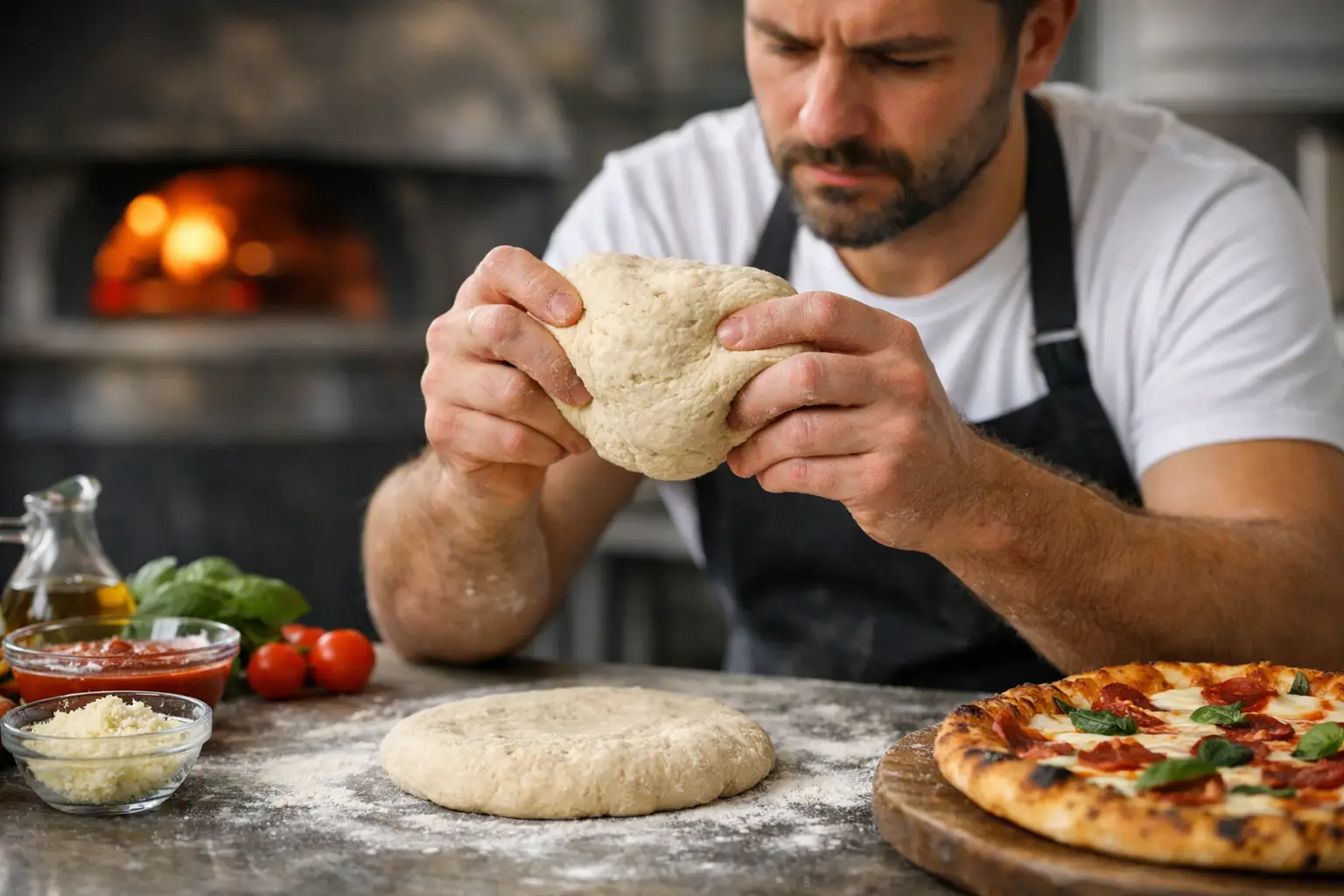
A dough that fights back at the bench is telling you something. If you are asking, "why is my pizza dough tough," the answer is usually not one dramatic mistake. It is more often a chain of small decisions - flour strength, water level, mixing intensity, fermentation time, shaping pressure, and baking conditions - all pushing the dough away from the soft, extensible character you want in a proper Neapolitan-style crust.
Tough dough can show up in different ways. Sometimes it is hard to stretch and snaps back into a tight disk. Sometimes it bakes into a dense, chewy rim instead of a light cornicione. Sometimes the crumb is dry and leathery rather than open and tender. Those are related problems, but not always the same problem. Good correction starts with identifying where the resistance begins.
Why is my pizza dough tough during mixing and shaping?
If dough feels tough before it ever reaches the oven, gluten development and hydration are the first places to look.
Gluten is essential. It gives pizza dough structure, gas retention, and strength. But gluten that is too developed for the style you are making creates a tight dough that resists extension. This often happens when mixers run too long, when dough is kneaded aggressively by hand, or when the baker assumes that more mixing always means better dough. It does not. For Neapolitan pizza, the goal is not maximum strength. The goal is balanced strength - enough to hold fermentation gases, but relaxed enough to open by hand without tearing or snapping back.
Hydration matters just as much. A dough with too little water will naturally feel firmer and less extensible. Lower hydration is not automatically wrong, because flour absorption varies and some environments require adjustment. But once hydration drops below what your flour and process need, the dough becomes harder to work, the crumb tightens, and the baked crust often eats tougher.
Flour choice also plays a major role. Strong flour with high protein can be useful, especially for longer fermentation. But strength is not a universal advantage. If you pair very strong flour with short fermentation, heavy mixing, and low hydration, you build a dough with more resistance than relaxation. The result is strength without finesse.
The most common reasons pizza dough turns tough
You overmixed the dough
Overmixing is one of the most common causes, especially for serious home bakers who are trying to be precise. Inexperienced bakers often undermix. Experienced beginners often swing the other way.
When mixing goes too far, the dough becomes overly organized and elastic. It may look smooth and impressive in the bowl, but at the bench it behaves like a rubber band. If you press it, it pulls back. If you stretch it, it resists. In baked form, that same overbuilt gluten network can translate into chewiness that feels dense rather than light.
A properly mixed dough should be cohesive and moderately smooth, but it should not feel like it has been pushed to its limit. In a craft setting, restraint is part of the technique.
Your dough is underproofed
This is the second major cause of toughness, and it is often misread as a mixing issue. Underproofed dough still has a tight gluten structure because fermentation has not had enough time to relax it. Even if the formula is correct, dough that has not matured sufficiently can feel stubborn in the hands and bake up heavy.
This is why timing matters as much as ingredients. A dough ball can appear ready because it has risen somewhat, yet still lack the extensibility and internal gas development needed for a tender crust. Fermentation is not only about volume. It is also about texture, digestibility, and workability.
Cold dough can exaggerate the problem. If dough comes straight from refrigeration and is opened too soon, it will feel tighter and harder than it really is. Temperature affects extensibility in a very practical way.
Your hydration is too low for your process
Many bakers reduce water to make dough easier to handle. That can help in the short term, but if it goes too far, it creates a tougher final product. Dough with insufficient hydration does not expand as gracefully in the oven, and it tends to bake drier.
The challenge is that ideal hydration is not a fixed number. It depends on flour, room conditions, fermentation schedule, and your handling skill. A hydration level that works in one shop may feel stiff in another kitchen. This is why copying a formula without understanding the flour and method behind it can produce disappointing results.
Your flour is too strong for the timeline
Strong flour is designed to tolerate fermentation and retain structure. But if the dough does not ferment long enough, or if the process does not allow enough relaxation, strong flour can leave the dough overly tenacious.
This is a classic trade-off. Weaker flour can produce tenderness more easily, but may break down sooner. Stronger flour offers security, but demands a process that fully develops and relaxes it. Tough dough often comes from choosing flour for power rather than suitability.
You degassed the dough during shaping
A well-fermented dough can still bake tough if it is handled poorly. Heavy pressing, rolling pins, or rough stretching force gas out of the rim and compress the structure you spent hours building.
For Neapolitan pizza, shaping should preserve the outer gas while guiding the dough open from the center. If you flatten everything evenly and aggressively, the crust loses its lightness. The baked result is often thinner, denser, and chewier in the wrong way.
Why is my pizza dough tough after baking?
If the dough felt decent while shaping but eats tough after baking, the issue may be less about dough development and more about moisture balance and oven performance.
The pizza baked too long
Extended bake time dries the crust. In a true high-heat Neapolitan environment, the pizza bakes quickly, which helps preserve internal moisture while creating exterior char and expansion. In lower-temperature home ovens, bakers often compensate with longer bake times. That can produce a crust that is crisp at first, then leathery as it cools.
This is one of the hardest realities for home pizza makers. You can execute the dough correctly and still lose tenderness if the oven environment is too slow or too dry. Process adaptation matters.
The dough was too dry going into the oven
Low hydration, excess bench flour, or uncovered dough balls can all dry the surface and reduce tenderness. Dough skinning is especially damaging. Once the outer layer dries, expansion is restricted and the finished crust can feel firm even if the interior is acceptable.
The formula is too lean for your setup
Traditional Neapolitan dough is a lean dough. That is correct for the style. But a lean dough depends heavily on proper fermentation and proper baking conditions. In a weaker oven, some bakers find that a slightly adjusted process improves tenderness more than changing the ingredient list. That may mean refining hydration, proof time, or dough ball temperature rather than adding fat or sugar, which would shift the style away from Neapolitan standards.
How to correct tough pizza dough
Start with the process, not random ingredient changes. If your dough is consistently tough, reduce mixing first. Mix only until the dough is cohesive and structured, then let time and fermentation do more of the work.
Next, evaluate proofing honestly. If the dough is hard to stretch and snaps back, give it more maturation time or more time at room temperature before opening. Watch the dough, not just the clock.
Then assess hydration in relation to your flour. A small increase in water can make a meaningful difference in extensibility and crumb softness, but only if your handling and fermentation are adjusted accordingly. More water is helpful only when the process can support it.
After that, look at shaping. Open the dough with controlled pressure from the center outward. Preserve the rim. Avoid rolling pins and avoid pressing out all the fermentation gases.
Finally, study your bake. If your oven runs cooler, work on heat management so the pizza sets and colors faster. In educational settings such as Neapolitan Pizza School, this is where many students realize that dough quality and oven execution cannot be separated. A strong dough formula will not fully compensate for weak baking conditions.
A simple way to diagnose the problem
If the dough is tight before proofing, suspect flour choice, low hydration, or overmixing. If it becomes easier later but still bakes dense, suspect shaping or baking. If it resists stretching even after a full proof, suspect underfermentation or dough that is too cold. If it stretches well but the crust turns leathery after baking, suspect excessive bake time or moisture loss.
That distinction matters because tough dough is not a single fault. It is a symptom.
The good news is that pizza dough usually improves when the baker becomes less forceful, not more. Better dough often comes from fewer corrections at the bench and more precision earlier in the process. When flour, water, mixing, fermentation, shaping, and heat are aligned, the dough stops fighting you and starts behaving like it should - supple, alive, and capable of producing a crust with both structure and tenderness. That is the standard worth aiming for every time.