
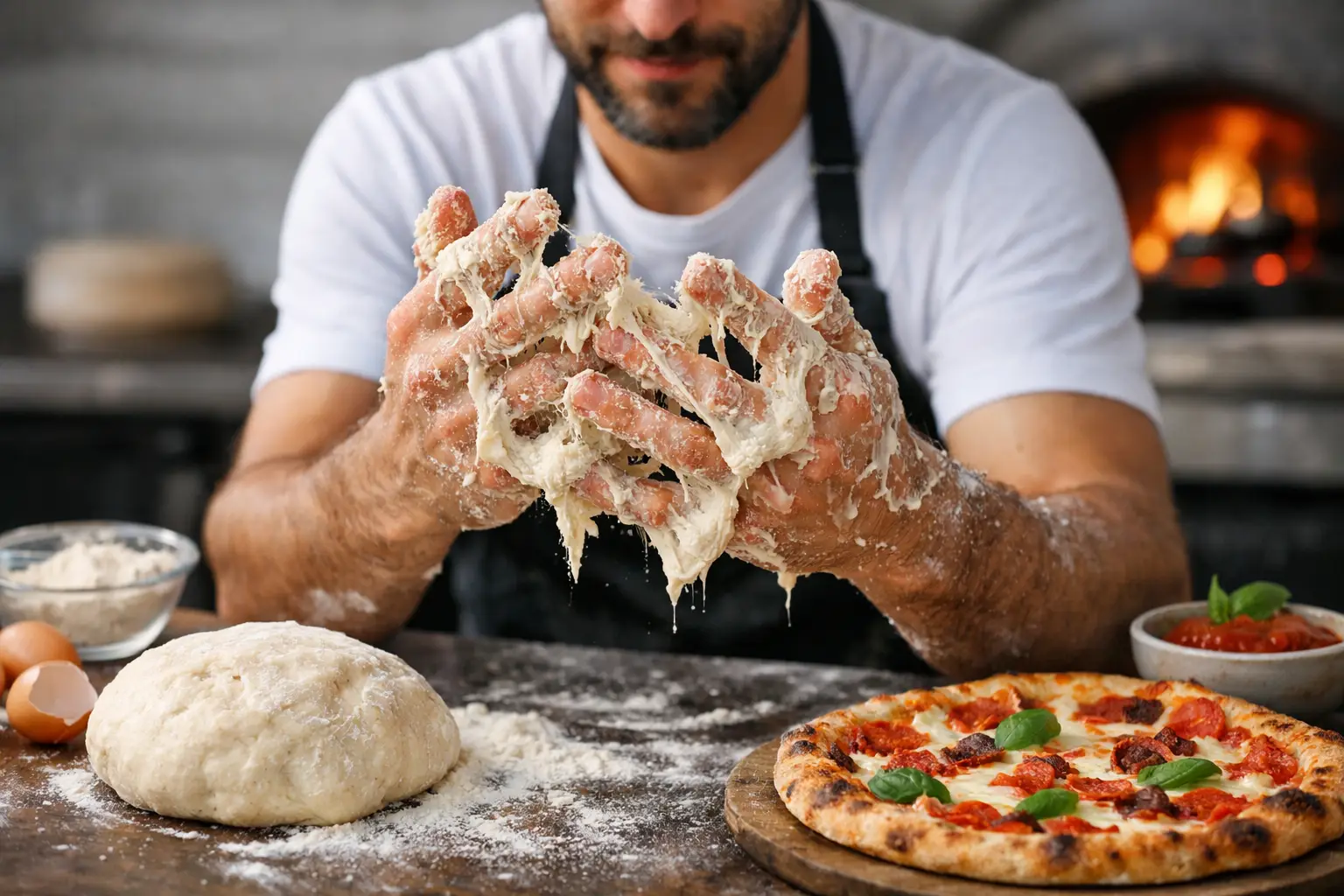
A dough that clings to your hands, the bench, and the peel can make even experienced bakers question the mix. If you have been asking why is pizza dough sticky, the answer is usually not a single mistake. Sticky dough is a signal. It tells you something about hydration, flour strength, mixing, temperature, or fermentation, and the fix depends on which of those variables is actually off.
For Neapolitan-style pizza, this matters more than most people realize. Proper dough should feel lively, elastic, and supple. It should not feel dry or stiff, but it also should not behave like batter. The line between correctly hydrated and unmanageably sticky is narrow, especially when you are working with long fermentation and high heat.
Why is pizza dough sticky in the first place?
Sticky dough develops when the balance between water absorption and gluten structure is incomplete or unstable. In simple terms, either there is more available moisture than the flour can manage at that stage, or the dough has not developed enough strength to hold itself together cleanly.
That can happen for several reasons. Sometimes the dough truly contains too much water for the flour being used. Sometimes the hydration is appropriate, but the dough has not been mixed enough to organize the gluten. In other cases, the dough was mixed correctly, then overfermented and began to lose strength later. Warm dough also feels stickier than cool dough, even when the formula itself is sound.
This is why adding more flour is not always the right answer. Extra flour can hide the symptom while creating a second problem - a heavier, tighter dough that bakes with less tenderness and less oven spring.
Hydration is often the first place to look
Water percentage has the strongest influence on stickiness. Many pizza makers increase hydration because they want a softer crumb, more open cornicione, or easier extensibility. Those are valid goals. But hydration only works when it matches the flour and the method.
A flour with strong protein content and good absorption can hold more water. A weaker flour reaches its limit sooner. If you use a formula designed for one flour and substitute another without adjustment, the dough may become slack and sticky very quickly.
For Neapolitan dough, moderate to moderately high hydration can work beautifully, but it is not a contest. More water does not automatically mean better pizza. If the dough cannot be managed cleanly through bulk fermentation, balling, opening, and launching, the hydration is too high for your flour, your room conditions, or your current level of handling skill.
Mixing and gluten development change everything
Freshly combined flour and water are naturally tacky. That alone does not mean the dough is wrong. Early in the mix, gluten has not yet formed a strong network, so the mass sticks more readily to hands and surfaces.
As mixing continues and the dough rests, the flour hydrates more fully and the gluten becomes organized. The dough should start to feel smoother and more cohesive. If you stop too early, the dough may remain rough, weak, and sticky well past the point where it should have tightened.
There is a trade-off here. Under-mixed dough lacks structure, but over-mixed dough can overheat and become harder to ferment well. In professional dough production, this balance is controlled carefully. The goal is enough development to create strength without pushing the dough too far or raising the final dough temperature beyond your target.
If your dough feels sticky right after mixing, do not judge it too quickly. Give it a short bench rest, then reassess. Many doughs become noticeably easier to handle after even 15 to 20 minutes.
Temperature can make a good dough feel worse
Warm dough feels softer and stickier. This is one of the most common reasons people think their formula has failed when it has not. If your mixing water was too warm, your kitchen is hot, or your dough fermented faster than planned, handling will become more difficult.
Temperature affects both texture and fermentation speed. As dough warms, yeast activity increases, organic acids develop more quickly, and the gluten can begin to soften. A dough that seemed manageable in the morning may feel fragile and adhesive by the afternoon.
This is why disciplined dough making always includes temperature control. Ingredient temperature, ambient temperature, mixing friction, and fermentation schedule all matter. Serious pizza production is not just about the recipe. It is about managing the process around the recipe.
Fermentation can turn stickiness into weakness
Well-fermented dough should feel relaxed but still strong. Overfermented dough loses that balance. It often becomes gassy, overly delicate, and sticky to the touch. When this happens, the issue is no longer just surface tackiness. The internal structure is starting to break down.
You may notice that overfermented dough spreads too easily, tears during opening, and sticks to the bench despite generous flour. It may also have a strong alcoholic aroma or an overly sour smell. At that point, adding flour during shaping will not restore the original structure.
Long fermentation is valuable, especially for flavor and digestibility, but only when time, yeast amount, and temperature are aligned. If one variable drifts, the dough can move past peak maturity before you use it.
Flour type matters more than many recipes admit
Not all flour behaves the same way, even when labels seem similar. Protein percentage gives part of the story, but flour strength, milling, and absorption characteristics matter too. A flour suited to long fermentation and high hydration will behave differently from an all-purpose flour intended for general baking.
If you are chasing authentic Neapolitan results, flour choice is not a minor detail. The dough is expected to remain extensible without collapsing, and to bake quickly at high temperatures while still producing a tender structure. That requires a flour that can support the process.
If your dough is consistently sticky across batches, and your handling and fermentation are sound, your flour may simply not match your formula. That is especially likely if you are using a high hydration percentage with a flour that cannot absorb enough water.
How to fix sticky pizza dough without damaging it
The correct fix depends on when the stickiness appears.
If the dough is sticky during the first stage of mixing, continue mixing as needed, then allow a short rest. Time often improves the dough more effectively than extra flour.
If the dough is sticky because the hydration is too high, reduce water slightly in the next batch rather than trying to correct everything on the bench. Bench flour should help with handling, not rewrite the formula.
If the dough became sticky later in fermentation, check your temperature control and timing. You may need cooler water, less yeast, a shorter room-temperature phase, or a different cold fermentation schedule.
If the dough sticks only during shaping, your handling may be the issue rather than the dough itself. Use bench flour sparingly but deliberately. Open the dough with confident, efficient movements. Excessive pressing and hesitation usually create more sticking, not less.
And if the dough is tearing, puddling, and sticking everywhere after a long rise, it may be overfermented beyond practical recovery. That is frustrating, but it is also useful information. The next dough will improve if you adjust the process instead of forcing the batch.
Why is pizza dough sticky on the counter but not in the bowl?
This usually points to surface management and dough maturity rather than a major formula failure. In the bowl or dough box, the dough is supported and relatively undisturbed. On the counter, pressure, stretching, and contact area increase. Any weakness in gluten structure becomes obvious immediately.
A light dusting of flour on the bench is appropriate. Heavy coating is not. Too much bench flour can burn in the oven, mute fermentation character, and leave the crust with a dry exterior. Skilled dough handling uses only enough flour to prevent adhesion while preserving the dough's natural texture.
A better question than "how do I make it stop sticking?"
The stronger question is, what is the dough trying to tell me? Stickiness is not random. It usually reflects one of five things: too much water, too little gluten development, excessive warmth, too much fermentation, or a mismatch between flour and method.
Once you identify which of those is responsible, the correction becomes straightforward. You are no longer guessing with handfuls of extra flour or changing three variables at once. You are training your eye and hands to read dough properly, which is one of the core skills behind consistent Neapolitan pizza.
That is where real progress happens. Not when the dough behaves perfectly every time, but when you can tell the difference between healthy tackiness and structural failure - and know exactly what to adjust on the next mix.