
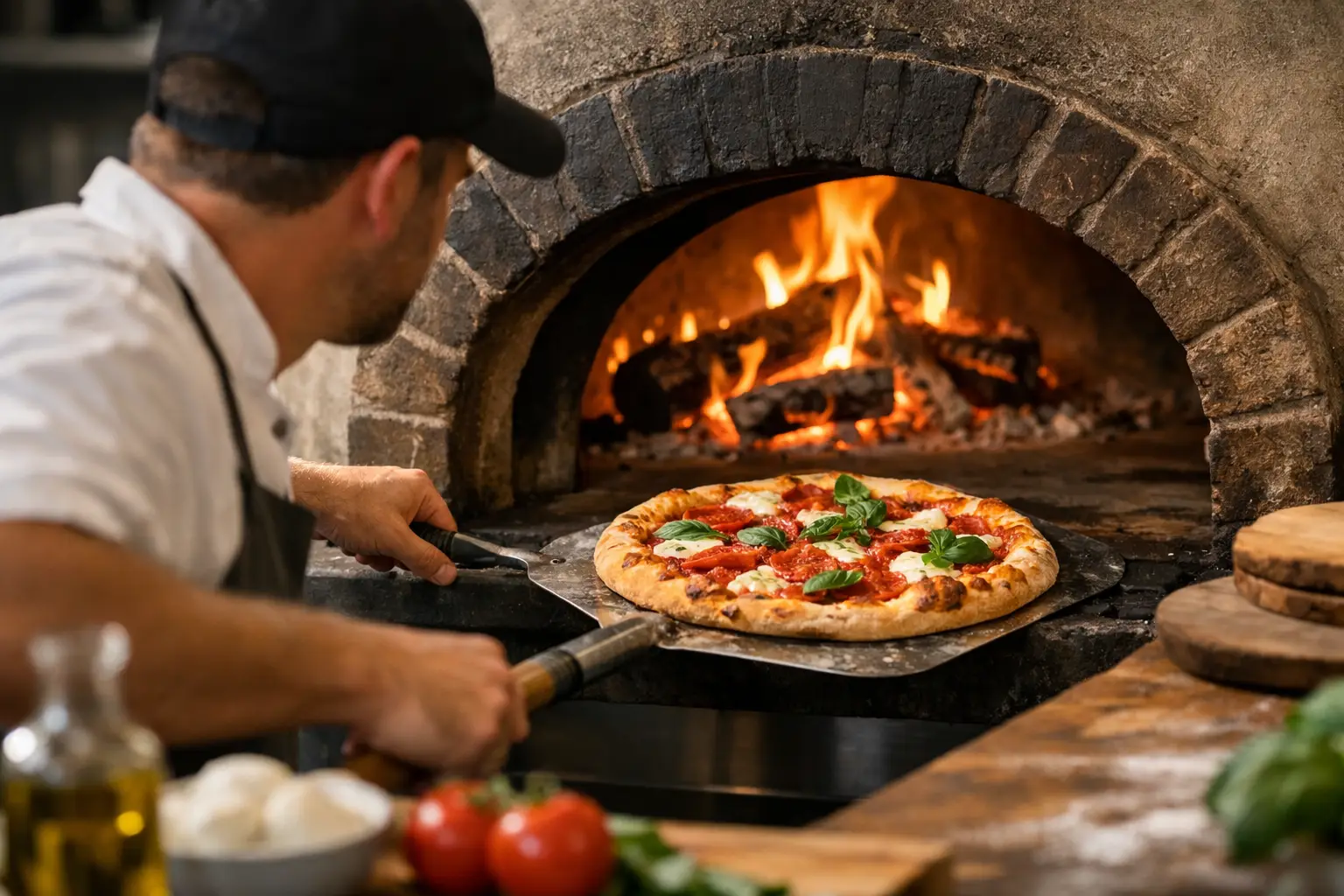
A pizza can look ready long before it is properly baked. The rim may color fast, the cheese may melt, and the underside can still be pale or scorched in the wrong places. That gap between appearance and structure is where wood fired pizza oven technique matters most. In a true Neapolitan context, the oven is not just a heat source. It is an active part of the craft, and its behavior has to be read, managed, and used with intent.
Many bakers first approach a wood-fired oven as if higher heat will solve every problem. It will not. Extreme heat without control produces a pizza that blisters before the dough sets, burns on one side, and bakes unevenly from edge to center. Good technique is less about chasing the biggest flame and more about balancing flame, dome heat, floor temperature, and timing. Once that balance is understood, the oven becomes predictable.
What wood fired pizza oven technique actually controls
For Neapolitan pizza, the oven must do several jobs at once. The floor has to set the base quickly without hardening it. The live flame and reflected heat from the dome have to drive oven spring, color the cornicione, and finish the top before the bottom overbakes. This is why managing the oven is inseparable from managing the dough.
A dough with proper fermentation and shaping will still fail if it enters an oven with an overheated floor and weak flame. The reverse is also true. An excellent fire cannot compensate for a dough that is underproofed, overworked, or topped too heavily. Technique lives in the relationship between these parts, not in one isolated variable.
Fire management is the foundation
Before a pizza ever touches the floor, the oven has to be stabilized. A common mistake is launching too soon after lighting the fire. At that stage, the flame may be active, but the masonry has not absorbed and distributed enough heat. You may see aggressive top heat with an unstable floor, which leads to inconsistency from one pizza to the next.
The goal is a mature fire and an oven that has fully come to temperature. In practical terms, that means a live flame burning cleanly, a dome that is storing heat, and a floor that is hot but not excessively so. In many ovens, the fire is maintained to one side or toward the back-side quadrant, giving the baker space to launch and rotate while preserving strong flame roll across the dome.
Wood choice also affects control. Well-seasoned hardwood burns more predictably and produces cleaner heat than damp or resinous wood. If the wood is poor, the oven becomes harder to read. Flame quality drops, smoke increases, and recovery between pizzas becomes unreliable.
Flame size is not the same as oven readiness
A large flame can be visually reassuring, but a dramatic flame alone does not mean the oven is balanced. In fact, an oversized flame can push too much top heat while masking an overheated or underheated floor. Experienced pizzaiolos look for consistency. They want a live, sustained flame that feeds the dome and responds quickly when small pieces of wood are added, not a bonfire effect.
Reading floor heat matters as much as reading the flame
Most baking faults in a wood-fired oven can be traced to floor temperature. If the floor is too hot, the pizza sets and chars underneath before the rim has fully developed. If the floor is too cool, the pizza dries out while waiting for structure, often leading to a tougher bake and reduced oven spring.
This is where discipline matters. The launch zone should not be treated as identical to the area nearest the fire. Different parts of the floor hold heat differently, and repeated baking changes those conditions. After several pizzas, one section may cool while another remains aggressive. Good wood fired pizza oven technique requires repositioning your bake area, brushing out ash and debris, and allowing the floor to recover when necessary.
There is no single fixed number that solves this in every oven. Dome shape, floor material, insulation quality, and firing history all change how the oven behaves. A small home oven and a commercial Neapolitan oven may both be wood-fired, but they will not recover heat at the same pace.
Launching cleanly protects the bake
Once the oven is ready, the launch has to be efficient. A well-shaped pizza should move from peel to floor without hesitation. If it sticks, deforms, or lands with a folded edge, the bake is already compromised.
This is not only about peel technique. It starts at the bench. Excess flour underneath can burn and create bitterness. Too little flour can cause sticking. Topping distribution matters as well. If the center is overloaded, the pizza becomes harder to launch and slower to set. In Neapolitan pizza, restraint is part of the method.
Place the pizza where the floor heat is appropriate for the current oven condition, not simply where you placed the last one. That decision changes throughout service.
Turning is part of the bake, not a correction after the fact
A wood-fired oven does not bake evenly from all directions. The side facing the flame receives more intense radiant heat, so the pizza must be turned with purpose. New bakers often wait too long, hoping the pizza will color evenly on its own. It will not.
The first turn usually comes quickly, once the rim nearest the flame has lifted and begun to set. Turn too early and the structure may tear. Turn too late and one side burns before the rest of the pizza catches up. This timing becomes intuitive with practice, but it is rooted in observation. Watch the rise of the cornicione, the movement of moisture on the surface, and the speed of spotting near the flame-facing edge.
Turning should be smooth and economical. A hesitant turn interrupts the bake and can drag the pizza into a hotter area than intended. In a proper rhythm, the pizza rotates through the oven so each section receives its share of flame exposure without overdeveloping any one side.
The oven rewards rhythm
A strong pizzaiolo works in a sequence. Launch, observe, turn, finish, clear the floor, feed the fire if needed, and reset the bake zone. This rhythm matters because wood-fired baking is dynamic. If you pause too long after one pizza, the flame may dip. If you overfeed the fire at the wrong moment, you may create excessive top heat for the next bake.
Consistency comes from managing the oven between pizzas, not only during them.
Top heat and bottom heat must stay in conversation
The most useful way to think about a wood-fired oven is as a balance between top and bottom heat. If one gets ahead of the other, quality declines. A pizza with heavy leopard spotting on the rim but weak underside structure is not finished correctly. Neither is a pizza with a dry base and undercolored top.
This balance changes based on the pizza itself. A marinara behaves differently from a Margherita because the moisture load is different. A slightly thicker opening may need a touch more time to set than a very open, tender disc. Even small changes in topping temperature can affect the pace of the bake.
That is why rigid formulas often fail. The standards of Neapolitan pizza are precise, but the execution still depends on reading conditions in real time.
Recovery between pizzas separates casual baking from disciplined oven work
One of the clearest differences between occasional wood-fired baking and professional-level execution is heat recovery. A baker may produce one excellent pizza, then struggle with the next three because the oven was not reset. Ash remains on the floor, the launch zone has cooled, or the fire was allowed to shrink too far.
Recovery does not require dramatic intervention. Often it is a matter of adding a small piece of wood at the right moment, moving embers to maintain flame path, and giving the floor a brief window to regain balance. In a busy service, this becomes continuous. In a home setting, it may mean slowing down rather than forcing the next pizza into poor conditions.
There is no shame in waiting 60 to 90 seconds for the oven to recover if that produces a better result. Good technique is not speed for its own sake.
Common problems in wood fired pizza oven technique
When the bottom burns before the top finishes, the floor is usually too hot, the launch area is poorly chosen, or the pizza sat too long in one position before turning. When the top bakes aggressively and the base stays blond, the flame may be strong while the floor has lost heat.
If the pizza bakes unevenly from side to side, the turn came too late or the launch position was too close to the fire. If the center stays wet, the issue may not be the oven alone. It can also come from dough strength, opening technique, or excessive topping load.
These are useful distinctions because they keep the baker from blaming the wrong variable. Better results come faster when faults are diagnosed accurately.
Why serious bakers train the oven as much as the dough
Students often spend months refining fermentation while treating oven work as instinctive. That is usually where progress stalls. The oven has its own logic, and it rewards repetition, observation, and disciplined adjustment. At Neapolitan Pizza School, this is treated as a technical skill, not an afterthought, because authentic results depend on execution at the oven mouth as much as on the mixing bench.
A wood-fired oven is demanding, but that is also why it produces such distinctive pizza. The live flame, the speed of the bake, and the interaction between floor and dome create qualities that cannot be copied by approximation alone. Once you begin to read those conditions with confidence, the bake becomes quieter. Fewer surprises, fewer random corrections, and far more intent.
That is the real aim of wood-fired technique - not just hotter pizza, but controlled pizza, baked with judgment.